Int-Ball2: Japan’s AI Space Robot Revolution Explained
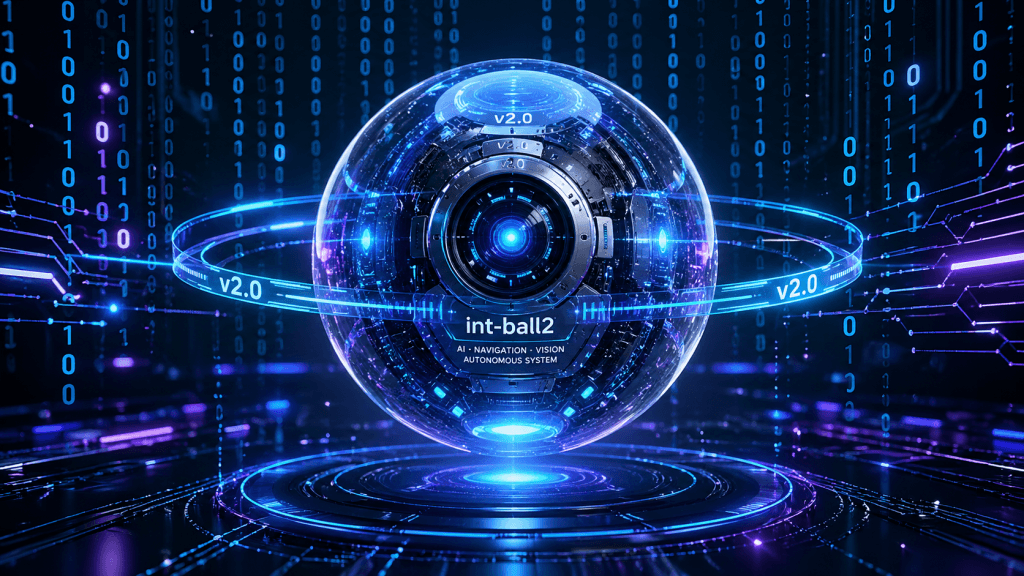
Int-ball2 is revolutionizing how astronauts work aboard the International Space Station. This floating camera robot, developed by the Japan Aerospace Exploration Agency (JAXA), resembles a soccer ball with glowing blue eyes and represents a quantum leap in space-based robotics (Space.com, 2025). Unlike its predecessor, int-ball2 is not merely a remote-controlled drone; it is an autonomous, AI-capable platform designed to take over the tedious, time-consuming task of video documentation. By doing so, int-ball2 frees astronauts to focus on scientific research and complex maintenance, fundamentally changing the dynamic of human spaceflight (IEEE, 2024).
From Ball to Brain: The Evolution of Int-Ball2
The journey of int-ball2 began with its predecessor, the original Int-Ball, which launched in 2017.While groundbreaking, the first model had limited autonomy and manoeuvrability. The second-generation system, launched in 2023, is a complete redesign. It features an upgraded propulsion subsystem for greater agility and a new docking station that allows for autonomous battery recharging, eliminating the need for astronaut intervention (IEEE, 2025). Equipped with an advanced inertial measurement unit and visual mapping systems, the robot can maintain its orientation and navigate the complex interior of the Kibo module without human input (International Astronautical Federation, 2024).
The system has now moved beyond its primary mission into a new phase. It has officially transitioned from a test model to a “technology demonstration platform” (JAXA, 2025).This shift means that int-ball2 is no longer just a camera; it is a flying computer that can run external software and test new algorithms in the unique microgravity environment of the ISS.
A Platform for Endless Experiments
The true genius of int-ball2 lies in its open architecture. JAXA has transformed it into a versatile testbed, allowing external users to upload their own programs. Recent successful orbital checkouts have proven that the robot can perform automated task repetition, such as autonomously undocking and docking from its station to gather performance data (IEEE, 2025).
The system also demonstrated the ability to run programs written in different operating environments. For example, engineers successfully installed a bridge package called RACS (ROS and cFS System). This allowed software from a completely different OS to control the robot, enabling advanced features like autonomous object recognition of people and laptops (JAXA, 2025).This flexibility ensures that int-ball2 will remain at the forefront of space robotics for years to come.
The ICHIBAN Mission: Speaking Two Languages
Perhaps the most historic moment for int-ball2 came in July 2025 during the ICHIBAN mission. In a spaceflight first, int-ball2 collaborated directly with another AI robot: Germany’s CIMON (Crew Interactive MObile companioN) (IBM, 2025).
This experiment was groundbreaking because the two robots were designed independently, on different continents, and ran on different internal networks. Thanks to a software update to CIMON using IBM’s watsonx AI, the German robot could understand voice commands and translate them into instructions for int-ball2 (Infobae, 2025).
Japanese astronaut Takuya Onishi asked CIMON to command the robot to search for objects hidden in the Kibo module. The system successfully located the items and streamed live video back to CIMON, allowing the astronaut to verify the find on the spot (The Register, 2025).
This “hide and seek” game was not just for fun. It proved that int-ball2 and other robots could one day work side-by-side with humans, taking verbal orders and performing complex inspection and maintenance tasks across different modules of a space station (TechNews, 2025).
Solving the Photography Burden
Why is int-ball2 so essential? Currently, astronauts spend approximately 10 percent of their working time just setting up cameras and taking photos for ground controllers (IEEE, 2024). This documentation is critical for engineering analysis and public outreach, but it pulls crew members away from their primary scientific duties.
The robot solves this problem by acting as a roaming, remote-controlled eye. Controllers at JAXA’s Tsukuba Space Center can fly it into position, adjust angles, and capture high-quality images without bothering the crew (International Astronautical Federation, 2024). Now, with the latest autonomy upgrades, it can even fly pre-programmed routes, ensuring consistent monitoring of experiments (IEEE, 2025).
Technical Capabilities in Microgravity
Operating a drone in microgravity is vastly different from operating one on Earth. Without gravity, there is no “down,” and any motion creates complex rotational dynamics. Int-ball2 utilizes a sophisticated propulsion system of small thrusters to move in six directions. Its visual mapping system, combined with the IMU, allows int-ball2 to stabilize itself and create a 3D map of its surroundings in real-time (IEEE, 2024).
The physical design of int-ball2 is also optimized for safety. Its spherical shape and soft exterior prevent it from damaging sensitive ISS equipment upon impact. It docks magnetically to its charging station, where it powers up between shifts, ensuring it is always ready for the next task (IEEE, 2025).
The Future of Human-Robot Teams
The implications extend far beyond the ISS. As humanity prepares to return to the Moon and venture to Mars, communication delays with Earth will make real-time remote control impossible. Astronauts will need autonomous robots like this to function as their eyes and hands (International Astronautical Federation, 2024).
Int-ball2 is proving that robots can take over routine tasks, run third-party experiments, and even coordinate with other AI systems. JAXA engineer Seiko Piotr Yamaguchi noted that this mission demonstrates how collaboration between robots and humans can open new possibilities for space exploration (TechNews, 2025). Int-ball2 is not just a tool; it is a teammate, and its success is paving the way for a future where humans and AI explore the cosmos together.
Conclusion
From a simple floating camera to an intelligent, collaborative platform, int-ball2 has redefined the role of robotics in space. By automating documentation, providing a testbed for new technology, and successfully communicating with a German counterpart, the robot has proven that the future of space exploration is autonomous and collaborative. It is a blueprint for the support systems that will help humanity reach Mars and beyond.
References
IBM. (2025, July 31). German, Japanese space agencies achieve robotics milestone aboard International Space Station. IBM Newsroom. https://uk.newsroom.ibm.com/german-japanese-space-agencies-achieve-robotics-milestone-aboard-international-space-station
IEEE. (2024). *Int-Ball2: ISS JEM internal camera robot with increased degree of autonomy – Design and initial checkout*. IEEE Xplore. https://ieeexplore.ieee.org/document/10688008
IEEE. (2025). *Int-Ball2: On-orbit demonstration of autonomous intravehicular flight and docking for image capturing and recharging*. IEEE Robotics & Automation Magazine. https://ieeexplore.ieee.org/document/10813456
Infobae. (2025, July 31). Dos robots juegan al escondite en la Estación Espacial Internacional, todo gracias a la IA. https://www.infobae.com/tecno/2025/07/31/dos-robots-juegan-al-escondite-en-la-estacion-espacial-internacional-todo-gracias-a-la-ia/
International Astronautical Federation. (2024). *Int-Ball2: JEM internal camera robot – Initial checkout in the ISS and prospects of its utilization*. IAF. https://iafastro.directory/iac/archive/browse/IAC-24/B3/6-A5.3/86147/
JAXA. (2025, July 7). *宇宙で活躍する自律カメラロボット「Int-Ball2」、新たな機能拡張プラットフォームを軌道上で実証完了*. JAXA Humans in Space. https://humans-in-space.jaxa.jp/biz-lab/news/detail/004741.html
Space.com. (2025, April 1). Floating blue-eyed robot keeps watch on the ISS: Space photo of the day. https://www.space.com/space-exploration/international-space-station/floating-blue-eyed-robot-keeps-watch-on-the-iss-space-photo-of-the-day
TechNews. (2025, August 6). 不是電影!日本與德國 AI 機器人完成太空站首次「任務接力」. https://technews.tw/2025/08/06/jaxa-dlr-iss-ichiban/
The Register. (2025, August 5). Germany and Japan teamed their ISS robots for seek-and-photograph mission. https://www.theregister.com/2025/08/05/germany_and_japan_teamed_their