
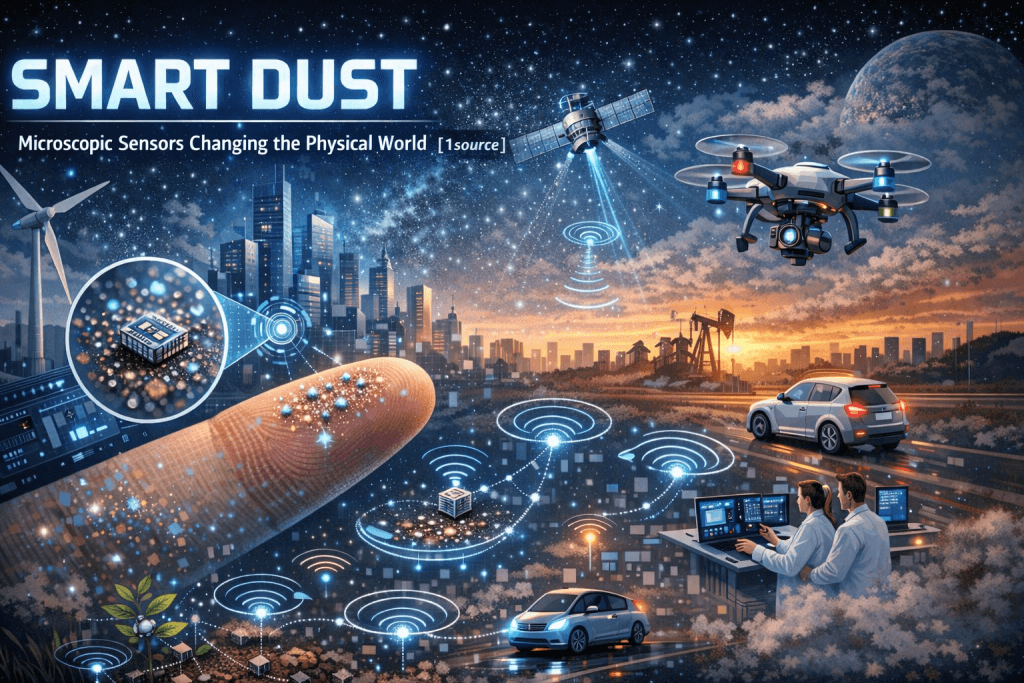
Smart Dust: Microscopic Sensors Changing the Physical World
Smart dust refers to a concept for massive networks of microscopic, wireless microelectromechanical systems (MEMS) that can sense, compute, and communicate environmental data. Evolving from defense research in the 1990s, the technology is now nearing widespread commercial reality, propelled by advances in miniaturization, low-power electronics, and the Internet of Things (IoT). This technology promises to create an invisible, intelligent fabric over the physical world, enabling real-time monitoring and interaction at an unprecedented scale. The global smart dust market, reflecting this transformative potential, is projected to grow significantly in the coming decade (Market Research Future, 2025).
1. Core Technology and Evolution
A single mote of smart dust is an engineering feat, typically smaller than a grain of rice, integrating sensors, a microprocessor, a wireless transceiver, and a power source into a cubic millimeter or less. These motes operate as cohesive distributed sensor networks, collecting data on parameters like temperature, light, vibration, or chemical presence and wirelessly relaying information to a central gateway.
The foundational work was pioneered in the late 1990s and early 2000s, with researchers like Kris Pister at the University of California, Berkeley, conceptualizing autonomous sensing and communication nodes (Koss & Glover, 2025). The technology has progressed from bulky prototypes to sophisticated systems designed for aerial dispersal, mimicking natural seeds for large-scale environmental deployment (Iyer et al., 2022). Microfabrication, the dominant manufacturing process, enables the precise, scalable production of these microscopic devices, which is central to the viability of smart dust.
2. Key Applications and Market Drivers
The applications for smart dust are vast and cross-sectoral. Its development is driven by the convergence of several trends: relentless electronic miniaturization, the expansion of the Industrial IoT, and critical needs in healthcare, agriculture, and environmental management.
- Precision Agriculture and Environmental Monitoring: In agriculture, networks of smart dust can provide hyper-local data on soil moisture, nutrient levels, and crop health, enabling precision irrigation and fertilization to boost yields and conserve resources. For environmental science, smart dust offers unparalleled tools for real-time tracking of air and water quality, detecting pollutants, and monitoring ecosystem changes across vast and remote areas (Shearer et al., 2016).
- Industrial IoT and Infrastructure Health: Within industrial settings, smart dust enables predictive maintenance by continuously monitoring the vibration, temperature, and structural integrity of machinery, helping to prevent costly failures. Embedded within critical infrastructure like bridges, buildings, and pipelines, these sensors provide continuous structural health monitoring, detecting stress, cracks, or corrosion long before they become safety hazards.
- Healthcare and Biomedical Innovation: Perhaps the most revolutionary application lies in biomedicine. Smart dust motes can be engineered for implantation or ingestion to monitor internal vital signs, track medication efficacy, or detect specific biomarkers (Open Access article, 2025). This paves the way for advanced chronic disease management, highly targeted drug delivery systems, and new forms of neural interfacing.
3. Critical Challenges and Ethical Considerations
Despite its promise, the path for smart dust is fraught with significant technical, ethical, and commercial hurdles that must be addressed for responsible adoption.
- Technical and Operational Constraints: The microscopic scale imposes inherent limits. Onboard power is the primary constraint, driving research into energy harvesting from ambient light, vibration, or thermal differentials to create self-sustaining devices. Furthermore, managing the torrent of data generated by millions of motes requires robust edge computing and AI-driven analytics to filter and process information locally before transmission.
- Privacy, Security, and Ethical Risks: The most profound concerns are ethical. The potential for pervasive, undetectable surveillance raises serious questions about individual privacy, autonomy, and consent (Qodequay, 2025). The covert collection of personal or behavioral data could enable unprecedented intrusions if not strictly regulated by policy. Consequently, data security is paramount, as these distributed networks could become targets for large-scale cyber-attacks, leading to data theft or systemic manipulation.
- Environmental and Economic Factors: Large-scale deployment introduces environmental questions regarding the long-term impact of dispersing synthetic micro-materials and the challenges of device retrieval or biodegradation. Economically, while microfabrication lowers unit costs, the total investment for deploying and managing vast smart dust networks and integrating them with legacy infrastructure remains a significant barrier for many organizations.
4. Future Trajectory and Strategic Roadmap
The future of smart dust will be defined by its convergence with other transformative technologies and its progression from specialized prototypes to standardized, trusted systems.
Artificial intelligence and machine learning are critical to this evolution. Embedding AI “at the edge” allows smart dust networks to perform local data analysis, make autonomous decisions, and identify complex patterns without constant communication with a central server, drastically improving efficiency and response times (FlowForge AI SP, 2025). A strategic roadmap emphasizes several parallel developments: advancing sustainable or biodegradable materials to mitigate environmental impact; establishing industry-wide standards for communication, security, and interoperability; and focusing commercial scaling on high-value applications like precision agriculture, predictive industrial maintenance, and remote health monitoring.
Regionally, North America currently leads in research, development, and early adoption, while the Asia-Pacific region is anticipated to exhibit the fastest market growth due to its strong manufacturing base and rapid smart city initiatives (MetaTech Insights, 2025).
5. Conclusion
In conclusion, smart dust represents a fundamental shift in humanity’s ability to perceive and interact with the physical environment. By deploying a microscopic, connected sensory layer across fields, cities, infrastructure, and even the human body, this technology unlocks a new frontier of data-driven optimization and understanding. However, its power is matched by its perils. The very attributes that make smart dust revolutionary, its scale, invisibility, and autonomy also necessitate proactive and rigorous technological, ethical, and legal governance. The successful integration of smart dust into society will therefore depend not only on continued engineering breakthroughs but, equally, on the development of strong societal frameworks that align its immense potential with the public good, ensuring security, privacy, and environmental responsibility.
References
FlowForge AI SP. (2025). Smart dust in the real world: 5 uses you’ll actually see (2025). LinkedIn. https://www.linkedin.com/pulse/smart-dust-real-world-5-uses-youll-actually-see-2025-quick-ik3qf/
Global Market Insights Inc. (2025). *Smart dust market size – by type, by component, by manufacturing process, and by end use application – global forecast, 2025 – 2034* (Report GMI14785). https://www.gminsights.com/industry-analysis/smart-dust-market
Iyer, V., Gaensbauer, H., Daniel, T. L., & Gollakota, S. (2022). Wind dispersal of battery-free wireless devices. Nature, 603(7901), 427–433. https://doi.org/10.1038/s41586-021-04363-9
Koss, H., & Glover, E. (2025, September 10). What is smart dust? Built In. https://builtin.com/articles/smart-dust
Market Research Future. (2025). Smart dust market size, share report, forecast 2035 (Report 34925). https://www.marketresearchfuture.com/reports/smart-dust-market-34925
MetaTech Insights. (2025, July). *Smart dust market share, size, trend & growth 2025-2035* (Report MI3071). https://www.metatechinsights.com/industry-insights/smart-dust-market-3071
Open Access article. (2025). Smart dust for chemical mapping. Advanced Materials, 37(19), 2419052. https://doi.org/10.1002/adma.202419052
Qodequay. (2025, September 25). Smart dust: The future of distributed sensing networks. https://www.qodequay.com/smart-dust-distributed-sensing-networks
Rigorous Web. (n.d.). Here is everything you need to know about smart dust technology. Retrieved December 27, 2025, from https://www.rigorousweb.com/here-is-everything-you-need-to-know-about-smart-dust-technology/
Shearer, C., West, M., Caldeira, K., & Davis, S. J. (2016). Quantifying expert consensus against the existence of a secret, large-scale atmospheric spraying program. Environmental Research Letters, 11(8). https://doi.org/10.1088/1748-9326/11/8/084011