Energy 3.0: AI, Fusion and the Future of Power
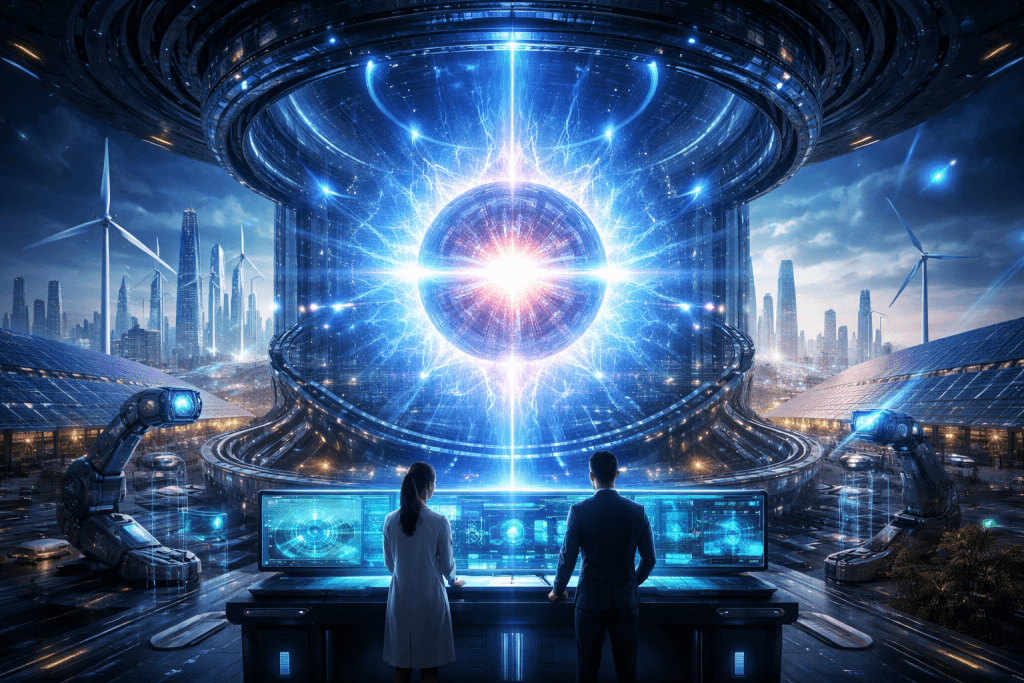
Future of power is undergoing its most profound transformation since the dawn of the electrical grid. We are entering an era that can be termed “Energy 3.0,” characterized by the powerful convergence of two revolutionary technologies: artificial intelligence and nuclear fusion. This synergy is accelerating the transition from a century-old model of centralized, carbon-intensive power generation to a new paradigm built on abundance, intelligence, and resilience. The journey to harness the sun’s power on Earth is no longer a distant scientific dream but a tangible engineering mission, propelled forward by unprecedented computational capabilities and global investment. This article explores how this convergence is actively reshaping the future of power, bringing it closer to reality with each breakthrough.
1. The Strategic Roadmap to Commercial Fusion
The global fusion landscape has decisively shifted from pure scientific research to a focused pursuit of commercial viability. National governments are now enacting formal strategies to capture the immense potential of this energy source. In the United States, the Department of Energy’s Fusion Science and Technology Roadmap outlines a clear “Build–Innovate–Grow” strategy, targeting the delivery of fusion power to the grid by the mid-2030s (Allain, 2025). This represents a critical step in defining the future of power, as it moves fusion from the laboratory into the realm of industrial policy and infrastructure development.
This ambition is part of a broader global race. According to the International Atomic Energy Agency (IAEA, 2025), over 160 fusion facilities are operational, under construction, or planned worldwide. The economic projections are staggering, with modeling suggesting fusion could generate up to 50% of global electricity by the end of the century in an optimistic scenario. This positions fusion not merely as an alternative energy source, but as a potential cornerstone of the future of power, with the capacity to redefine energy security and economic competitiveness on a global scale.
2. AI: The Critical Accelerant for Fusion Development
Artificial intelligence has emerged as the indispensable catalyst for solving fusion’s most intractable challenges. The core obstacle containing and stabilizing superheated plasma is a problem of immense complexity, perfect for AI’s strengths in pattern recognition, real-time optimization, and predictive modeling. AI is dramatically compressing the development timeline, making the future of power through fusion achievable within decades rather than half-centuries.
One groundbreaking application is in plasma diagnostics and control. Researchers have developed AI systems, such as “Diag2Diag,” which can synthesize missing data from failed sensors and generate more detailed plasma information than physical sensors alone can provide (Jalalvand et al., 2025). For a future commercial power plant requiring 24/7 reliability, such technology is foundational. Furthermore, companies like Google DeepMind have successfully applied deep reinforcement learning to control tokamak magnets and stabilize complex plasma shapes in simulations. These AI-powered control systems are being deployed in partnerships with fusion companies to explore optimal reactor configurations and operating scenarios, effectively turning a physics experiment into an optimizable engineering system (World Economic Forum, 2025).
3. Economic Viability and Early Market Signals
For fusion to truly define the future of power, it must eventually compete on cost. Recent techno-economic analyses provide a roadmap to competitiveness. A detailed assessment of a conceptual fusion power plant estimates a Levelized Cost of Electricity (LCOE) ranging from $140 to $550 per MWh (Araiinejad & Shirvan, 2025). While the upper range is currently high, the study identifies that the largest cost driver is the reactor equipment itself, meaning costs are poised to fall significantly with manufacturing scale, advanced materials, and learning-curve effects.
This analysis suggests the future of power from fusion could become cost-competitive, especially when valuing its attributes as a firm, dispatchable, zero-carbon baseload resource.
The market is already placing strategic bets on this outcome. A pivotal validation comes from early power purchase agreements (PPAs) signed by major technology firms. For instance, Commonwealth Fusion Systems has secured agreements from Google and the energy company Eni. Similarly, Helion Energy has signed Microsoft as its first power off-take partner. These corporations, facing skyrocketing energy demands from data centers and AI computing, are proactively seeking to secure a future of power that is dense, clean, and reliable. These agreements provide crucial early-market validation and de-risking capital for fusion developers.
4. A Diversified Technological and Geopolitical Landscape
The quest to commercialize fusion is characterized by a striking diversity of technological approaches and intense international competition. While the tokamak, exemplified by the international ITER project, remains the most mature path, several alternative concepts are advancing rapidly. Companies like TAE Technologies are pursuing a “field-reversed configuration” (FRC) that could enable the use of aneutronic fuels like hydrogen-boron, which present significant safety and waste advantages (Roche et al., 2025). This technological pluralism enriches the future of power by providing multiple pathways to success, each with different potential benefits.
The geopolitical dimension is equally pronounced. Analysis of global patent filings reveals China’s commanding lead, accounting for 67% of world-class fusion patents from 2016-2023, compared to 19% for the United States. This indicates a strategic, long-term commitment to owning the intellectual property and industrial capacity of the future of power. The race is not just to achieve a scientific milestone, but to establish technological sovereignty and dominate a multi-trillion-dollar future energy industry. A key enabling breakthrough across all concepts is the development of high-temperature superconducting (HTS) magnets, which allow for stronger magnetic fields in smaller, cheaper, and more efficient reactors.
5. Overcoming the Final Hurdles
Despite extraordinary progress, significant hurdles remain on the path to making fusion a cornerstone of the future of power. The foremost challenge is the integrated demonstration: engineering a full-scale pilot plant that reliably produces net electricity for the grid over sustained periods. This requires moving from proving scientific feasibility to achieving unprecedented levels of engineering reliability and material durability.
Concurrently, a tailored regulatory framework must be established. Unlike nuclear fission, fusion presents a fundamentally different risk profile with no risk of meltdown and minimal long-lived radioactive waste. Developing a clear, efficient, and internationally harmonized regulatory pathway is essential to avoid the cost escalations and delays that have plagued other complex energy projects. Finally, building a specialized workforce and robust industrial supply chains for highly specific components, from plasma-facing materials to specialized cryogenics, is a monumental task that must proceed in parallel. The pace at which these hurdles are cleared will ultimately dictate the timeline for the future of power.
Conclusion
We stand at the threshold of Energy 3.0, a new era for the future of power defined by the synergistic forces of artificial intelligence and nuclear fusion. What was once a perpetual “50 years away” is now on the horizon of the 2030s, driven by strategic roadmaps, massive private investment, and the transformative problem-solving power of AI. While substantial engineering, regulatory, and economic challenges persist, the trajectory is unambiguous. Fusion energy is rapidly transitioning from a distant scientific aspiration into a deployable technology capable of fundamentally reshaping global energy systems.
It promises a future of power that is abundant, clean, secure, and capable of meeting the soaring energy demands of the 21st century while addressing the imperative of climate stability. The final steps of this journey will demand sustained commitment, but the destination a transformed future of power is now firmly in sight.
References
Allain, J. P. (2025, October 16). Fusion is real, near, and ready for coordinated action [Statement in U.S. Department of Energy press release]. U.S. Department of Energy. https://www.energy.gov/articles/energy-department-announces-fusion-science-and-technology-roadmap-accelerate-commercial
Araiinejad, L. S., & Shirvan, K. (2025). Techno-economic analysis of deuterium-tritium magnetic confinement fusion power plants. Applied Energy, 401(Part B), 126567. https://doi.org/10.1016/j.apenergy.2025.126567
International Atomic Energy Agency. (2025). Fusion energy in 2025: Six global trends to watch. IAEA Newscenter. https://www.iaea.org/newscenter/news/fusion-energy-in-2025-six-global-trends-to-watch
Jalalvand, A., Day, M. S., Abbate, J., & Kolemen, E. (2025). Diag2Diag: An AI for enhancing diagnostic data in fusion energy systems. Nature Communications, 16, Article 3487. https://doi.org/10.1038/s41467-025-58849-5
Roche, T., Guo, H. Y., & TAE Team. (2025). Generation of field-reversed configurations via neutral beam injection. Nature Communications, 16(1), 3487. https://doi.org/10.1038/s41467-025-58849-5
World Economic Forum. (2025, December). How AI will help get fusion from lab to grid by the 2030s. https://www.weforum.org/stories/2025/12/how-ai-will-help-get-fusion-from-lab-to-grid-by-the-2030s/