The Future of Creativity: How AI Enhances, Not Replaces, Human Ingenuity
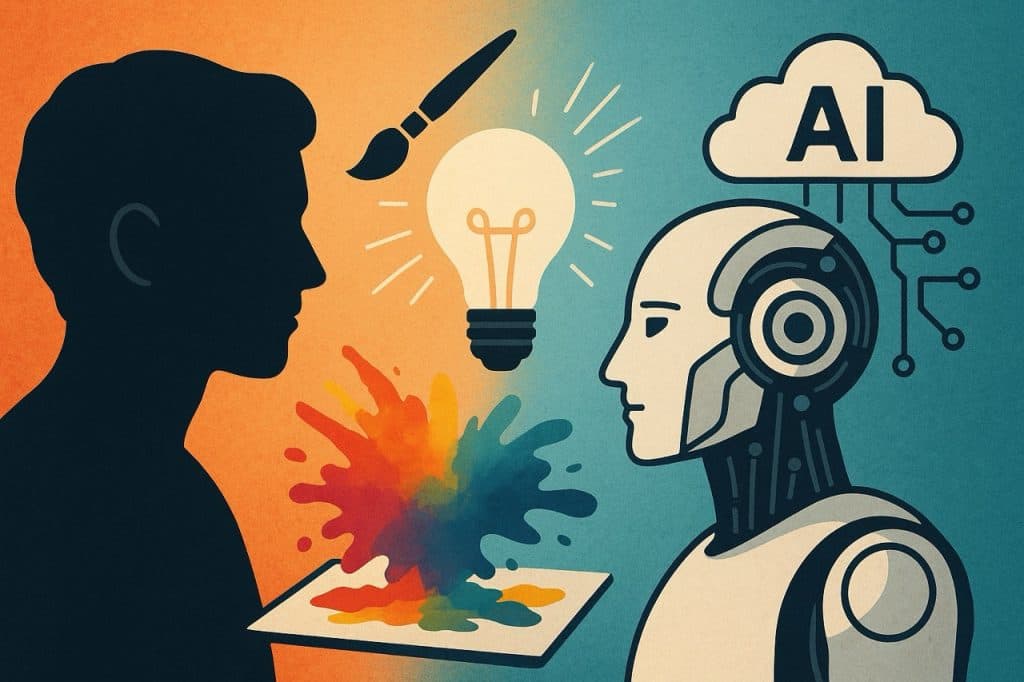
The rise of artificial intelligence (AI) has transformed creative fields, from art and music to writing and design, sparking a heated debate about its impact on human creativity. As AI-generated content grows more sophisticated, questions arise: Will AI render human creativity obsolete, or will it amplify our creative potential? This article explores the unique qualities of human creativity, AI’s role as a collaborative tool, and the economic and social implications of this technological shift. Drawing on recent research and expert insights, we argue that AI will not replace human creativity but will enhance it, fostering a future where human ingenuity and technology coexist symbiotically.
The Uniqueness of Human Creativity
Human creativity is distinguished by its emotional depth, personal experiences, and intuitive leaps—qualities that AI struggles to emulate. A study published in Cognitive Research: Principles and Implications (July 4, 2023) found that participants rated artworks labelled as human-created higher in liking, beauty, profundity, and worth compared to those labelled as AI-created, even when all artworks were AI-generated. This preference highlights the value placed on the human experience embedded in creative works, which AI can only approximate by analysing patterns in existing data.
Human creativity also excels in originality and innovation, often driven by personal rebellion or inspiration. As noted in an article from AI Contentfy (May 28, 2025), AI lacks the ability to handle unpredictable situations or generate truly novel ideas without human prompts. For example, a human artist might create a groundbreaking style inspired by a personal struggle, whereas AI relies on historical data, limiting its capacity for radical innovation.
Moreover, the social value of creative works lies in the connection between creator and audience. Reddit discussions (September 16, 2023) emphasize that people prefer content reflecting human emotions, hopes, and fears, valuing imperfections as unique traits. A user noted, “We like humans; we prefer content with human imperfections over perfect AI output,” underscoring the appeal of authenticity in human art, such as hand-thrown pottery with slight undulations.
Historical precedents support this view. Technologies like photography transformed art without rendering human creativity obsolete, just as AI chess engines like Deep Blue (1997) surpassed human players yet did not diminish the popularity of human chess. These examples suggest that human creativity retains cultural and emotional significance, even as AI advances.
AI as a Collaborative Tool
Far from replacing human creativity, AI is emerging as a powerful collaborator that enhances creative processes. The World Economic Forum (January 21, 2025) highlights AI’s role in revolutionizing storytelling in the entertainment industry, enabling performers, writers, and creatives to explore new possibilities. For instance, tools like Flawless AI sync actors’ lip movements with different languages, improving dubbed film quality while ensuring fair compensation and consent. Similarly, platforms like Narrativ allow performers to control AI-generated digital replicas, opening new revenue streams.
In business, generative AI augments creativity by supporting idea generation and evaluation. The Harvard Business Review (July 1, 2023) outlines how AI promotes divergent thinking, challenges expertise bias, assists in idea evaluation, refines concepts, and facilitates collaboration. For example, AI can analyse large datasets to inspire new hypotheses, as seen in chemical research for car batteries, allowing humans to focus on innovative refinement.
A study by the Gottlieb Duttweiler Institute found that AI can catalyse creativity by presenting digestible content, though it may inhibit creativity if overly distracting. In music composition, AI generates possibilities that artists refine, creating a symbiotic workflow. Research from Workhuman (February 20, 2025) indicates that AI tools like text-to-image generators enhance creative productivity by 25%, demonstrating their potential to streamline routine tasks and boost innovation.
Economic and Social Impacts
While AI offers significant creative benefits, it also raises concerns about economic and social impacts, particularly in creative industries. The Harvard Business Review (April 13, 2023) identifies three scenarios for AI’s disruption of the creator economy, valued at $14 billion annually:
- Augmentation: AI enhances human work, increasing productivity.
- Flood of Cheap Content: AI generates inexpensive content, potentially displacing human creatives.
- Premium on Human-Made Work: Human-created work commands higher value due to its authenticity.
A study from Science Advances (July 12, 2024) found that while AI enhances individual creativity, it reduces collective diversity, as AI-generated stories were more similar to each other than human-only stories. This suggests that widespread AI adoption could narrow the scope of novel content, posing a risk to creative diversity.
However, human-made work often retains a premium. The Cognitive Research study (July 4, 2023) showed that participants assigned higher monetary value to human art, indicating a market preference for authenticity. Reddit users echoed this, noting that while AI could dominate commercial settings like stock image creation, human connection remains crucial socially and competitively.
The potential for job displacement raises broader societal questions. Reddit discussions suggest that societal changes, such as universal basic income, could address economic inequality caused by AI’s impact on creative industries. These concerns highlight the need for policies that balance technological advancement with human welfare.
The Future Outlook
The future of creativity lies in a symbiotic relationship between AI and human ingenuity. The World Economic Forum (January 21, 2025) emphasizes the importance of ethical standards, collective action, and responsible innovation to ensure AI elevates human creativity. For example, SAG-AFTRA’s agreements with platforms like Narrativ ensure performers retain control over AI-generated content, fostering trust and fairness.
Strong intellectual property protections are also critical, as argued in SSIR (January 29, 2025). These protections incentivise human creativity, which is essential for advancing AI applications. By fostering global dialogue, platforms like the World Economic Forum can establish standards that prioritise human creativity while leveraging AI’s capabilities.
Despite concerns, the evidence suggests that AI will not make human creativity obsolete. Instead, it will open new frontiers of creative expression, where AI and humans collaborate to achieve greater innovation. By embracing AI as a tool and preserving the emotional depth and originality of human creativity, we can create a future where creativity thrives.
Conclusion
The evidence overwhelmingly supports the view that AI-generated content will not render human creativity obsolete. Instead, AI will enhance human creativity by serving as a collaborative tool, streamlining tasks, and inspiring innovation. While economic and social challenges, such as job displacement and reduced creative diversity, must be addressed, the unique qualities of human creativity—emotional depth, originality, and connection—ensure its enduring value. As we navigate this AI-powered future, fostering an environment where AI and human creativity coexist will unlock unprecedented creative potential, ensuring that human ingenuity remains at the heart of artistic expression.
Summary Table: Key Arguments For and Against AI Replacing Human Creativity
| Argument For AI Replacing Human Creativity | Argument Against AI Replacing Human Creativity |
|---|---|
| AI can generate content “indistinguishable from reality” and may create “realities” by 2030 (Reddit, lean_keen). | Humans prefer content with human emotions, hopes, fears, and dreams over perfect AI output (Reddit, AlbertoRomGar). |
| AI can surpass humans in creativity, imitating imperfections and understanding the human condition, potentially within 10 years (Reddit, inteblio). | AI cannot replicate the depth, complexity, and nuances of human emotion (Reddit, theweekinai). |
| AI will eliminate jobs requiring creativity in commercial settings, making it hard for middle and lower-tier artists to make a living (Reddit, AppropriateScience71). | Human creativity is safe, as seen in chess; despite AI like Deep Blue (1997) beating humans, human chess remains popular (Reddit, AlbertoRomGar). |
| AI can do creativity 100x better and 99% cheaper, leading humans to prefer it, like choosing Amazon over local shops (Reddit, AppropriateScience71). | Imperfection adds character and uniqueness, valued in human art like hand-thrown pottery (Reddit, deleted comment). |
| AI will create variations on its own art, and humans may copy AI, reducing human originality (Reddit, Krowebar). | Art’s value lies in relationships with artists, and human involvement is necessary for AI to communicate relevantly (Reddit, wonderifatall, Zer0pede). |
| AI may devalue post-2023 visual arts, adapting like art did to photography (Reddit, inteblio). | AI will value human creativity, inspire artists, and complement human creatives, freeing people from mundane work (Reddit, deleted comment). |
| For marketing or ambient music, AI will outperform humans in scaling and optimizing conversion rates (Reddit, arembi). | Humans will always have something to say to humans, and AI needs human prompts to communicate relevantly (Reddit, Zer0pede). |
Citations
- Bellaiche, L., et al. (2023). Humans versus AI: whether and why we prefer human-created compared to AI-created artwork. Cognitive Research: Principles and Implications, 8(1), 42. https://cognitiveresearchjournal.springeropen.com/articles/10.1186/s41235-023-00499-6
- World Economic Forum. (2025, January 21). How AI can empower, not replace, human creativity. https://www.weforum.org/stories/2025/01/artificial-intelligence-must-serve-human-creativity-not-replace-it/
- Harvard Business Review. (2023, July 1). How Generative AI Can Augment Human Creativity. https://hbr.org/2023/07/how-generative-ai-can-augment-human-creativity
- Harvard Business Review. (2023, April 13). How Generative AI Could Disrupt Creative Work. https://hbr.org/2023/04/how-generative-ai-could-disrupt-creative-work
- Science Advances. (2024, July 12). Generative AI enhances individual creativity but reduces the collective diversity of novel content. https://www.science.org/doi/10.1126/sciadv.adn5290
- SSIR. (2025, January 29). Encouraging Human Creativity in the AI-Powered Future. https://ssir.org/articles/entry/ai-creativity-copyrights-patents