Tesla Optimus Robot Could Redefine Human Machine Work
Tesla Optimus is poised to transform the fundamental relationship between humans and machines. Since its unveiling in 2021, this humanoid robot has evolved from a conceptual prototype into a tangible product ready for mass production. With the third generation now entering production and a groundbreaking digital AI system in development, tesla optimus represents not just a technological milestone but a paradigm shift in how work is performed across industries. From factory floors to household chores, tesla optimus aims to take over dangerous, repetitive, and tedious tasks, freeing humans for more creative and fulfilling endeavors (D1EV, 2026; PCM, 2026).
The Evolution to Optimus Gen 3
Tesla optimus has undergone remarkable evolution since its first appearance. The third generation, known as Optimus Gen 3, represents the culmination of years of engineering refinement. Elon Musk announced at the Abundance Summit in March 2026 that the new generation is nearly complete and will enter production this summer (D1EV, 2026). Unlike earlier prototypes that demonstrated basic walking and waving capabilities, Optimus Gen 3 is designed as a fully functional general-purpose robot capable of performing thousands of distinct tasks.
The technical specifications of tesla optimus Gen 3 are impressive. Standing approximately 173 centimeters tall and weighing about 57 kilograms, the robot is built to operate alongside humans in industrial and domestic environments (PCM, 2026; ECOticias, 2026). Its most sophisticated feature is the hand design, which boasts 22 degrees of freedom with actuators relocated to the forearm, allowing for human-like dexterity through a complex tendon-driven system. This enables tesla optimus to perform over 3,000 distinct tasks, from delicate operations like handling eggs to industrial work such as parts kitting and battery handling (PCM, 2026).
The Brain Behind the Machine
The intelligence powering tesla optimus draws directly from Tesla’s expertise in autonomous driving. At its core sits a version of the Full Self-Driving (FSD) computer, repurposed for embodied AI applications (PCM, 2026; Goldman Sachs, 2026). The robot uses eight cameras to build real-time 3D maps of its environment, processing visual data through end-to-end neural networks. Unlike traditional industrial robots that rely on hard-coded instructions, tesla optimus learns through two complementary methods: simulation-to-reality training, where skills are practiced millions of times in virtual environments, and imitation learning, where the robot observes and replicates human movements (PCM, 2026).
Goldman Sachs has noted that Tesla is making meaningful advances in key components of the robot, particularly the hands and forearms, which are among the most complex engineering challenges in humanoid robotics (Goldman Sachs, 2026). The bank highlighted that Tesla is focusing on improving reliability and manufacturability to support scaling, while continuing to design critical components in-house to retain control over intellectual property and performance.
The Digital Optimus Revolution
Perhaps the most ambitious aspect of the tesla optimus project extends beyond physical hardware. Elon Musk revealed that Tesla is collaborating with xAI to develop “Macrohard Digital Optimus,” an AI system that combines Grok as the reasoning layer with Digital Optimus as the execution layer (D1EV, 2026). This system can read computer screens, understand keyboard and mouse operations, and complete complex workflows autonomously. According to Musk, this AI could theoretically simulate the complete operation of an entire company, representing a new paradigm in digital labor (D1EV, 2026).
The Digital Optimus system is designed to operate primarily on Tesla’s AI4 computing platform, with the ability to tap into Nvidia hardware when needed. Musk has indicated that this system will be available to users within approximately six months, bringing the capabilities of tesla optimus into the digital realm as well as the physical (Sina, 2026). This dual approach physical robots for real-world tasks and digital agents for computer-based work positions tesla optimus as a comprehensive labor solution across both domains.
Mass Production and Factory Transformation
Tesla has made the strategic decision to prioritize tesla optimus production over legacy vehicle programs. The company announced it will end production of the Model S and Model X in the second quarter of 2026, repurposing the Fremont, California, factory to manufacture Optimus robots (Chosun, 2026; Inc., 2026). The Fremont facility is being retooled with a target capacity of one million units per year, though Musk has cautioned that early production will be “agonizingly slow” before ramping up (PCM, 2026; ECOticias, 2026).
The shift represents a fundamental reorientation of Tesla’s corporate identity. As one analyst noted, Tesla is accelerating its transition from an automotive company to a technology company centered on autonomous vehicles and humanoid robots (Chosun, 2026). The capital expenditure for this transition exceeds $20 billion in 2026, funding new production lines, AI infrastructure, and robot deployment (Inc., 2026; TechNews, 2026).
A vast network of hundreds of Chinese suppliers, dubbed the “Optimus Chain,” provides critical components including actuators, motors, sensors, and batteries (TechNews, 2026). While final assembly occurs in the United States, this supply chain leverages Tesla’s established relationships from electric vehicle manufacturing to achieve cost targets of approximately $20,000 to $30,000 per unit (PCM, 2026; TechNews, 2026).
Real-World Deployment Begins
Tesla has already begun deploying tesla optimus in its own facilities. At a recent autonomous driving event in Austin, Texas, multiple Optimus prototypes were demonstrated working behind a bar, handing out bottled water to attendees, shaking hands, and interacting naturally with people (Sina, 2026). The robots demonstrated stable standing, precise object manipulation, and the ability to handle random crowd movements without human intervention.
Starting in February 2026, tesla optimus units began training at the Austin factory, described as an “apprenticeship period” before full deployment (Chosun, 2026). The company has reportedly hired dozens of “Optimus trainers” to facilitate this learning process. Musk has stated that Optimus could be available for external sale by the end of 2027, with early deployment focused on factory automation and industrial applications (Chosun, 2026).
Technical Specifications and Capabilities
The technical capabilities of tesla optimus Gen 3 represent significant advances over previous generations. Powered by a 2.3 kilowatt-hour battery, the robot can operate for approximately 10 to 12 hours on a single charge, sufficient for a full work shift (ECOticias, 2026). It can carry payloads of up to 20 kilograms and walk at speeds of approximately 8 kilometers per hour (AINOW, 2026).
The robot’s AI training pipeline combines simulation-based learning with real-world imitation. By practicing tasks millions of times in virtual environments before physical deployment, tesla optimus achieves reliable performance while maintaining the ability to self-correct when errors occur (PCM, 2026). This self-correction capability is critical for autonomous operation without human oversight.
Competitive Landscape
Tesla optimus enters a rapidly growing field of humanoid robotics. Competitors include Boston Dynamics with its Atlas robot, Figure AI with Figure 03 (backed by Microsoft and OpenAI), and Chinese manufacturers like Unitree with its G1 model (AINOW, 2026). Google Deepmind has adopted an “Android model,” providing foundational AI for third-party robotics manufacturers (PCM, 2026).
However, tesla optimus maintains distinct advantages. Tesla’s vertical integration manufacturing batteries, motors, and AI chips in-house provides cost advantages that competitors cannot easily match (AINOW, 2026). The company’s experience scaling automotive production to millions of units per year gives it unique capabilities in manufacturing efficiency. Goldman Sachs notes that while widespread adoption will take time, the physical AI ecosystem represents a potentially massive market (Goldman Sachs, 2026).
Applications Across Industries
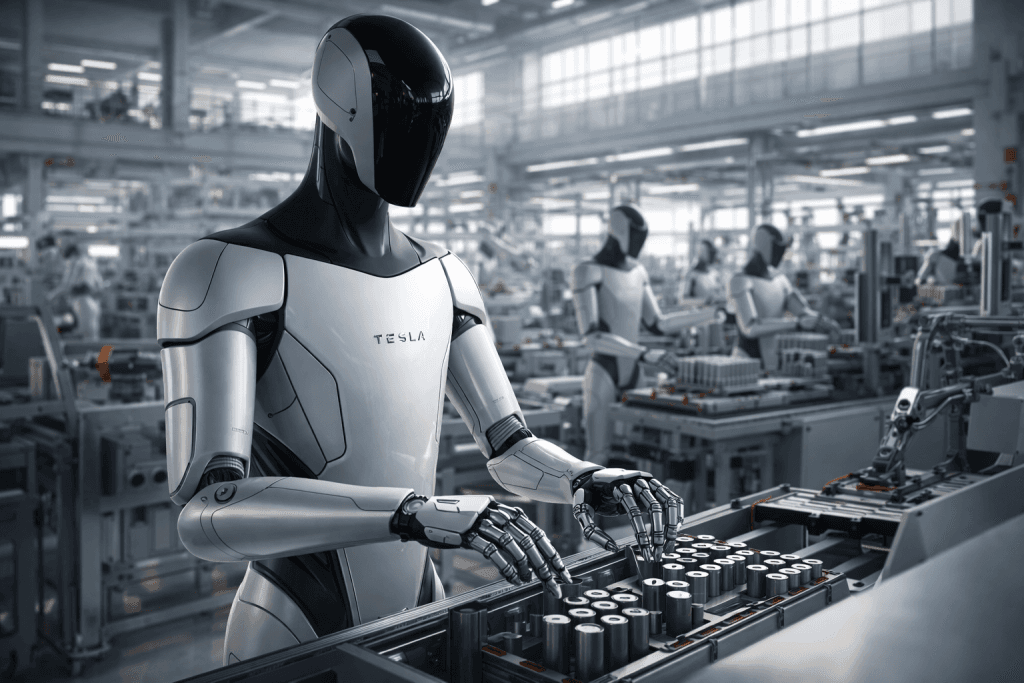
Tesla’s immediate focus for tesla optimus is industrial deployment. Within Tesla’s own factories, the robots will handle battery cell transport, parts kitting, and other repetitive tasks that currently require human labor (PCM, 2026). After proving reliability in controlled environments, Tesla plans to expand to external manufacturing partners.
Logistics represents another significant opportunity. Warehouse operations involving picking, sorting, and loading are ideal candidates for humanoid robots (AINOW, 2026). Longer-term applications include construction, agriculture, and eventually household assistance. Musk has suggested that home use could become feasible as safety standards develop and costs decrease (AINOW, 2026).
Economic and Social Implications
The economic implications of tesla optimus extend far beyond Tesla itself. Analysts project that humanoid robotics could create a $380 billion market by 2035 (AINOW, 2026). For businesses, the promise is reduced labor costs and increased productivity. For workers, the impact is more complex while dangerous and repetitive tasks may be automated, labor unions have raised concerns about employment displacement (ECOticias, 2026).
From an environmental perspective, tesla optimus presents both opportunities and challenges. If deployed with renewable energy, the robots could improve manufacturing efficiency and reduce waste (ECOticias, 2026). However, mass production of millions of robots will create significant electricity demand and require substantial material resources. Tesla’s commitment to sustainable energy in its factories will be critical to ensuring that tesla optimus contributes positively to climate goals.
The Path Forward
As tesla optimus moves toward mass production, the timeline is ambitious. Summer 2026 will see initial production start, with gradual ramp-up through the year. Large-scale production targets of one million units annually are set for 2027 (D1EV, 2026; PCM, 2026). Meanwhile, Digital Optimus will launch within months, bringing AI-driven automation to computer-based work.
The vision for tesla optimus extends beyond individual tasks. Musk has described a future where humanoid robots become as ubiquitous as smartphones, transforming the nature of work itself. Whether that vision materializes on the proposed timeline remains uncertain, but the direction is clear: tesla optimus is redefining the relationship between humans and machines, ushering in an era where intelligent robots work alongside people to build, create, and serve.
References
AINOW. (2026, January 12). Tesla Optimus完全ガイド|スペック・価格・将来計画【2026年】. https://ainow.jp/tesla-optimus-guide/
Chosun. (2026, January 28). Tesla halts Model S and X production for Optimus robot. https://www.chosun.com/english/industry-en/2026/01/29/ORIQLQJVJVCEVMDMITQJCOMOZE/
D1EV. (2026, March 11). *特斯拉正打造”实体+数字”双Optimus体系,Optimus3今夏启动生产*. https://www.d1ev.com/newsflash/291110
ECOticias. (2026, January 31). Elon Musk’s plan to redesign the world’s factories and perhaps the planet too: Humanoid robots that work 12 hours a day. https://www.ecoticias.com/en/elon-musks-plan-to-redesign-the-worlds-factories-and-perhaps-the-planet-too-humanoid-robots-that-work-12-hours-a-day-never-rest-and-use-artificial-intelligence/26445/
Goldman Sachs. (2026, March 20). Goldman shares latest updates on Tesla’s Optimus project. https://ca.investing.com/news/company-news/goldman-shares-latest-updates-on-teslas-optimus-project-4526579
Inc. (2026, January 28). Elon Musk just slashed 2 of Tesla’s car models to double down on robots. https://www.inc.com/chloe-aiello/elon-musk-just-slashed-2-of-teslas-car-models-to-double-down-on-robots/91293854
PCM. (2026, January 21). 訂下年產百萬目標 Tesla Optimus Gen 3 機械人投產. https://www.pcmarket.hk/tesla-optimus-gen-3-begin-mass-production-aimed-for-making-millions-per-year/
Sina. (2026, March 14). 汽车行业周报:DIGITAL OPTIMUS计划6个月后上线 TERAFAB项目将在3月21日启动. http://stock.finance.sina.com.cn/stock/go.php/vReport_Show/kind/lastest/rptid/826933816065/index.phtml
TechNews. (2026, February 1). 特斯拉「Optimus 鏈」曝光,數百家中國供應商撐起機器人量產夢. https://technews.tw/2026/02/02/chinese-suppliers-form-the-backbone-of-teslas-humanoid-robot-initiative/