
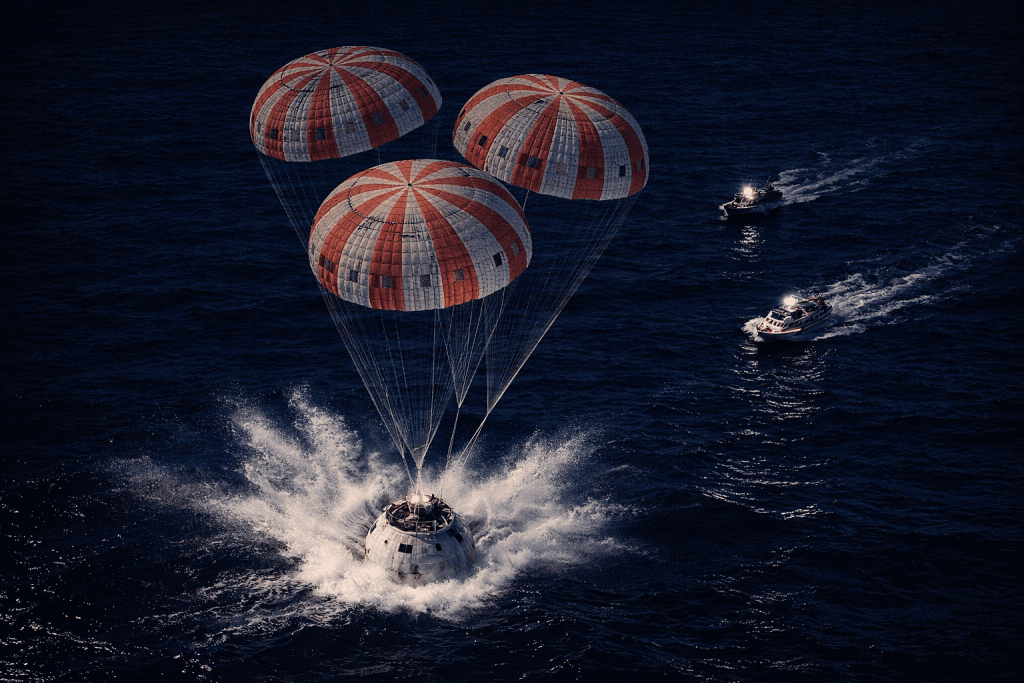
Historic Artemis II Mission Ends With Successful Splashdown
Artemis ii mission ends today with a flawless splashdown in the Pacific Ocean, marking humanity’s triumphant return from the Moon for the first time in over five decades. On April 10, 2026, at 5:07 PM Pacific Time, the Orion spacecraft, named Integrity, gently descended under three main parachutes into the waters off the coast of San Diego, California (Asianet Newsable, 2026; China Daily, 2026). As the artemis ii mission ends, NASA and its international partners celebrate the safe return of four astronauts who have pushed the boundaries of human space exploration farther than ever before.
A Perfect Splashdown
As the artemis ii mission ends, the final 13 minutes of reentry were among the most critical of the entire 10-day journey. The Orion capsule entered Earth’s atmosphere at a staggering speed of nearly 40,000 kilometers per hour, experiencing temperatures of approximately 2,760 degrees Celsius twice as hot as volcanic lava (NASASpaceFlight.com, 2026). The capsule performed a modified “skip” reentry trajectory, designed to reduce peak heating loads on the heat shield following issues identified during the uncrewed Artemis I mission in 2022 (Orlando Sentinel, 2026).
During the most intense phase of reentry, a layer of plasma formed around the capsule, blocking all radio communications for approximately six minutes (RTI Central Broadcasting Station, 2026). When communication was reestablished and the parachutes deployed successfully, the artemis ii mission ends with what NASA officials described as “a perfect bullseye splashdown” (Vietnam.vn, 2026). Commander Reid Wiseman reported shortly after landing that all four crew members were in good condition and able to walk unassisted (Central News Agency, 2026).
The Crew’s Historic Journey
As the artemis ii mission ends, the achievements of the crew are being celebrated worldwide. The four astronauts aboard Orion Integrity were NASA Commander Reid Wiseman, Pilot Victor Glover, Mission Specialist Christina Koch, and Canadian Space Agency astronaut Jeremy Hansen (Xinhua, 2026). They launched aboard the Space Launch System (SLS) rocket from Kennedy Space Center on April 1, 2026, beginning a journey that would cover approximately 1.12 million kilometers (European Space Agency, 2026a).
Before the artemis ii mission ends, the crew achieved several historic firsts. On April 6, they performed a lunar flyby, passing just 6,545 kilometers above the Moon’s surface (NASASpaceFlight.com, 2026). During this period, they broke the record for the farthest distance any humans have traveled from Earth, reaching 406,771 kilometers surpassing the 400,171-kilometer mark set by Apollo 13 in 1970 (Asianet Newsable, 2026). Victor Glover became the first person of color to orbit the Moon, Christina Koch became the first woman to accomplish this feat, and Jeremy Hansen became the first Canadian to fly to the Moon (Central News Agency, 2026).
European Service Module Performance
As the artemis ii mission ends, the European Space Agency’s contribution has proven invaluable. The European Service Module (ESM) supplied the Orion spacecraft with air, potable water, electrical power through four solar arrays, thermal control, and propulsion throughout the journey (European Space Agency, 2026b). The module was built by European industry under ESA leadership, assembled by Airbus Defence and Space in Bremen, Germany, with contributions from companies across 13 European countries (European Space Agency, 2026a).
The precision of the ESM’s performance was remarkable. The translunar injection burn on Flight Day 2 was so accurate that two of three planned trajectory correction burns were canceled (European Space Agency, 2026b). As the artemis ii mission ends, ESA Director General Josef Aschbacher praised the demonstration of European capability to deliver critical elements for ambitious international exploration missions (European Space Agency, 2026a). The service module itself burned up harmlessly in Earth’s atmosphere during reentry, as designed.
Heat Shield and Reentry Modifications
One of the most closely watched aspects as the artemis ii mission ends was the performance of Orion’s heat shield. During Artemis I in 2022, the AVCOAT ablative material on the heat shield experienced unexpected charring and material loss due to the skip guidance entry profile (Orlando Sentinel, 2026). NASA engineers determined that gases became trapped within the material during the first atmospheric dip, causing cracking and uneven ablation during the second descent (NASASpaceFlight.com, 2026).
For Artemis II, NASA opted to modify the reentry trajectory rather than replace the heat shield (Orlando Sentinel, 2026). The capsule took a steeper descent angle, limiting exposure to the heating environment that caused the erosion seen on Artemis I. As the artemis ii mission ends, initial indications suggest the modified trajectory was successful, though NASA will conduct thorough inspections of the heat shield to inform future Artemis missions (NASASpaceFlight.com, 2026).
Recovery Operations
Immediately following splashdown, recovery operations commenced. The USS John P. Murtha, stationed near the landing zone, deployed helicopters and boats to reach the floating capsule (Xinhua, 2026). Navy divers secured the spacecraft, and the four astronauts were assisted out of Integrity. Within two hours after splashdown, the crew was transported by helicopter to the recovery ship, where they underwent initial medical evaluations (Vietnam.vn, 2026).
NASA reported that all four astronauts were in good health and able to walk across the flight deck unassisted (Central News Agency, 2026). As the artemis ii mission ends, the crew will be transported to NASA’s Johnson Space Center in Houston for further post-mission medical evaluations and debriefings (China Daily, 2026). The Orion spacecraft itself will be recovered and shipped to NASA’s Kennedy Space Center in Florida for detailed inspection.
Scientific Achievements
Before the artemis ii mission ends, the crew conducted a wide range of scientific activities. During their lunar flyby, they observed the Moon’s near and far sides through Orion’s windows, imaging the lunar surface and discussing regions of scientific interest with Earth-based teams (European Space Agency, 2026b). The crew also witnessed a 57-minute solar eclipse from their unique vantage point, during which the Moon eclipsed the Sun, allowing observations of the solar corona and Earthshine reflected light from Earth illuminating the dark side of the Moon (NASASpaceFlight.com, 2026).
The astronauts captured stunning photographs, including an “Earthset” image showing the blue Earth sinking below the grey lunar horizon, paying tribute to Apollo 8’s famous 1968 “Earthrise” photograph (RTI Central Broadcasting Station, 2026). As the artemis ii mission ends, these images are being shared worldwide, inspiring a new generation of explorers.
International Collaboration
The success of Artemis II demonstrates the power of international partnership. As the artemis ii mission ends, NASA Administrator Jared Isaacman stated, “We are back in the business of sending astronauts to the Moon, bringing them back safely” (Central News Agency, 2026). The mission involved contributions from ESA, the Canadian Space Agency, and numerous international contractors (European Space Agency, 2026a).
President Donald Trump congratulated the crew following splashdown, writing on Truth Social: “Congratulations to the great and talented crew of Artemis II. The entire journey was spectacular, the landing was perfect, and as President, I am incredibly proud!” (Central News Agency, 2026). He added, “Next stop, Mars!” (RTI Central Broadcasting Station, 2026).
Looking Ahead
As the artemis ii mission ends, NASA is already planning the next steps in the Artemis campaign. Artemis III, scheduled for 2027, will focus on testing systems and operational capabilities in low Earth orbit, ahead of the Artemis IV crewed lunar landing mission in 2028 (NASASpaceFlight.com, 2026). The long-term goal remains the establishment of a sustainable human presence on the Moon, serving as a proving ground for future Mars exploration (European Space Agency, 2026b).
The success of Artemis II validates Orion’s life support systems, navigation capabilities, and reentry procedures. As the artemis ii mission ends, the world celebrates not just the end of a mission but the beginning of a new era of human space exploration one that will return humans to the lunar surface and eventually carry them to the Red Planet.
References
Asianet Newsable. (2026, April 11). Artemis II crew nears Earth for Pacific splashdown after historic mission. https://newsable.asianetnews.com/world/artemis-ii-crew-nears-earth-for-pacific-splashdown-after-historic-mission-articleshow-8wa17d4
Central News Agency. (2026, April 11). 阿提米絲2號通過重返考驗 川普賀凱旋:下一步火星. https://www.cna.com.tw/news/ait/202604110034.aspx
China Daily. (2026, April 11). NASA’s Artemis II crew splashes down in Pacific Ocean. http://www.chinadaily.com.cn/a/202604/11/WS69d9c207a310d6866eb42d7e.html
European Space Agency. (2026a, April 11). Artemis II: Splashdown. https://www.esa.int/Science_Exploration/Human_and_Robotic_Exploration/Artemis_II_splashdown
European Space Agency. (2026b, April 11). Splashdown for Artemis II. https://www.esa.int/Newsroom/Press_Releases/Splashdown_for_Artemis_II
NASASpaceFlight.com. (2026, April 10). *Artemis II returns to Earth after historic 10-day mission around the Moon*. https://www.nasaspaceflight.com/2026/04/artemis-ii-return/
Orlando Sentinel. (2026, April 10). Pictures: Artemis II crew back on Earth after Orion splashdown. https://www.orlandosentinel.com/2026/04/10/pictures-artemis-ii-crew-back-on-earth-after-orion-splashdown/
RTI Central Broadcasting Station. (2026, April 11). 阿提米絲2號太空人順利濺落太平洋 創紀錄10天任務完美收尾. https://www.rti.org.tw/news?uid=3&pid=202398
Vietnam.vn. (2026, April 11). The Artemis II crew landed at sea, awaiting return to shore. https://www.vietnam.vn/en/phi-hanh-doan-artemis-ii-dap-xuong-bien-cho-ve-bo
Xinhua. (2026, April 11). NASA’s Artemis II splashes down off southern U.S. California coast. https://english.news.cn/northamerica/20260411/9911a11d7fff4fe58cbf311b7b2c0c57/c.html