How CERN Particle Collider Is Unlocking the Secrets of the Universe
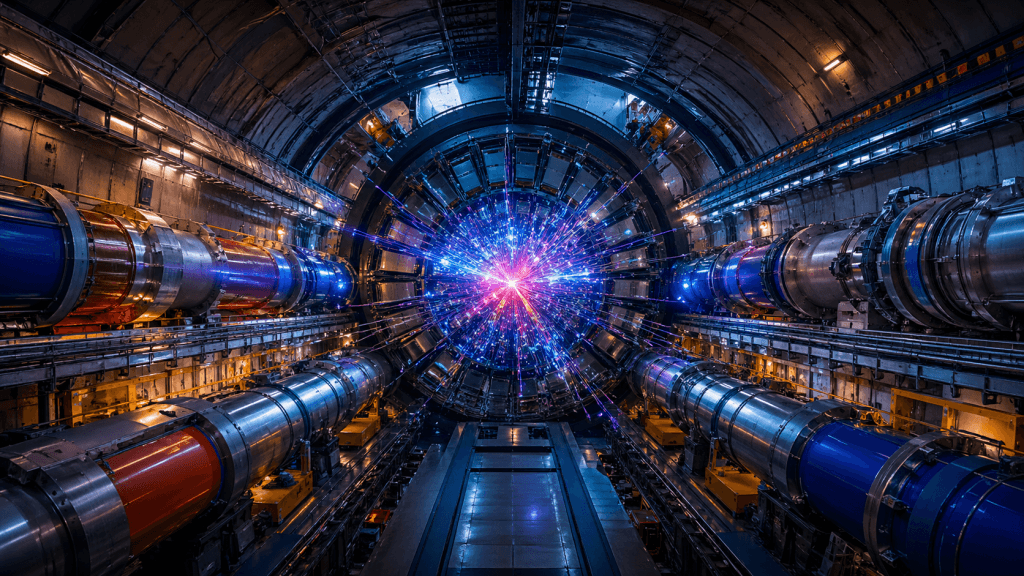
CERN Particle Collider, known officially as the Large Hadron Collider (LHC), is humanity’s most powerful tool for exploring the fundamental nature of reality. Deep beneath the Franco-Swiss border, this 27-kilometer ring of superconducting magnets has been smashing particles together at extraordinary energies since 2008.
The CERN Particle Collider is not merely a machine; it is a window into the conditions that existed just fractions of a second after the Big Bang. By recreating these extreme environments, scientists at the European Organization for Nuclear Research (CERN) are unlocking secrets that have remained hidden since the dawn of time.
From the famous Higgs boson to mysterious dark matter candidates, the CERN Particle Collider continues to push the boundaries of human knowledge. This article explores the latest discoveries from this remarkable instrument and what they mean for our understanding of the universe.
The Higgs Boson and Rare Decays
One of the primary missions of the CERN Particle Collider has been to study the Higgs boson, the particle responsible for giving mass to other fundamental particles. Since its discovery in 2012, researchers have been meticulously characterizing its properties. Recent results from the ATLAS experiment represent a significant leap forward.
In April 2026, the ATLAS collaboration announced major breakthroughs in the study of rare Higgs boson decays. The team achieved the most stringent constraints to date on the H→Zγ decay channel, a process so rare that only about one in every ten trillion proton collisions produces such an event (ATLAS Collaboration, 2026). This achievement with the CERN Particle Collider required analyzing the entire Run 2 dataset from 2015 to 2018 combined with partial Run 3 data from 2022 onward.
Even more exciting, the CERN Particle Collider provided evidence for the H→μμ decay channel at a significance of 3.4 sigma. In particle physics, this means the probability that the signal is a random background fluctuation is less than one in a thousand (ATLAS Collaboration, 2026).
These rare decays are crucial because they offer windows into potential new physics beyond the Standard Model. As one physicist involved in the research noted, these results point toward “opening a door to new physics” (Jakobs, 2026). The significance of these findings cannot be overstated. The Higgs field itself is linked to deep structural questions of the Standard Model, including flavor, naturalness, and the stability of the vacuum of the universe.
Every new measurement from the CERN Particle Collider brings us closer to understanding whether the Higgs boson is truly a fundamental particle or something more complex.
A New Particle Discovery Solving a 20-Year Mystery
The CERN Particle Collider has also delivered a discovery that resolves a decades-old puzzle. Scientists working on the LHCb experiment have observed a new particle called the Ξcc⁺ (Xi-cc-plus), a heavier relative of the proton (University of Manchester, 2026).
What makes this discovery particularly compelling is its history. The proton, famously discovered by Ernest Rutherford in Manchester in 1917-1919, contains two up quarks and one down quark. The newly discovered Ξcc⁺ replaces the up quarks with heavier charm quarks, making it a “charming cousin” to the ordinary proton.
The CERN Particle Collider detected this particle through its decay into three lighter particles, with a clear peak of around 915 events observed at a mass of 3619.97 MeV/c² (University of Manchester, 2026).
This discovery solves a mystery that had persisted for more than two decades. In 2002, physicists at the SELEX experiment thought they had spotted a similar particle, but at a mass that conflicted with theoretical predictions. The new observation with the CERN Particle Collider confirms a mass consistent with expectations based on a previously discovered partner particle, the Ξcc⁺⁺ (New Scientist, 2026).
With a statistical significance exceeding 7 sigma well beyond the 5-sigma threshold required for a formal discovery this result definitively closes the book on the debate. The upgraded LHCb detector, which came online in 2024, made this detection possible. Professor Chris Parkes of the University of Manchester, who led the international collaboration, explained: “Rutherford’s gold-foil experiment in a Manchester basement transformed our understanding of matter, and today’s discovery builds on that legacy using state-of-the-art technology at the CERN Particle Collider” (University of Manchester, 2026).
Hints of New Physics Beyond the Standard Model
Perhaps the most tantalizing developments from the CERN Particle Collider involve hints that the Standard Model of particle physics may be incomplete. Recent results from the LHCb experiment show a tension of four standard deviations from theoretical predictions when studying rare “penguin” decays of B mesons (The Conversation, 2026).
In real-world terms, this means there is only a one in 16,000 chance that a random fluctuation would produce such an extreme deviation if the Standard Model is correct. While this falls short of the gold-standard 5 sigma required for a formal discovery, the evidence is mounting. Independent results from the CMS experiment, published earlier in 2025, agree with the LHCb findings, strengthening the case that something unexpected is happening (The Conversation, 2026).
These penguin decays are uniquely sensitive to the effects of potentially very heavy new particles that cannot be created directly even at the CERN Particle Collider. Such particles might still exert a measurable influence on these decays, similar to how radioactivity was discovered 80 years before the W bosons responsible for it were directly observed.
Among the potential explanations are new particles called “leptoquarks” that would unite two different types of matter: leptons and quarks. Dr. Mark Thomson, who took over as CERN’s Director-General on January 1, 2026, expressed enthusiasm about these developments. “This is really an opportunity for discovery,” he said. “Sometimes you make small steps in science. This is not a small step. This is a giant, giant leap forward” (FutureFactual, 2026).
The High Luminosity LHC Upgrade
The CERN Particle Collider is about to become even more powerful. In June 2026, the LHC will shut down for a major upgrade known as the High Luminosity LHC (HL-LHC) (CERN, 2026). During this four-year shutdown, 1.2 kilometers of the 27-kilometer ring will be replaced with advanced high-field superconducting magnets.
When complete around 2030, the HL-LHC will multiply the “luminosity”—the number of collisions per second—by a factor of ten compared to the current machine (CERN, 2026). This means the upgraded CERN Particle Collider will produce ten times more data, allowing scientists to study rare processes with unprecedented precision.
As Thomson explained, “We’re going to have a brighter machine, so we get much, much more data, and every bit of data we get, we have a clearer image of what’s going on” (FutureFactual, 2026).
The HL-LHC represents more than just a continuation of the current program. In fifteen years of operation, the existing CERN Particle Collider has collected substantial data on the Higgs boson, but the picture remains somewhat fuzzy.
The upgraded machine will effectively complete the remaining 90 percent of the LHC’s scientific program. This upgrade is critical for testing the hints of new physics that have emerged from recent data. If the anomalies observed in penguin decays are confirmed, the HL-LHC could provide the statistical power needed to make a definitive discovery.
The Future Circular Collider
Looking beyond the HL-LHC, CERN is planning an even more ambitious machine. The Future Circular Collider (FCC) would be an electron-positron collider with a circumference of 91 kilometers, more than three times the size of the current LHC (Pedrero, 2026).
The European Strategy for Particle Physics has recommended the FCC-ee as the next flagship collider project at CERN (CERN, 2025). The scientific goals of the FCC are extraordinary. It would function as a “Higgs factory,” producing millions of Higgs bosons to measure their properties with far greater precision than even the HL-LHC can achieve.
The FCC would also generate a million times more Z bosons than the current CERN Particle Collider, enabling the detection of extremely subtle quantum effects (Vos, 2025).
The cost of this ambitious project is estimated at approximately 19.5billion. “They’re not expecting anything in return. This is really for the good of science,” Thomson noted (Pedrero, 2026). A final decision on whether to proceed with the FCC is expected from the CERN Council around 2028. If approved, the FCC would ensure that Europe remains at the forefront of particle physics for decades to come, building on the legacy of the current CERN Particle Collider.
Conclusion
From rare Higgs decays to new exotic particles and hints of physics beyond the Standard Model, the CERN Particle Collider continues to unlock the secrets of the universe. The discovery of the Ξcc⁺ particle has solved a 20-year mystery, while anomalies in penguin decays suggest that the Standard Model may be just the beginning. As the LHC prepares for its dramatic High Luminosity upgrade and plans take shape for the even more powerful Future Circular Collider, the future of particle physics has never looked brighter. The CERN Particle Collider stands as a testament to human curiosity and our relentless drive to understand our place in the cosmos. Each collision brings us one step closer to answering the most profound questions: What is the universe made of? How did it begin? And what fundamental laws govern its existence?
References
ATLAS Collaboration. (2026). Higgs rare decay breakthroughs in H→Zγ and H→μμ channels. Institute of High Energy Physics, Chinese Academy of Sciences. https://www.ihep.cas.cn/xwdt2022/gnxw/hotnews/2026/202604/t20260423_8190178.html
CERN. (2025, December 11). European Strategy for Particle Physics reaches important milestone. CERN Home. https://home.cern/fr/news/press-release/cern/european-strategy-particle-physics-reaches-important-milestone
CERN. (2026). Accelerator report: The accelerator complex gradually waking from winter shutdown. CERN Home. https://home.cern/fr/news/news/accelerators/accelerator-report-accelerator-complex-gradually-waking-winter-shutdown
FutureFactual. (2026, January 3). Mark Thompson on CERN’s High Luminosity LHC Upgrades, Antimatter, and the Future of Particle Physics. FutureFactual. https://futurefactual.com/video/mark-thompson-on-cerns-high-luminosity-lhc-upgrades-antimatter-and-the-future-of-particle-physics
Jakobs, K. (2026). Perspective on the Future of High-Energy Collider Physics. APC Colloquium, CNRS. https://cosmo17.in2p3.fr/fr/apc-colloquium-perspective-future-high-energy-collider-physics
New Scientist. (2026, March 17). Particle discovered at CERN solves a 20-year-old mystery. New Scientist. https://www.newscientist.com/article/2519595-particle-discovered-at-cern-solves-a-20-year-old-mystery
Pedrero, A. (2026, January 26). CERN chief upbeat on funding for new particle collider. eNCA. https://www.enca.com/business/cern-chief-upbeat-funding-new-particle-collider
The Conversation. (2026, April 19). Our Large Hadron Collider results hint at undiscovered physics. The Conversation. https://theconversation.com/our-large-hadron-collider-results-hint-at-undiscovered-physics-272620
University of Manchester. (2026, March 16). University of Manchester scientists play key role in discovery of new heavy-proton particle at CERN. EurekAlert!. https://www.eurekalert.org/news-releases/1120118
Vos, A. (2025, December 9). Mark Thomson takes on the crazy bet of CERN’s future accelerator. University of Geneva. https://www.unige.ch/campus/campus163/invite/#mm-1