Swarm Robotics: Autonomous Multi Agent Collaboration
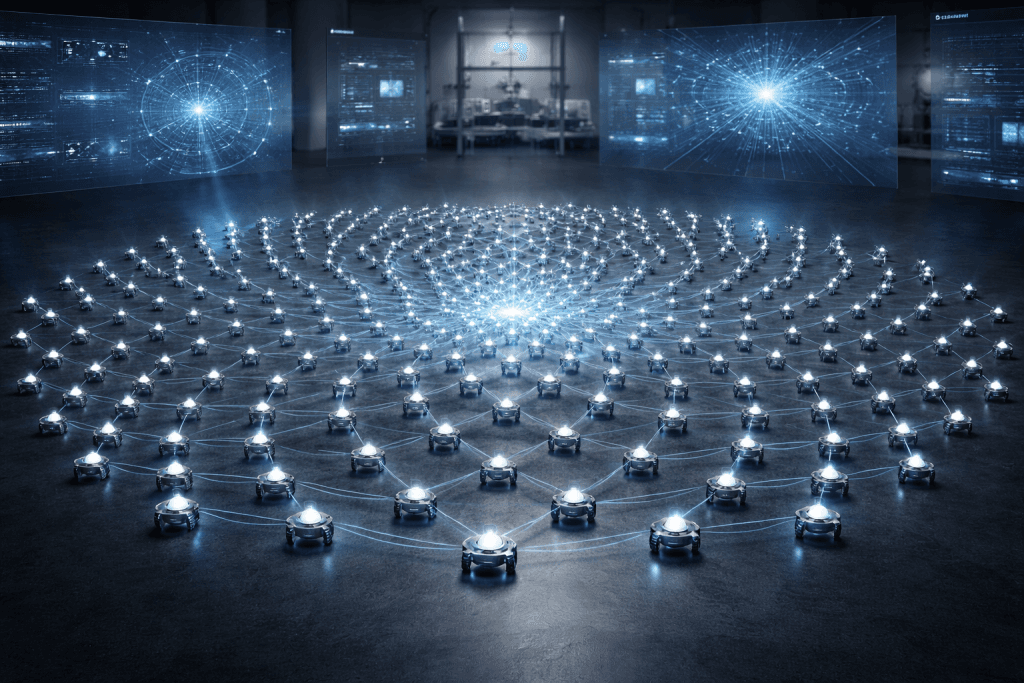
Swarm robotics represents a transformative approach to designing robotic systems, where coordination emerges from local interactions among large numbers of relatively simple, physically embodied agents. This field is fundamentally inspired by the collective intelligence observed in biological systems like ant colonies, bee hives, and bird flocks. At its core, swarm robotics investigates how desired collective behaviors such as exploration, pattern formation, or collective transport can arise not from a central command unit, but from the decentralized, self-organized actions of individual robots following basic rules.
The primary strength of this paradigm is its robustness and scalability; the system can adapt dynamically to changes, and the failure of individual units does not lead to systemic collapse. This introduction to swarm robotics establishes its foundational principles, which are essential for understanding its application in achieving sophisticated autonomous multi-agent collaboration (Şahin et al., 2007).
Foundational Principles and Design
The defining principles and design characteristics of swarm robotics systems are what enable their unique capabilities. These principles are primarily decentralization, self-organization, robustness, and scalability. In a swarm robotics system, there is no central controller dictating actions to every robot. Instead, each agent operates autonomously based on local information gathered from its sensors and from limited communication with its immediate neighbors. This local interaction, governed by simple rules (e.g., “maintain a minimum distance from neighbors” or “follow the strongest signal”), leads to self-organization, where coherent and functional global behavior emerges spontaneously. This structure inherently provides robustness; since no single robot is critical, the swarm can tolerate malfunctions and continue its task.
Furthermore, these systems are highly scalable, meaning that adding or removing agents does not require a redesign of the control architecture, allowing the swarm to efficiently operate at vastly different scales (Hamann, 2018). The hardware embodiment of these principles can be seen in platforms like the Kilobot, where hundreds of simple robots use infrared signals to coordinate movements, demonstrating how swarm robotics translates theory into physical reality.
Coordination and Communication Mechanisms
Effective collaboration in swarm robotics is facilitated by specific coordination and communication mechanisms. Agents primarily rely on local sensing using cameras, infrared, or proximity sensors and direct, short-range wireless communication to share basic data like position or simple states. A powerful concept borrowed from nature is stigmergy, or indirect coordination through the environment. For example, in a foraging task, a robot might deposit a virtual or physical marker at a resource location, which then probabilistically guides other robots to that spot, creating an efficient, self-reinforcing system (Al-Sahaf et al., 2024).
Task allocation is similarly decentralized, often emerging from the interactions of robots with the environment and each other based on their current state and simple rules, rather than being assigned by a supervisor. To engineer these behaviors, researchers implement bio-inspired algorithms. Prominent among these are Ant Colony Optimization (ACO), which mimics pheromone trail-laying for pathfinding, and Particle Swarm Optimization (PSO), inspired by the social motion of bird flocks. These algorithms provide the mathematical underpinning for the collective problem-solving that defines swarm robotics (Nguyen, 2024).
Key Application Domains
The practical applications of swarm robotics are vast and address complex real-world challenges across multiple domains. A primary application area is exploration and area coverage, which is critical for search and rescue in disaster zones, environmental monitoring, and precision agriculture. Here, a swarm can quickly disperse to cover a large, unknown area, using sensors to map terrain, locate survivors via thermal signatures, or assess crop health (Al-Sahaf et al., 2024). The decentralized nature of swarm robotics makes it ideally suited for these tasks, as the swarm can adapt its search pattern to obstacles and dynamically reallocate robots as needed.
In collective construction and manipulation, swarms can assemble structures or transport objects too large for a single robot, drawing inspiration from termites building mounds. In logistics and warehouse management, systems like Amazon’s Kiva robots exemplify how coordinated fleets can optimize inventory transport. Looking forward, swarm robotics principles are converging with advanced AI, such as Large Language Models (LLMs), to create next-generation multi-agent systems for telecommunications network management, where AI agents collaborate to optimize traffic and perform predictive maintenance (Tomás, 2024). These diverse applications underscore the versatility of the swarm robotics paradigm.
Current Challenges and Research Frontiers
Despite its promise, the development and deployment of swarm robotics systems face significant challenges that drive current research. A major hurdle is design and predictability: engineering simple local rules that reliably produce a desired, stable global behavior is non-trivial. The emergent properties of swarms can sometimes be unpredictable, necessitating advanced formal modeling and verification techniques to ensure safety and reliability (Hamann, 2018). Real-world robustness presents another challenge, as algorithms proven in simulation must contend with noisy sensor data, communication delays, and heterogeneous real-world environments.
Furthermore, as swarms grow, issues of scalable communication and avoiding interference or congestion become paramount. Finally, for swarms to interact safely and effectively with humans or other systems, robust methods for human-swarm interaction and interface design are required (Şahin & Spears, 2005). Addressing these challenges is essential for advancing swarm robotics from controlled laboratories to widespread, dependable real-world use.
Conclusion
In conclusion, swarm robotics offers a powerful and resilient framework for autonomous multi-agent collaboration by leveraging decentralization, self-organization, and bio-inspired intelligence. From foundational platforms like the Kilobot to sophisticated applications in agriculture, disaster response, and intelligent networks, the field demonstrates how complexity and capability can emerge from simplicity and local interaction. While challenges in design, predictability, and real-world integration remain active areas of research, the continued evolution of this field holds the potential to revolutionize how automated systems operate in dynamic, large-scale environments.
The journey of swarm robotics from a bio-inspired concept to a key enabling technology illustrates a fundamental shift in our approach to building collaborative intelligent systems.
References
Al-Sahaf, M., et al. (2024). A survey on swarm robotics for area coverage problem. Algorithms, 17(1), 3. https://doi.org/10.3390/a17010003
Hamann, H. (2018). Swarm robotics: A formal approach. Springer. https://doi.org/10.1007/978-3-319-74528-2
Milvus. (n.d.). How do multi-agent systems work in swarm robotics? Retrieved from https://milvus.io/ai-quick-reference/how-do-multiagent-systems-work-in-swarm-robotics
Nguyen, T. T. (2024). Swarm intelligence-based multi-robotics: A comprehensive review. AppliedMath, 4(4), 1192–1210. https://doi.org/10.3390/appliedmath4040064
Şahin, E., & Spears, W. M. (Eds.). (2005). Swarm robotics: SAB 2004 International Workshop, Santa Monica, CA, USA, July 17, 2004, revised selected papers. Springer. https://doi.org/10.1007/b105069
Şahin, E., Spears, W. M., & Winfield, A. F. T. (Eds.). (2007). *Swarm robotics: Second SAB 2006 International Workshop, Rome, Italy, September 30-October 1, 2006 revised selected papers*. Springer. https://doi.org/10.1007/978-3-540-71541-2
SuperAGI. (2025, June 20). From isolation to collaboration: The rise of multi-agent architectures in AI. Retrieved from https://superagi.com/from-isolation-to-collaboration-the-rise-of-multi-agent-architectures-in-ai/
Tomás, J. P. (2024, November 27). Multi-agent collaboration enables high-level autonomous networks. RCR Wireless. Retrieved from https://www.rcrwireless.com/20241127/5g/multiagent-collaboration