Supersonic Mars Landing: NASA’s Parachute Breakthrough
supersonic Mars landing has long been one of the most daunting challenges in space exploration. The Martian atmosphere is thin just 1 percent as dense as Earth’s making it notoriously difficult to slow down incoming spacecraft. Traditional parachutes simply cannot generate enough drag to decelerate large payloads safely. But NASA has achieved a major breakthrough. Through the Advanced Supersonic Parachute Inflation Research Experiment (ASPIRE) program, engineers have developed and tested parachute technology capable of deploying at supersonic speeds, paving the way for heavier rovers, sample return missions, and eventually human landings. This supersonic Mars landing capability represents a quantum leap in entry, descent, and landing (EDL) technology, transforming what is possible on the Red Planet (NASA, 2026; Research and Markets, 2026).
The Challenge of Landing on Mars
Every supersonic Mars landing attempt faces a fundamental physical problem. When a spacecraft enters the Martian atmosphere at speeds exceeding 12,000 miles per hour, it must slow to near zero in just a few minutes. The atmosphere is too thin for parachutes alone to do the job, yet thick enough to generate intense heating. This “Goldilocks” problem has limited Mars payloads to roughly one ton enough for a rover like Curiosity or Perseverance, but far short of what is needed for human missions or large-scale sample return (NASA, 2026; Baidu Baike, 2026).
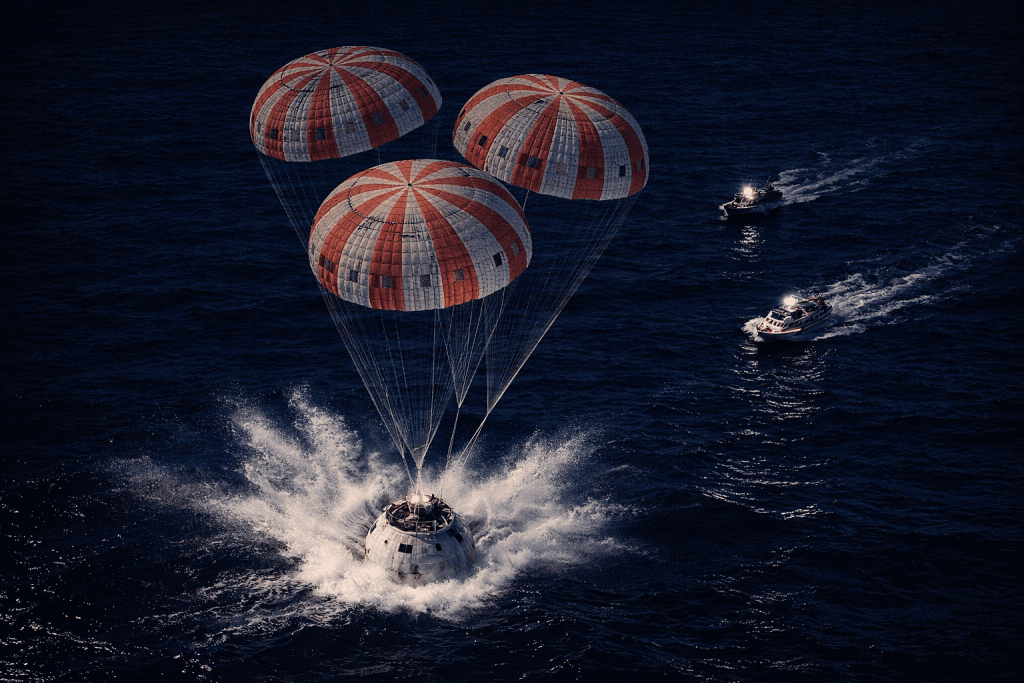
The solution requires a multi-stage deceleration system. A supersonic Mars landing typically begins with an aeroshell and heat shield to manage atmospheric entry heating. Once speeds drop to around Mach 2 to Mach 3, a supersonic parachute deploys to further slow the spacecraft. Finally, retro-rockets or airbags handle the terminal descent. The parachute phase has historically been the most failure-prone, with multiple test campaigns experiencing parachute shredding or failure to inflate (Spaceflight Now, 2015; Zero-G News, 2015).
The ASPIRE Program: Testing at the Edge of Space
NASA’s ASPIRE program was designed specifically to qualify supersonic parachute technology for demanding missions. Building on earlier Low-Density Supersonic Decelerator (LDSD) tests that encountered parachute failures, ASPIRE conducted a series of high-altitude tests from the Pacific Missile Range Facility in Kauai, Hawaii. The test vehicle, a rocket-powered, saucer-shaped craft, was lifted by a helium balloon to approximately 120,000 feet before firing its rocket motor to reach near-space altitudes and supersonic speeds (JAXA, 2025; Spaceflight Now, 2015).
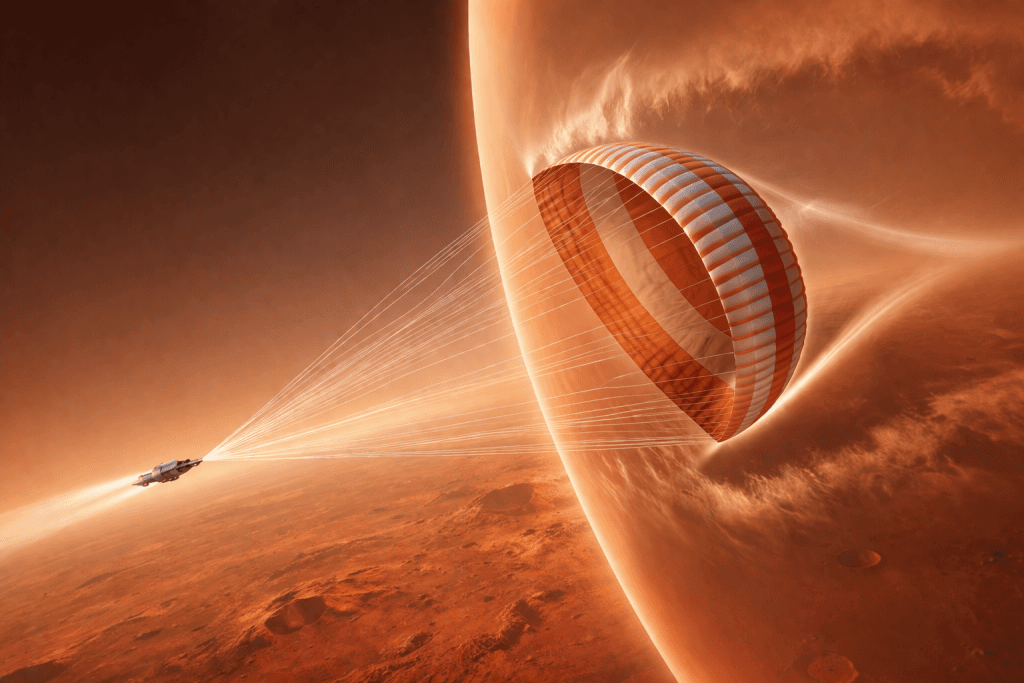
The ASPIRE-2 test, planned for early 2026, was designed to push the limits further. Engineers aimed to deploy the supersonic parachute at Mach 2.1 and under higher load conditions than any previous Mars mission. The parachute itself is a massive 100-foot diameter ringsail design the largest supersonic parachute ever built. Its surface area is twice that of the parachute used for the Mars 2020 Perseverance rover, yet it must deploy reliably at speeds exceeding 1,500 miles per hour (JAXA, 2025; Research and Markets, 2026).
The Breakthrough: Modeling and Simulation
A supersonic Mars landing depends not only on physical hardware but on sophisticated modeling and simulation. The ASPIRE-2 program developed new analytical frameworks to characterize parachute performance in dynamic environments. These models account for the complex interactions between the supersonic flow field, the parachute canopy, and the suspension lines physics that cannot be fully replicated in ground tests (JAXA, 2025).
The modeling work builds on previous frameworks from the 2017-2018 ASPIRE tests that qualified the Mars 2020 parachute. However, the requirements for future missions particularly Mars Sample Return and crewed landings demand higher fidelity simulations. Engineers had to develop new sensitivity analyses to understand how variations in atmospheric density, deployment timing, and parachute geometry affect overall system performance. This modeling capability is essential for certifying a supersonic Mars landing system before it flies (JAXA, 2025).
From Failure to Success
The path to a reliable supersonic Mars landing has been marked by spectacular failures. During early LDSD tests in 2014 and 2015, supersonic parachutes shredded or failed to inflate entirely. High-definition onboard video captured the moments when parachutes tore apart under the immense aerodynamic forces of supersonic deployment (Zero-G News, 2015; Azvision, 2015). NASA officials remained confident that the data from these failures would lead to design improvements. As one engineer noted, “We learn more from our failures than our successes” (Spaceflight Now, 2015).
The ASPIRE program successfully turned failure into success. By analyzing high-resolution video and telemetry from failed tests, engineers identified design flaws and implemented fixes. Subsequent tests demonstrated reliable deployment at supersonic speeds, qualifying the parachute for the Mars 2020 mission. Now, with ASPIRE-2, the technology is being pushed to even higher performance levels, ensuring that a supersonic Mars landing can accommodate the heavier payloads of the future (NASA, 2026; Research and Markets, 2026).
Market Growth and Commercial Interest
The breakthrough in supersonic Mars landing technology has sparked significant commercial interest. The Mars entry, descent, and landing (EDL) system market is projected to grow from $2.76 billion in 2026 to $4.54 billion by 2030, a compound annual growth rate of 13.2 percent (Research and Markets, 2026). Key drivers include increasing demand for crewed Mars landing systems, precision landing technologies, and reusable EDL components.
Major aerospace companies are investing heavily. SpaceX acquired Pioneer Aerospace Corporation in 2024 to bolster its parachute technology capabilities for Mars missions. Airbus has introduced new lander platforms featuring throttlable retro-propulsion systems for improved landing accuracy. Lockheed Martin, Northrop Grumman, and China Aerospace Science and Technology Corporation are also active in the EDL market, developing technologies that enable a supersonic Mars landing for their respective mission concepts (Research and Markets, 2026).
The Low-Density Supersonic Decelerator
The Low-Density Supersonic Decelerator (LDSD) project has been central to advancing supersonic Mars landing technology. The LDSD test vehicle is a saucer-shaped craft designed to test two key technologies: the Supersonic Inflatable Aerodynamic Decelerator (SIAD) and the supersonic ringsail parachute (Baidu Baike, 2026). The SIAD is a doughnut-shaped airbrake that inflates around the vehicle’s rim, increasing drag and slowing the spacecraft from Mach 3.5 to Mach 2 before parachute deployment.
The SIAD expands the vehicle’s diameter from approximately 15 feet to 26 feet, significantly increasing drag area. This technology is crucial for a supersonic Mars landing because it allows deceleration to begin at higher altitudes, where the atmosphere is thinner but aerodynamic forces are more manageable. After SIAD deployment, the massive 100-foot parachute deploys to complete the deceleration (Baidu Baike, 2026; Spaceflight Now, 2015).
Applications for Mars Sample Return
The primary driver for the ASPIRE-2 supersonic Mars landing technology is the Mars Sample Return campaign. This ambitious international effort, led by NASA and ESA, aims to collect rock and soil samples cached by the Perseverance rover and return them to Earth for analysis. The lander that will retrieve these samples must be significantly heavier than previous Mars landers, requiring advanced deceleration capabilities (JAXA, 2025).
A successful supersonic Mars landing is essential for the sample return lander. The mission architecture calls for the largest spacecraft ever sent to Mars, carrying both a sample retrieval rover and a Mars Ascent Vehicle to launch samples off the surface. Without the enhanced parachute and SIAD technologies, this lander would be too heavy to slow down safely. The ASPIRE-2 test campaign directly supports this mission, with the parachute scheduled to fly on the sample return lander (JAXA, 2025; NASA, 2026).
Crewed Mars Landing Systems
Looking further ahead, a supersonic Mars landing capability is a prerequisite for human missions. NASA’s current EDL technology limits Mars payloads to about one ton far short of the 20 to 50 tons needed for a crewed habitat, life support systems, and ascent vehicles. The parachute and SIAD technologies developed through LDSD and ASPIRE are critical stepping stones, but they alone cannot slow a human-scale lander (Research and Markets, 2026; Baidu Baike, 2026).
Future human missions will likely combine supersonic parachutes with supersonic retro-propulsion using rocket engines to slow the spacecraft while traveling at supersonic speeds. This approach, which SpaceX is developing for Starship, would reduce reliance on enormous parachutes. However, even with retro-propulsion, a supersonic Mars landing using advanced parachutes provides a critical backup and initial deceleration stage, reducing fuel requirements and increasing safety margins (Research and Markets, 2026).
European Contributions: ExoMars Landing Legs
While NASA focuses on supersonic parachutes, European engineers are advancing other aspects of Mars landing technology. The ExoMars Rosalind Franklin rover mission, scheduled for launch in 2028 with landing in 2030, features a sophisticated landing system including a supersonic parachute and four deployable landing legs. In January 2026, ESA released footage of drop tests conducted at ALTEC facilities in Turin, Italy, where a full-scale model of the landing platform was dropped onto simulated Martian surfaces (ESA, 2026).
The legs are lightweight, deployable, and equipped with shock absorbers to withstand impact. A sensor system in each leg detects when the spacecraft approaches the surface and triggers shutdown of the descent engines. These leg tests complement the supersonic Mars landing parachute work, ensuring that after the parachute slows the spacecraft, the final touchdown is safe and stable (ESA, 2026).
The Role of Supersonic Inflatable Decelerators
The SIAD technology tested alongside supersonic parachutes represents an alternative approach to a supersonic Mars landing. Unlike parachutes, which are limited in size by the need to pack them into tight spaces, inflatable decelerators can be made much larger. The SIAD tested in the LDSD program expanded the vehicle’s diameter from 15 to 26 feet a 70 percent increase in size and a corresponding increase in drag (Baidu Baike, 2026).
Future SIAD designs could be even larger. NASA has studied inflatable decelerators up to 50 feet in diameter, which would dramatically increase drag and allow deceleration at higher altitudes. This technology could eventually enable a supersonic Mars landing for human-scale payloads without requiring massive parachutes or excessive retro-propulsion fuel. The SIAD concept has also been proposed for Venus and Titan missions, where atmospheric conditions present different but equally challenging deceleration requirements (Baidu Baike, 2026; NASA, 2026).
Economic Impact and Global Competition
The global market for supersonic Mars landing technology extends beyond government space agencies. Private companies are developing commercial Mars missions, including telecommunications relay satellites, imaging services, and even private science landers. These ventures require EDL capabilities, driving demand for supersonic parachutes and related technologies (Research and Markets, 2026).
Asia-Pacific is projected to be the fastest-growing region for Mars EDL systems, driven by China’s ambitious space program. China has successfully landed rovers on Mars and is developing its own sample return mission, which will require advanced supersonic Mars landing capabilities. India, Japan, and the United Arab Emirates are also investing in Mars exploration, contributing to market growth (Research and Markets, 2026).
Conclusion
The supersonic Mars landing breakthrough achieved through NASA’s ASPIRE program represents decades of research, testing, and learning from failure. The 100-foot parachute, capable of deploying at Mach 2.1, is the largest and most capable ever built. Combined with inflatable decelerators and advanced modeling, this technology enables a new generation of Mars missions—from sample return to human landings. As the global space industry races toward the Red Planet, the ability to safely execute a supersonic Mars landing will be the foundation upon which all future successes are built.
References
Azvision. (2015, June 12). NASA parachute fails to inflate during Mars mission prep test. https://en.azvision.az/news/11922/nasa-parachute-fails-to-inflate-during-mars-mission-prep-test.html
Baidu Baike. (2026). 低密度超音速减速器 (Low-Density Supersonic Decelerator). https://baike.baidu.com/item/%E4%BD%8E%E5%AF%86%E5%BA%A6%E8%B6%85%E9%9F%B3%E9%80%9F%E5%87%8F%E9%80%9F%E5%99%A8/13679115
European Space Agency. (2026, January 21). Legs made for a Mars landing. https://www.esa.int/esatv/Videos/2026/01/Legs_made_for_a_Mars_landing
JAXA. (2025, January 27). *Advanced Supersonic Parachute Inflation Research Experiment-2 (ASPIRE2) parachute modeling and flight mechanics performance*. https://repository.exst.jaxa.jp/dspace/handle/a-is/1301877
NASA. (2026). Mars entry, descent, and landing. https://www.nasa.gov/mars-edl
Research and Markets. (2026, January 21). Advancements in supersonic parachute technology drive Mars market expansion. GlobeNewswire. https://www.globenewswire.com/news-release/2026/01/21/3222608/28124/en/Advancements-in-Supersonic-Parachute-Technology-Drive-Mars-Market-Expansion.html
Spaceflight Now. (2015, June 9). NASA confident in finding fix for test parachute failure. https://spaceflightnow.com/tag/ldsd/
Zero-G News. (2015, June 28). Success for NASA’s experimental supersonic “flying saucer”. http://www.zerognews.com/tag/ldsd/