Artemis II: NASA’s Bold Return To Crewed Lunar Flight
Artemis II represents humanity’s first return to deep space in over half a century. For the first time since Apollo 17 in 1972, humans will venture beyond low Earth orbit, setting a course for the Moon. This 10-day journey will carry four astronauts around our celestial neighbor, testing the systems that will one day take humanity to Mars. As the first crewed flight of NASA’s Artemis campaign, artemis II stands as a critical milestone not just for NASA, but for the future of human space exploration (NASA, 2025; BBC, 2026).
What Is Artemis II?
Artemis II is the second flight in NASA’s Artemis campaign, but it marks the first mission with humans aboard. Following the successful uncrewed Artemis I mission in November 2022, which sent an empty Orion capsule around the Moon to test the Space Launch System (SLS) rocket and spacecraft systems, artemis II will carry a crew of four astronauts on a lunar flyby trajectory (Manchester Evening News, 2026; ABC News, 2026).
The mission serves as a critical test flight, confirming that all systems and hardware are ready for human deep space exploration. Unlike Apollo missions that landed on the lunar surface, artemis II will loop around the Moon in a figure-eight trajectory, taking the astronauts thousands of kilometers beyond the far side before slinging them back to Earth (NASA, 2025). This path will potentially carry humans farther from Earth than ever before, surpassing the record set by Apollo 13’s crew of 400,171 kilometers (ABC News, 2026).
The Space Launch System and Orion Spacecraft
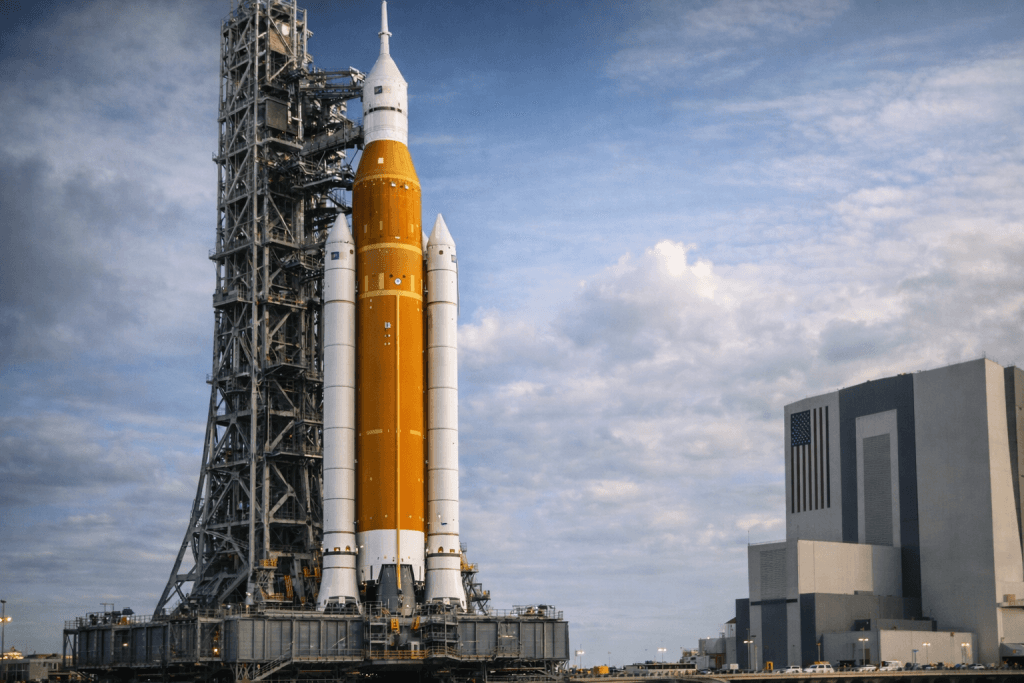
At the heart of artemis II stands the Space Launch System (SLS), the most powerful rocket ever built. Standing 322 feet tall approximately 30 stories the SLS rocket, combined with the Orion crew capsule, creates a vehicle capable of sending humans into deep space (CTV News, 2026; Sky News, 2026). The rocket uses components from NASA’s space shuttle program, which ended in 2011, but represents a significant evolution in heavy-lift capability (ABC News, 2026).
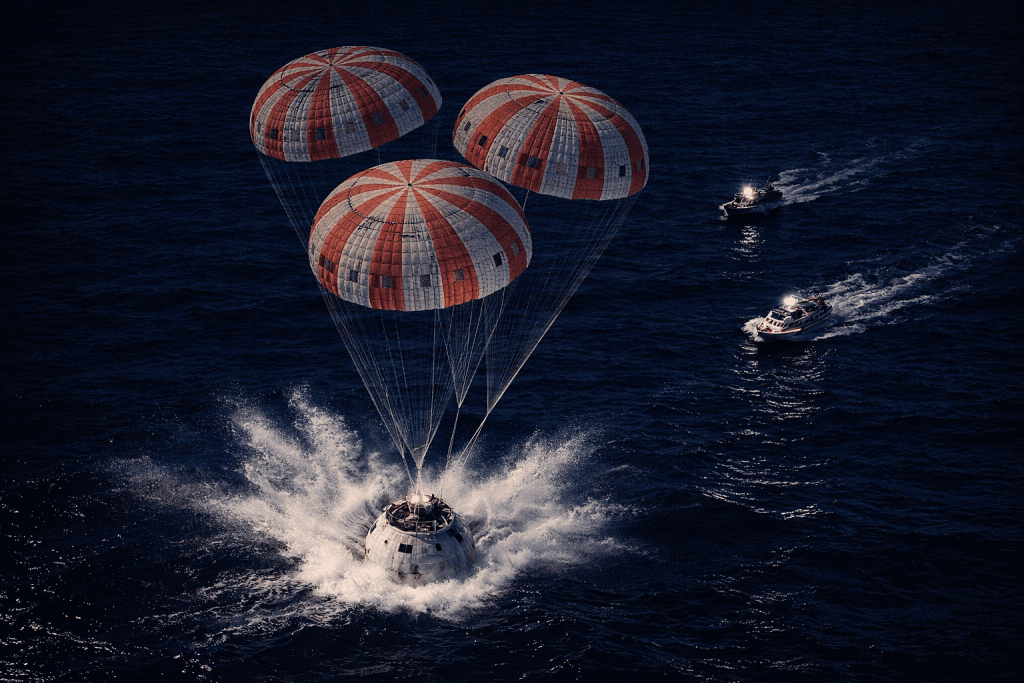
The Orion spacecraft has been specifically designed for deep space missions. It provides sleeping areas, food supplies, exercise equipment, and life support systems that will sustain the crew during their 10-day journey (Manchester Evening News, 2026). The capsule features a heat shield that must withstand temperatures reaching approximately 2,760 degrees Celsius during re-entry a system that experienced unexpected damage during Artemis I but has since been deemed safe for crewed flight (ABC News, 2026). The success of artemis II depends on the flawless integration of these complex systems.
Meet The Artemis II Crew
The four astronauts selected for artemis II represent a diverse and highly experienced team. NASA commander Reid Wiseman leads the mission, bringing experience from a 165-day stay aboard the International Space Station (ISS) in 2014, where he conducted spacewalks and hundreds of experiments (Manchester Evening News, 2026). Wiseman previously served as NASA’s Chief of the Astronaut Office, helping select and train future crews.
Victor Glover serves as the mission pilot, already making history as the first Black astronaut to live and work on the ISS. A former Navy test pilot, Glover completed four spacewalks during his six-month mission and later served as the key communicator between astronauts in space and mission control (Manchester Evening News, 2026). His extensive experience flying high-performance fighter jets and managing spacecraft systems makes him ideal for piloting Orion around the Moon.
Christina Koch, a mission specialist, holds the record for one of the longest spaceflights by a woman—328 consecutive days aboard the ISS. She participated in the first all-female spacewalks and has worked in extreme environments including Antarctica and the Arctic, preparing her for the challenges of deep space exploration (Manchester Evening News, 2026).
Canadian Space Agency astronaut Jeremy Hansen rounds out the crew as a mission specialist, making history as the first Canadian to fly to the Moon. A former fighter pilot, Hansen has never flown in space before, but brings years of preparation including extreme simulations living underwater and underground to mimic deep-space conditions (Manchester Evening News, 2026). His selection represents a major milestone for Canada’s space program and underscores the international collaboration at the heart of artemis II (CTV News, 2026).
Launch Preparations and Timeline
Artemis II has faced several delays due to technical issues. Originally scheduled for launch in February 2026, the mission was pushed back after engineers identified a hydrogen leak and helium flow problems during pre-launch testing (CTV News, 2026; Sky News, 2026). The rocket was returned to the Vehicle Assembly Building for repairs, where teams conducted multiple upgrades, battery replacements, and system checks (Mid-day, 2026).
In March 2026, NASA successfully rolled the SLS rocket and Orion spacecraft back to Launch Pad 39B at Kennedy Space Center in Florida. The four-mile journey took approximately 11 hours, with the crawler-transporter moving at roughly one mile per hour (CTV News, 2026; BERNAMA, 2026). The rollout was briefly delayed by high winds but proceeded successfully, marking a key milestone in final launch preparations (Mid-day, 2026).
The crew entered quarantine in Houston on March 18, 2026, limiting contact with others to ensure they remain healthy ahead of launch. They will travel to Kennedy Space Center approximately five days before liftoff to continue quarantine in astronaut crew quarters (Mid-day, 2026). NASA is now targeting a launch window from April 1 through April 6, 2026, with additional opportunities available through early April (CTV News, 2026; Sky News, 2026). Lori Glaze, acting associate administrator for NASA’s Exploration Systems Development Mission Directorate, expressed confidence in the timeline, stating, “At this point, we’re very focused on April” (BBC, 2026). The world waits as artemis II prepares for its historic flight.
Mission Objectives and Timeline
The 10-day artemis II mission follows a carefully planned trajectory. After launch, the crew will spend approximately 24 hours orbiting Earth, testing Orion’s life support, navigation, and communication systems while remaining close to home in case of emergency (Sky News, 2026). During this phase, the astronauts will manually pilot Orion for the first time, testing the steering and docking maneuvers needed for future lunar landings (Manchester Evening News, 2026).
Once systems are verified, Orion will fire its engines to begin the translunar injection, sending the crew on a four-day journey to the Moon. The spacecraft will loop around the far side of the Moon the side never visible from Earth traveling approximately 4,600 miles beyond the lunar surface (BBC, 2026). This trajectory will carry the astronauts into a region of space never visited by humans, potentially surpassing the distance record set by Apollo 13 (ABC News, 2026). The crew of artemis II will become the first humans to witness the far side of the Moon from close range.
After completing its lunar flyby, Orion will use the Moon’s gravity to slingshot back toward Earth. The capsule will re-enter Earth’s atmosphere at tremendous speed, with its heat shield facing temperatures of nearly 2,800 degrees Celsius before splashing down in the Pacific Ocean (ABC News, 2026). The mission will test critical systems including navigation, communication, life support, and manual flight controls—all essential for the subsequent artemis III mission, which aims to land astronauts on the lunar South Pole region (NASA, 2025).
Why Return To The Moon?
The Artemis program represents a fundamentally different approach to lunar exploration than the Apollo missions of the 1960s and 1970s. While Apollo was driven by Cold War competition and focused on “getting there first,” Artemis aims to establish a sustained human presence on the Moon, with the ultimate goal of preparing for missions to Mars (BBC, 2026).
The lunar South Pole region has become a primary target due to the presence of water ice detected in permanently shadowed craters. This water could be used for drinking, oxygen production, and even rocket fuel enabling refueling in space and dramatically reducing the cost of deep space missions (BBC, 2026). The Moon also contains valuable resources including metals like iron, aluminum, and titanium, as well as helium-3, a rare isotope that could potentially fuel future nuclear fusion reactors (BBC, 2026).
Artemis II is the critical stepping stone. As Namrata Goswami, author of “Scramble for the Skies,” explained to BBC, the mission is part of “a broader strategy to establish a permanent presence on the Moon and mine vital minerals” (BBC, 2026). The success of artemis II will pave the way for artemis III, currently targeted for 2028, which will land the first woman and the first person of color on the lunar surface (CTV News, 2026; NASA, 2025).
International Collaboration and Global Context
Artemis II exemplifies the power of international collaboration in space exploration. The crew includes astronauts from NASA and the Canadian Space Agency, and 61 nations have signed the Artemis Accords, an agreement governing the peaceful exploration and use of outer space (ABC News, 2026). Australia will play an essential role in tracking and supporting communications with artemis II via NASA’s Deep Space Network station at Tidbinbilla, providing capabilities including 4K video transmission, remote operations, and telemedicine support (ABC News, 2026).
However, the global context for lunar exploration has evolved significantly since the Apollo era. China has emerged as a major space power, with its Chang’e-4 mission becoming the first to land on the far side of the Moon in 2019. China aims to land astronauts on the Moon by 2030, while NASA targets 2028 for artemis III. Experts describe this as a new space race, though one with different stakes than the Cold War competition (BBC, 2026). India, Japan, and Russia are also developing lunar capabilities, adding to the growing international interest in the Moon.
Risks and Challenges
NASA officials have been candid about the risks involved in artemis II. John Honeycutt, chair of the Artemis II Mission Management Team, noted that historically, “one out of two is successful” when building new rockets, though he expressed confidence that NASA’s thorough testing and risk mitigation efforts put the mission in a much stronger position (BBC, 2026).
The heat shield remains a particular focus. During Artemis I, the Orion capsule’s heat shield experienced unexpected damage, raising concerns about its performance during crewed re-entry. NASA has conducted extensive analysis and determined the shield is safe for artemis II, though some in the space community remain cautious (ABC News, 2026).
NASA has also decided against conducting another wet dress rehearsal a pre-launch test where the rocket is filled with fuel and taken through the countdown sequence after the successful February rehearsal. “There’s not a lot more to be gained from that,” Glaze explained. “The next time we tank the vehicle will be when we’re attempting to launch” (BBC, 2026). The stakes for artemis II could not be higher.
Looking Ahead
The eyes of the world will be on Launch Pad 39B as artemis II prepares to lift off, marking humanity’s first return to deep space in more than 50 years. For the four astronauts, it represents the culmination of years of training and the beginning of a journey that will push the boundaries of human exploration. For Canada, Hansen’s flight represents a historic milestone. For NASA and its international partners, artemis II is proof that humanity is ready to venture farther than ever before.
As Australian astronaut Katherine Bennell-Pegg told ABC News, “I hope the whole of Australia is going to be looking up as humans go back out around the Moon for the first time in more than half a century. Let yourself be amazed by the things that humanity can do in times of international collaboration” (ABC News, 2026). The legacy of artemis II will inspire generations to come.
References
ABC News. (2026, February 19). NASA’s Artemis II mission set to send humans beyond the Moon. Here’s what you need to know. Australian Broadcasting Corporation. https://newsapp.abc.net.au/news/science/2026-02-21/artemis-2-mission-scheduled-to-launch-humans-moon-travel/106273572
BBC. (2026, March 11). Artemis II: Nasa targets early April for Moon mission. https://www.bbc.co.uk/news/articles/c4g8qp42rq6o
BBC News 中文. (2026, February 7). 我們為什麼要重返月球?新一輪太空競賽的利害關係是什麼? https://www.bbc.com/zhongwen/articles/cx2lx71ylplo/trad.amp
BERNAMA. (2026, March 21). NASA moves Artemis 2 rocket back to launch pad ahead of Moon mission. Malaysian National News Agency. https://web11.bernama.com/en/world/news.php?id=2536500
CTV News. (2026, March 20). Artemis II rocket arrives to launch pad after slow rollout ahead of April flight date. Vancouver Island. https://vancouverisland.ctvnews.ca/sci-tech/article/artemis-ii-rocket-arrives-to-launch-pad-after-slow-rollout-ahead-of-april-flight-date/
Manchester Evening News. (2026, February 1). Meet the four Artemis II astronauts about to travel beyond the Moon. https://www.manchestereveningnews.co.uk/news/world-news/artemis-ii-meet-four-astronauts-33349897
Mid-day. (2026, March 20). NASA rolls out Artemis II Space Launch System rocket for first crewed Moon mission; launch preparations underway. https://www.mid-day.com/amp/news/world-news/article/nasa-artemis-ii-rollout-space-launch-system-rocket-moves-to-launch-pad-for-crewed-moon-mission-23621759
NASA. (2025, September 21). Artemis II partnerships. https://www.nasa.gov/artemispartnerships/
Sky News. (2026, March 20). NASA prepares Artemis II launch-with rocket back on site and crew in quarantine. https://news.sky.com/story/nasa-prepares-artemis-ii-launch-with-rocket-back-on-site-and-crew-in-quarantine-13522109