
Apollo 16 Vs Artemis II: The Evolution Of Space Imaging
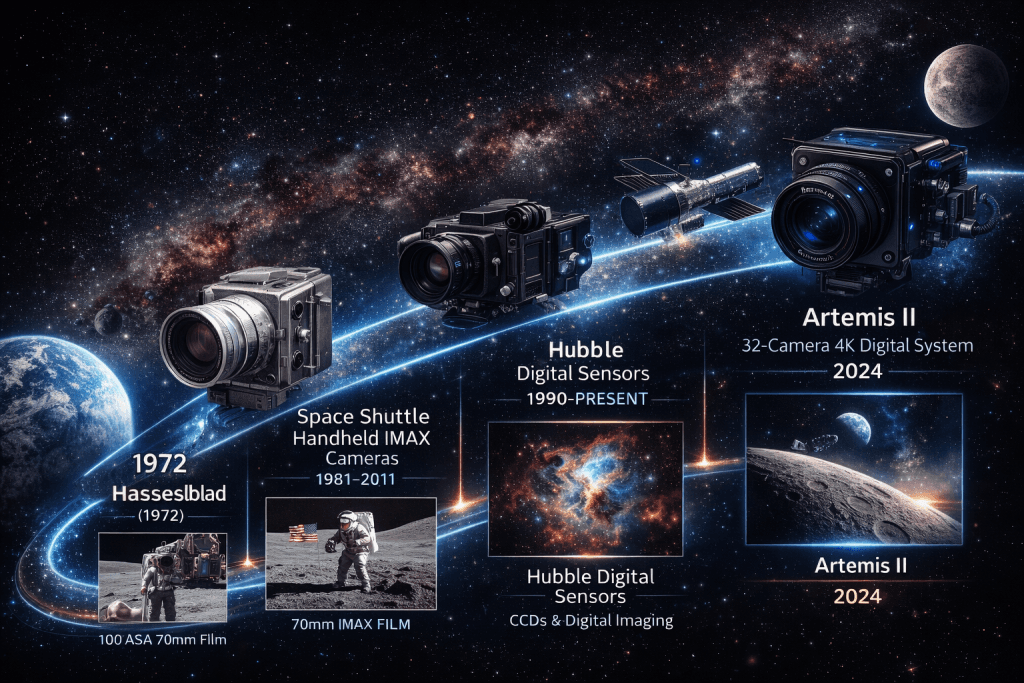
Apollo 16 vs artemis ii comparison reveals one of the most dramatic technological leaps in human history. Fifty-four years separate these two lunar missions, yet the difference in their imaging capabilities is measured not in decades but in quantum leaps of physics and engineering. Apollo 16, which launched on April 16, 1972, carried modified Hasselblad cameras loaded with 70mm film, capturing images that would not be seen until the astronauts returned to Earth (Lunar and Planetary Institute, n.d.). Artemis II, which launched in April 2026, carries 32 digital cameras streaming 4K video in real time from 400,000 kilometers away (Diario de Pontevedra, 2026). This evolution from apollo 16 vs artemis ii tells the story of how space photography transformed from a technical challenge into a global shared experience.
The Film Era: Apollo 16’s Imaging Arsenal
When examining apollo 16 vs artemis ii, the starting point is Apollo 16’s sophisticated for its time but primitive by today’s standards camera system. The mission carried multiple imaging systems, each designed for specific scientific and documentation purposes (Space Exploration Stack Exchange, n.d.). The workhorse was the electric 70mm Hasselblad camera, a modified commercial medium-format camera that astronauts operated while wearing bulky space suit gloves. These cameras used 70mm film, with image sizes of approximately 53 x 53 millimeters, capturing rich detail but requiring physical film return to Earth (Saunders, 2025).
The lunar surface Hasselblads were equipped with 60mm lenses and mounted on chest plates, as astronauts could not use traditional viewfinders through their helmets. They received special training to aim the cameras without visual confirmation (Space Exploration Stack Exchange, n.d.). A third Hasselblad with a 500mm telephoto lens allowed for more distant surface photography. Beyond the Hasselblads, Apollo 16 carried 16mm data acquisition cameras (DAC) for documenting operations, and a 35mm Nikon camera (DLR, n.d.).
In lunar orbit, Apollo 16 deployed even more sophisticated equipment. The panoramic camera used 24-inch focal length optics to capture high-resolution panoramas of the lunar surface with stereoscopic coverage, producing over 1,400 images from approximately 100 kilometers altitude (Lunar and Planetary Institute, n.d.). The Fairchild mapping camera provided metric photographs with 20-meter resolution, capturing over 2,000 images. The total photographic output was impressive: Hasselblad cameras alone exposed 31 film magazines, producing 3,999 photographs, while orbital cameras captured an additional 4,878 images (Lunar and Planetary Institute, n.d.).
The Digital Revolution: Artemis II’s Camera Network
The apollo 16 vs artemis ii comparison becomes staggering when examining Artemis II’s imaging systems. The Orion spacecraft carries 32 cameras and imaging devices, a number that includes any instrument with a lens capable of capturing photos or video (Diario de Pontevedra, 2026). Fifteen cameras are mounted directly on the spacecraft, while 17 are portable cameras operated by the crew of four astronauts.
Redwire Corporation, a Florida-based space technology company, is responsible for the Orion Camera System for Artemis missions I through V (Redwire Corporation, 2026). The system comprises 11 internal and external inspection and navigation cameras, including wireless cameras positioned on each of Orion’s four solar arrays, allowing complete in-flight inspection of the entire spacecraft. These cameras record 4K video and 12-megapixel images, streaming live both inside and outside the vehicle throughout the mission (Redwire Corporation, 2026).
The Optical Navigation Camera provides high-resolution imagery to the spacecraft’s machine vision algorithm, enabling Orion to determine its position and velocity relative to Earth autonomously (Redwire Corporation, 2026). This represents a fundamental shift from apollo 16 vs artemis ii: Apollo astronauts manually calculated navigation, while Artemis uses cameras as sensors for autonomous positioning.
GoPro cameras have also flown on Artemis II, with four specialized modified units mounted on the solar array wings, capturing high-resolution views of the spacecraft, Earth, and the Moon while serving as inspection tools during critical mission events (Diario de Pontevedra, 2026). National Geographic equipped the astronauts with additional GoPro cameras to document daily life inside Orion, helping narrate this historic flight.
Real-Time Streaming vs. Film Return
Perhaps the most dramatic difference in apollo 16 vs artemis ii is how images reach Earth. Apollo 16’s film had to physically return with the command module, requiring days before anyone saw the photographs. Even then, images required chemical development, processing, and careful handling in clean rooms (Saunders, 2025).
Artemis II streams live 4K video from 406,773 kilometers away, the farthest distance ever traveled from Earth by humans (Diario de Pontevedra, 2026). Within hours of launch, Commander Reid Wiseman captured and shared a viral photograph of the complete Earth, showing blue oceans, white cloud swirls, and the brown landmass of Africa, an image evoking the iconic “Blue Marble” captured by Apollo 17 over half a century ago. NASA immediately shared this image on social media, side by side with the 1972 photograph, demonstrating the apollo 16 vs artemis ii evolution in real time.
Scientific Imaging Beyond Photography
The apollo 16 vs artemis ii comparison extends beyond visible light photography into scientific imaging that was impossible in 1972. Artemis II carries six Timepix chips developed at CERN, forming part of NASA’s Hybrid Electronic Radiation Assessor (HERA) system (CERN, 2026). These hybrid pixel detectors, originally designed for particle physics experiments at the Large Hadron Collider, measure the composition, intensity, and energy of incoming radiation particles in real time.
Each Timepix chip consists of a matrix of pixels capable of detecting individual particles and measuring the energy they deposit. Combined with characteristic track shapes left in the sensor, this allows different types of radiation to be identified (CERN, 2026). As Artemis II travels beyond Earth’s geomagnetic field and through the Van Allen radiation belts, these chips provide real-time radiation data essential for protecting both crew and electronics. This represents a dimension of apollo 16 vs artemis ii that could not have been imagined in 1972: imaging invisible particles to ensure crew safety.
Public Engagement and Accessibility
The apollo 16 vs artemis ii comparison also reveals a profound shift in who can experience space. Apollo-era photographs were processed, curated, and released by NASA’s public affairs office, often days or weeks after missions (Saunders, 2025). The public saw what officials selected. Artemis II’s live streams and social media sharing allow anyone with an internet connection to witness the journey in real time.
Mike Gold, President of Redwire Space, captured this transformation when he said, “We can’t all be astronauts, but through the amazing imagery that our cameras will capture, the whole world can be a part of the extraordinary journey of discovery that is Artemis II” (Redwire Corporation, 2026). The apollo 16 vs artemis ii comparison shows that space imaging has evolved from a technical documentation tool into a bridge connecting humanity to the cosmos.
The Human Element: Astronauts as Photographers
In the apollo 16 vs artemis ii comparison, the role of the astronaut-photographer has transformed. Apollo astronauts received basic photography training, but operating cameras in bulky suits without viewfinders was challenging (Space Exploration Stack Exchange, n.d.). The iconic Earthrise and Blue Marble images were partly accidental, captured at moments when astronauts happened to look out windows at the right time.
Artemis II astronauts have extensive photography training, operating modern digital cameras with intuitive interfaces. The 17 portable cameras allow them to document their journey creatively, sharing selfies, Earth views, and spacecraft interiors. This shift from apollo 16 vs artemis ii reflects a broader change: astronauts are no longer just test pilots or scientists but storytellers, sharing their personal experiences with a global audience.
Technical Specifications Comparison
A direct apollo 16 vs artemis ii technical comparison illustrates the quantum leap:
| Specification | Apollo 16 | Artemis II |
|---|---|---|
| Primary Cameras | 70mm Hasselblad (film) | Redwire 4K digital |
| Total Imaging Devices | Approximately 8 | 32 |
| Resolution | 53mm film frame | 12 megapixels, 4K video |
| Live Streaming | None | Real-time 4K from 400,000 km |
| Navigation Imaging | Manual star sightings | Optical navigation camera with AI |
| Radiation Imaging | Passive dosimeters | CERN Timepix active detectors |
| Public Access | Days after return | Instant global streaming |
The Legacy and Future
The apollo 16 vs artemis ii comparison demonstrates how space imaging has evolved from a supporting tool to a primary mission function. Apollo 16’s cameras documented scientific discovery. Artemis II’s cameras are integrated into navigation, safety, public engagement, and scientific research. The 32 imaging systems on Orion serve purposes ranging from solar array inspection to radiation monitoring to viral social media content.
As humanity prepares for Artemis III’s lunar landing and eventual Mars missions, imaging technology will continue to advance. The apollo 16 vs artemis ii comparison shows that in just over five decades, we have moved from film canisters to live 4K streaming. The next half century promises even more remarkable advances, perhaps virtual reality experiences from the lunar surface or holographic transmissions from Mars. But the fundamental shift from apollo 16 vs artemis ii is already clear: space imaging is no longer about what we bring back. It is about what we share, in real time, with the entire world.
References
CERN. (2026, April 1). CERN Timepix chips fly to the Moon. https://home.cern/news/news/knowledge-sharing/cern-timepix-chips-fly-moon
Diario de Pontevedra. (2026, April 4). Las 32 cámaras de Orión, los ojos que capturan el éxito de la misión Artemis II. https://www.diariodepontevedra.es/articulo/mundo/32-camaras-orion-ojos-que-capturan-exito-mision-artemis-ii/202604051538021441317.html
DLR. (n.d.). Apollo 16. Deutsches Zentrum für Luft- und Raumfahrt. https://raumfahrtmissionen.dlr.de/programme/28-apollo-16
Lunar and Planetary Institute. (n.d.). *Apollo mission lunar photography index maps – Apollo 16*. https://www.lpi.usra.edu/resources/mapcatalog/apolloindex/apollo16/
Redwire Corporation. (2026, April 1). Redwire to supply optical imaging and sun sensor systems for NASA’s Artemis II Orion mission. SatNow. https://www.satnow.com/news/details/4958-redwire-to-supply-optical-imaging-and-sun-sensor-systems-for-nasa-s-artemis-ii-orion-mission
Saunders, A. (2025, May 6). 太空摄影的发展 (伊岚, Trans.). The Paper. https://m.thepaper.cn/newsDetail_forward_30770190
Space Exploration Stack Exchange. (n.d.). What specific camera equipment was used on Apollo 16? https://space.stackexchange.com/questions/67670/what-specific-camera-equipment-was-used-on-apollo-16