Neuromorphic Computing: Brain-Inspired Future of AI
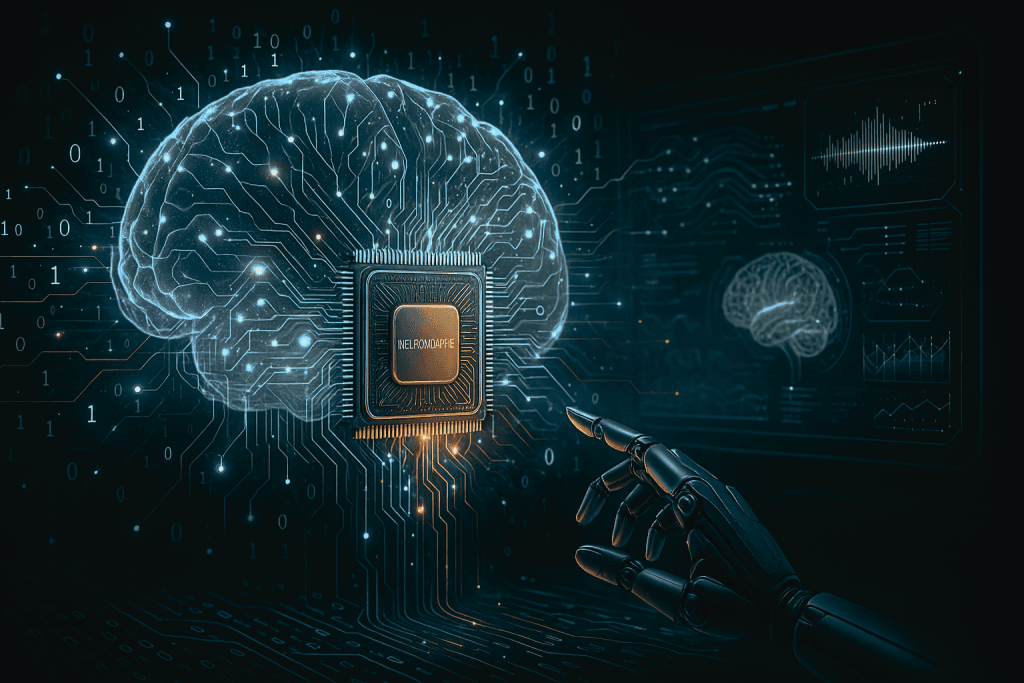
Neuromorphic computing is emerging as a groundbreaking frontier in artificial intelligence. Inspired by the architecture of the human brain, it promises to revolutionise the way machines process information. As demand for real-time, energy-efficient, and adaptive systems increases, this brain-inspired approach is becoming essential for next-generation AI.
Unlike traditional systems that rely on the von Neumann architecture, it integrates memory and processing into one unit. This allows parallel processing and efficient learning without consuming excessive energy. It’s an ideal solution for autonomous vehicles, edge AI, robotics, and low-power smart devices (Schuman et al., 2017).
The term was coined in the 1980s by Carver Mead, who envisioned hardware that could mimic the brain’s structure and behaviour. Today, innovations like Intel’s Loihi (Davies et al., 2018) and IBM’s TrueNorth (Merolla et al., 2014) chips are turning that vision into a reality. These chips function more like a human brain than a traditional computer, making them suitable for dynamic, responsive applications.
What Makes Neuromorphic Computing Different?
The brain is a highly efficient, parallel-processing machine. It has billions of neurons that communicate through spikes or pulses. Neural-inspired technology mirrors this with spiking neural networks (SNNs), which use event-based communication. This means power is only consumed when information is being processed (Schemmel et al., 2010).
In conventional AI systems, power consumption and data bottlenecks are major concerns. Data moves back and forth between the CPU and memory, leading to latency and inefficiencies. Neuromorphic chips, however, integrate memory and processing, significantly reducing delays and power use (Furber et al., 2014).
These systems operate asynchronously, just like the brain. They can process information as it arrives, making them ideal for environments where real-time decision-making is critical.
Advantages of Neuromorphic Computing
Energy Efficiency
This brain-inspired technology offers a significant advantage in power consumption. Traditional deep learning models require vast amounts of computing power and energy. In contrast, these systems can operate on minimal power, making them suitable for battery-powered devices and energy-conscious applications (Davies et al., 2018).
Real-Time Processing
With the ability to process multiple streams of data simultaneously, it supports real-time applications. This includes speech recognition, robotics, and autonomous systems, where immediate feedback is essential.
Adaptive Learning
Neuromorphic systems can learn from data continuously without the need for retraining from scratch. This continuous learning capability mirrors how humans adapt to new information and environments. It’s particularly useful in applications like robotics, where machines must react and evolve in dynamic settings (Merolla et al., 2014).
Robustness
Brain-mimicking systems are naturally fault-tolerant. Since they operate with parallel pathways and decentralised architectures, a failure in one part doesn’t halt the entire system. This is especially useful for mission-critical tasks like space exploration or disaster response.
Key Applications
Autonomous Systems
Self-driving cars and drones need to process vast amounts of sensory data in real time. Neuromorphic chips provide the responsiveness and low power usage required for these systems to function reliably and safely (Schuman et al., 2017).
Healthcare and Biomedical Devices
Smart prosthetics, brain-machine interfaces, and diagnostic tools benefit greatly from neural-mimicking processors. These systems can interpret neural signals and adapt to users in real time, enabling personalised and responsive medical devices.
Edge AI and IoT
The growth of smart devices demands on-device intelligence that doesn’t rely on cloud computing. Neuromorphic computing allows devices to process data locally, reducing latency and preserving bandwidth.
Cognitive Robotics
Robots working in unpredictable environments like warehouses or rescue zones must learn and adapt continuously. Neuromorphic systems provide the flexibility and learning ability that traditional systems lack.
Challenges and Limitations
Designing hardware that replicates biological neurons is complex. Materials science, nanoelectronics, and neuroscience must converge to make truly effective neuromorphic chips (Schemmel et al., 2010).
Moreover, current programming tools are not yet optimised for this architecture. Developers need new frameworks and software environments to take full advantage of neuromorphic capabilities. Integration with existing AI systems also requires effort, as most tools are designed for conventional CPUs and GPUs.
There is also the question of standards. With various companies developing their own versions of neuromorphic systems, a lack of standardisation could slow down adoption and compatibility (Schuman et al., 2017).
The Future of Neuromorphic Computing
Despite these hurdles, momentum is growing. Companies like Intel, IBM, and startups such as BrainChip are investing heavily in neuromorphic computing technologies. Their goal is to build systems that are not only powerful but also efficient and adaptable (Davies et al., 2018).
Innovations in materials like memristors, as well as improvements in brain-inspired algorithms, are pushing the field forward. As these technologies mature, neuromorphic computing is expected to integrate seamlessly with other emerging technologies such as quantum computing, 5G networks, and advanced robotics.
As AI becomes more embedded in our lives, from smart homes to industrial automation, neuromorphic computing may well become its foundational platform. Its ability to process information efficiently, learn in real time, and operate at low power makes it the ideal solution for the future.
Conclusion
Neuromorphic computing marks a significant shift in how we design and deploy artificial intelligence. By mimicking the human brain, it opens up new possibilities for real-time processing, energy efficiency, and adaptive learning. From autonomous vehicles and healthcare to edge AI and robotics, this technology is laying the groundwork for smarter, more resilient systems.
As research continues and the technology becomes more accessible, neuromorphic computing will likely move from specialised labs to mainstream applications. It’s not just a concept for the future it’s the next step in making AI more human.
References
Davies, M., Srinivasa, N., Lin, T.-H., Chinya, G., Cao, Y., Choday, S. H., Dimou, G., Joshi, P., Imam, N., Jain, S., Liao, Y., Lin, C.-K., Lines, A., Liu, R., Mathaikutty, D., McCoy, S., Paul, A., Tse, J., Venkataramanan, G., … Wang, Y. (2018). Loihi: A neuromorphic manycore processor with on-chip learning. IEEE Micro, 38(1), 82–99. https://doi.org/10.1109/MM.2018.112130359
Furber, S. B., Galluppi, F., Temple, S., & Plana, L. A. (2014). The SpiNNaker project. Proceedings of the IEEE, 102(5), 652–665. https://doi.org/10.1109/JPROC.2014.2304638
Merolla, P. A., Arthur, J. V., Alvarez-Icaza, R., Cassidy, A. S., Sawada, J., Akopyan, F., Jackson, B. L., Imam, N., Guo, C., Nakamura, Y., Brezzo, B., Vo, I., Esser, S. K., Appuswamy, R., Taba, B., Amir, A., Flickner, M. D., Risk, W. P., Manohar, R., & Modha, D. S. (2014). A million spiking-neuron integrated circuit with a scalable communication network and interface. Science, 345(6197), 668–673. https://doi.org/10.1126/science.1254642
Schuman, C. D., Potok, T. E., Patton, R. M., Birdwell, J. D., Dean, M. E., Rose, G. S., & Plank, J. S. (2017). A survey of neuromorphic computing and neural networks in hardware. arXiv. https://arxiv.org/abs/1705.06963
Schemmel, J., Briiderle, D., Griibl, A., Hock, M., Meier, K., & Millner, S. (2010). A wafer-scale neuromorphic hardware system for large-scale neural modeling. Proceedings of the 2010 IEEE International Symposium on Circuits and Systems (ISCAS), 1947–1950. https://doi.org/10.1109/ISCAS.2010.5536970