
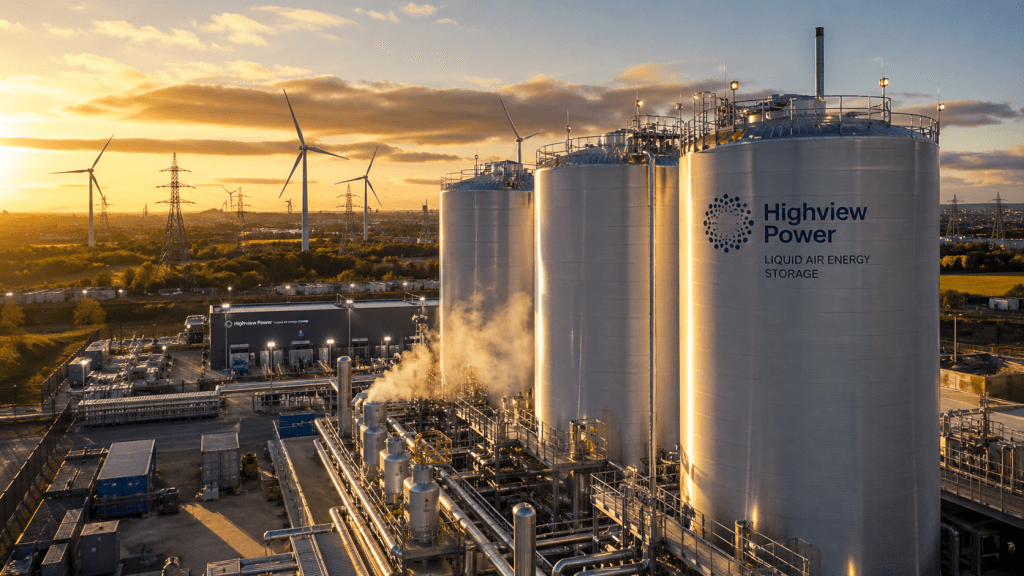
Highview Power’s Liquid Air Energy Storage Breakthrough
Liquid air energy is emerging as a game-changing solution for one of the most pressing challenges of the renewable energy transition: long-duration energy storage. Highview Power, a British company that has spent 17 years developing its proprietary cryogenic storage technology, is now bringing the world’s largest commercial-scale liquid air energy storage facilities online in the United Kingdom and China. As wind and solar power expand rapidly, the need to store excess energy for hours or even days has become critical. Liquid air energy offers a unique advantage: it can store renewable power for weeks, provide grid stability services, and operate without degradation for up to 50 years. This breakthrough is finally moving from pilots to scaled-up commercial viability, with major projects in Manchester and the Gobi Desert set to begin operations in 2026 (Forbes, 2026; Highview Power, 2025a).
How Liquid Air Energy Storage Works
Liquid air energy storage technology is rooted in established cryogenic engineering. The process begins when surplus electricity typically generated from renewables like wind or solar is used to power a liquefier that cools atmospheric air to minus 196 degrees Celsius. At this temperature, air becomes a liquid, shrinking in volume by a factor of approximately 750 (Forbes, 2026). This liquid air is stored in insulated, low-pressure tanks until electricity demand increases.
When power is needed, the liquid air is pumped to high pressure and reheated. As it warms, it expands rapidly back into a gas, and this expansion drives turbines that generate electricity. The entire process produces no combustion and no direct emissions. What makes liquid air energy particularly valuable is that it can provide synchronous generation spinning machinery that delivers grid inertia and stability services even when the plant is operating at zero megawatts (cold-facts.org, 2026). This capability is becoming increasingly important as conventional thermal power plants retire.
The Carrington Manchester Facility
The flagship project demonstrating liquid air energy’s commercial potential is located in Carrington, near Manchester, England. Mayor Andy Burnham officially broke ground at the Trafford Low Carbon Energy Park in November 2025 (Highview Power, 2025b). The Carrington plant will deliver 300 megawatt-hours of storage with an output of 50 megawatts for six hours—enough clean energy to power approximately 480,000 homes (Highview Power, 2025b). The facility connects to existing transmission infrastructure and includes a “stability island” designed to stabilize the local grid against outages and blackouts.
Construction is well underway, with the facility expected to be operational by late 2026 (cold-facts.org, 2026). The project has attracted over £500 million in funding from investors including the National Wealth Fund, Centrica, Rio Tinto, Goldman Sachs, and KIRKBI (Centrica, 2025; National Wealth Fund, 2024). This liquid air energy facility builds on more than a decade of development work, including pilot and demonstration plants that validated the technology cycle and informed system design (cold-facts.org, 2026).
The Gobi Desert Super Power Bank
While the Manchester plant captures attention in Europe, an even larger liquid air energy project is rising in China’s Gobi Desert. Located outside Golmud in Qinghai province, the 60-megawatt storage project has been coined a “super air power bank” (Forbes, 2026). It takes surplus, unused power from a vast solar photovoltaic farm and converts it into liquid air. The system can deliver up to 600,000 kilowatt-hours (kWh) of electricity and run fully for up to 10 hours.
Maxime Johnson of Alfa Laval, which acquired the French company providing heat exchangers to the Gobi Desert project, noted that interest in liquid air energy has always existed, but what was lacking was scale. “That is now coming in China and the UK everyone is watching and this could spark a big wave of investment” (Forbes, 2026). This liquid air energy facility demonstrates how the technology can be paired directly with solar generation in some of the world’s sunniest locations.
The Hunterston Millennium Series
Highview Power is not stopping with Carrington. The company has secured an additional £130 million in funding to commence work on the first stage of its planned 3.2-gigawatt-hour hybrid long-duration energy storage solution at Hunterston, Scotland (Centrica, 2025). The Hunterston facility kicks off deployment of Highview’s Millennium Series, which will include further plants across the UK. The facility will combine liquid air energy storage with lithium-ion batteries for greater operational performance and flexibility.
The Hunterston facility will be located on the Peel Ports site in North Ayrshire and is expected to support 1,000 jobs onsite during construction and 650 jobs in the supply chain (Centrica, 2025). Once complete, it will deliver enough clean electricity to power around 650,000 homes for up to 12.5 hours. A second facility of similar scale is planned at Killingholme, Lincolnshire. Both projects have been deemed eligible for support under the UK’s “cap and floor” funding mechanism, designed to de-risk and attract private sector backing for long-duration energy storage (Forbes, 2026).
Why Liquid Air Energy Matters Now
The urgency behind scaling liquid air energy technology stems from a fundamental challenge in renewable energy systems. As wind and solar capacity grows, periods of excess generation are becoming more frequent, leading to negative electricity prices and wasted clean power. In Europe, frequent negative prices for renewables have been linked to insufficient storage capacity (Forbes, 2026). At the same time, when the wind doesn’t blow or the sun doesn’t shine, grids have traditionally fallen back on fossil fuels.
Dom Walters, Chief of Corporate Affairs at Highview Power, explained the competitive advantage: “While batteries are good at short-term storage, they don’t do long duration because the harder you work them, the faster they degrade so over time they are an expensive resource. We are here, we have done the pilots, we are proven” (Forbes, 2026). This liquid air energy solution can store energy for weeks, not just hours, and can operate without degradation for between 40 and 50 years (Highview Power, 2025b).
Grid Stability and Synchronous Inertia
One of the most valuable features of liquid air energy storage is its ability to provide grid stability services. Unlike battery storage systems that rely on power inverters, Highview Power’s design uses synchronous generation. The synchronous generator can provide grid inertia and voltage support even when the plant is operating at zero megawatts, achieved through mechanical decoupling using a clutch system (cold-facts.org, 2026).
This capability is becoming increasingly critical as coal and gas plants retire. These traditional power plants provided inertia to the grid automatically. Liquid air energy facilities can fill this gap while also delivering energy storage. As Mark Vyvyan Robinson, Business Development Director at Highview Power, noted, this capability is not available in inverter-based storage technologies and is becoming increasingly important for grid reliability (cold-facts.org, 2026).
Global Expansion and Investment
The success of liquid air energy is attracting global attention. South Korea’s Institute for Advanced Engineering, in collaboration with Alfa Laval, is deploying the country’s first large-scale liquid air energy storage plant to help meet new climate targets (Forbes, 2026). Sumitomo Heavy Industries, a long-term investor and technology partner since 2020, is constructing a commercial demonstration plant based on Highview’s technology at Hiroshima Gas Hatsukaichi plant in Japan (Sumitomo Heavy Industries, 2024).
Julia Souder, CEO of the Long Duration Energy Storage Council, said liquid air energy and similar technologies are being commercially deployed worldwide. “It is increasingly seen as essential economic infrastructure, not a niche energy technology” (Forbes, 2026). According to recent reports, with the right policy and financial support, costs of longer storage technologies could decline by up to 47 percent by 2030. Scaled deployment could represent a $4 trillion investment opportunity by 2040, triggering up to $540 billion in savings across global energy systems (Forbes, 2026).
Locational Flexibility and Scalability
Unlike pumped hydro storage, which requires significant elevation differences, or compressed air storage, which depends on suitable underground caverns, liquid air energy facilities can be located wherever grid needs are greatest. This locational flexibility allows projects to be integrated directly into transmission networks without geological constraints (cold-facts.org, 2026).
The technology is also highly scalable. The Carrington facility represents the first commercial-scale plant, but Highview Power has already announced plans for much larger 3.2-gigawatt-hour facilities. The levelized cost of storage for a 10-hour, 200-megawatt system is approximately £110 per megawatt-hour, offering a competitive alternative to other long-duration storage technologies (Highview Power, 2025c). This makes liquid air energy a compelling option for utilities and grid operators seeking to balance renewable generation.
Policy Support and Market Mechanisms
Government policies have played a crucial role in unlocking the potential of liquid air energy. The UK government’s current goal is to have around 20 gigawatts of short-duration and 20 gigawatts of long-duration energy storage capacity to support the growth of renewables (Forbes, 2026). Over several years, UK government-backed pilots have helped test Highview Power’s technology, including a £10 million grant in 2020.
The UK’s energy regulator Ofgem has announced that the Hunterston and Killingholme projects are eligible for support under the “cap and floor” scheme, a new funding mechanism designed to de-risk and attract private sector backing for long-duration energy storage projects (Forbes, 2026). This policy framework provides revenue stability over long operating lifetimes, making it easier to finance multi-billion-pound infrastructure projects.
The Road Ahead
As the Carrington and Gobi Desert projects come online in 2026, liquid air energy will move from demonstration to mainstream deployment. The technology addresses the critical missing piece in renewable energy systems: the ability to store clean power for days or weeks, not just hours. With over £500 million raised, global expansion underway, and strong policy support, liquid air energy is poised to play a major role in the energy transition. Dom Walters captured the moment: “We are here, we have done the pilots, we are proven” (Forbes, 2026).
References
Centrica. (2025, November 10). Highview surpasses half a billion pounds of funding. https://editor.centrica.com/media-centre/news/2025/highview-surpasses-half-a-billion-pounds-of-funding/
cold-facts.org. (2026, March 10). Liquid air comes of age in Manchester. https://cold-facts.org/2026/03/10/liquid-air-comes-of-age-in-manchester/
Forbes. (2026, April 18). Liquid air: Heralding a breakthrough for long duration energy storage? https://www.forbes.com/sites/we-dont-have-time/2026/04/18/liquid-air-heralding-a-breakthrough-for-long-duration-energy-storage/
Highview Power. (2025a, October 27). Highview Power to develop multiple cryogenic energy storage facilities in the UK and to build Europe’s largest storage system. https://highviewpower.com/news-announcements/highview-power-to-develop-multiple-cryogenic-energy-storage-facilities-in-the-uk-and-to-build-europes-largest-storage-system/
Highview Power. (2025b, November 23). Mayor of Greater Manchester Andy Burnham officially breaks ground on Highview’s pioneering liquid air energy storage facility in Carrington, Manchester. https://highviewpower.com/news-announcements/mayor-of-greater-manchester-andy-burnham-officially-breaks-ground-on-highviews-pioneering-liquid-air-energy-storage-facility-in-carrington-manchester/
National Wealth Fund. (2024, June 13). *UK Infrastructure Bank backs Highview Power with £165 million to deliver cutting edge long-duration energy storage facility*. https://www.nationalwealthfund.org.uk/news-and-publications/news/uk-infrastructure-bank-backs-highview-power-with-165-million-to-deliver-cutting-edge-long-duration-energy-storage-facility/
Sumitomo Heavy Industries. (2024, June 19). Highview Enterprise Limited completed funding for LAES plant. https://www.shi.co.jp/english/info/2024/6kgpsq0000003l7o.html