Compact Fusion Reactors: Powering the Future with Portable Nuclear Innovation
As the global energy system undergoes one of the most significant transitions in human history, the demand for reliable, clean, and decentralised power sources has never been greater. Renewable technologies such as solar, wind, and hydro have made remarkable strides, yet they face inherent intermittency and geographic limitations. Energy storage solutions are improving, but scaling them to meet industrial and global baseload needs remains a challenge.
Enter compact fusion reactors—small, modular, and potentially revolutionary devices that could finally deliver on the decades-long promise of nuclear fusion. Unlike their gigantic predecessors, these reactors aim to bring the science of the stars down to Earth in a form that is not only manageable but also scalable and commercially viable. By harnessing cutting-edge advances in materials science, plasma physics, and artificial intelligence, compact fusion reactors may redefine the future of energy—shaping how nations, businesses, and individuals access power in the decades to come.
What Exactly Is a Compact Fusion Reactor?
Fusion, at its core, is the process of combining two light atomic nuclei—most commonly isotopes of hydrogen such as deuterium and tritium—into a heavier nucleus. This process releases immense amounts of energy, the same reaction that powers the sun. Unlike nuclear fission, which involves splitting heavy atoms like uranium and leaves behind hazardous radioactive waste, fusion offers a cleaner, inherently safer alternative.
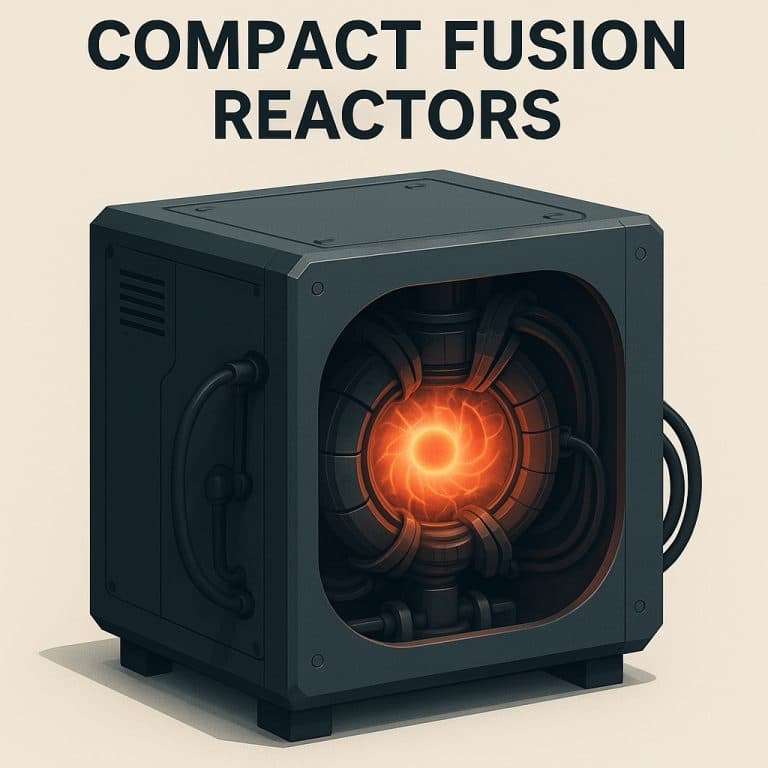
A compact fusion reactor takes this principle and applies it in a small-scale device, designed to generate significant amounts of energy in a footprint much smaller than traditional experimental reactors such as ITER in France. Rather than requiring kilometre-long superconducting magnets or massive containment domes, compact designs utilise innovations like:
- High-temperature superconducting (HTS) magnets to create powerful magnetic fields in much smaller systems.
- Plasma confinement innovations that allow stable operation without reactor-scale disruptions.
- AI-driven control systems for predictive plasma management.
- Advanced materials capable of withstanding extreme temperatures and neutron fluxes.
These smaller reactors could, in theory, be deployed closer to demand centres, reducing transmission losses, avoiding reliance on centralised grids, and bringing clean baseload power to industries and communities previously reliant on fossil fuels.

Why Compact Fusion Matters Now
1. Decentralisation of Energy Systems
One of the largest shifts in energy infrastructure is toward decentralisation. Instead of a few massive coal or nuclear plants feeding sprawling grids, we are seeing distributed systems of microgrids, renewables, and on-site generation. Compact fusion fits neatly into this transition, offering a scalable, dispatchable, and localised source of power.
2. Advances in Materials and Engineering
For decades, the stumbling block for fusion was technological: how do you confine plasma hot enough to mimic the sun in a way that is controlled, stable, and efficient? The development of high-temperature superconductors and new nanostructured alloys has unlocked new pathways for miniaturisation and efficiency.
3. Climate Imperatives
Global decarbonisation targets are tightening. With the Intergovernmental Panel on Climate Change (IPCC) warning that net-zero must be reached by mid-century to avoid catastrophic warming, compact fusion reactors present a potential carbon-free baseload power solution that could complement renewables and storage.
4. Energy Security and Geopolitics
Russia’s invasion of Ukraine, supply chain disruptions, and volatile fossil fuel markets have underscored the fragility of current energy systems. Compact fusion offers fuel independence, relying on deuterium (easily extracted from seawater) and lithium (abundant for tritium breeding), making it geopolitically resilient.
The Global Race Toward Compact Fusion
Several private companies and research institutes are leading the charge to commercialise compact fusion:
- Helion Energy (USA): Pursuing a pulsed, linear fusion system with ambitions to produce electricity directly from plasma without needing steam turbines.
- Commonwealth Fusion Systems (USA): Leveraging MIT-developed HTS magnets to develop its SPARC reactor, with commercial rollout aimed in the 2030s.
- TAE Technologies (USA): Focusing on advanced fuel cycles such as hydrogen-boron fusion, which produces minimal radioactive by-products.
- Zap Energy (USA): Pursuing a sheared-flow-stabilised Z-pinch reactor design, aiming for simplicity and cost reduction.
- Tokamak Energy (UK): Combining spherical tokamak designs with high-field superconductors.
Unlike ITER—which is designed as a massive scientific experiment—these companies aim for commercial viability, portability, and affordability. Many predict functional compact fusion reactors within the next decade, though timelines remain speculative given fusion’s notorious history of “always being 30 years away.”

Applications: Where Compact Fusion Could Transform Power Supply
Military and Defence Operations
Compact fusion reactors could provide independent, transportable energy sources for forward bases, naval vessels, and autonomous systems. Instead of relying on vulnerable fuel supply chains, militaries could generate clean, secure energy on-site.
Space Exploration and Off-World Colonies
Space agencies are exploring compact fusion as a potential power source for lunar bases and Mars missions. Unlike solar energy, which is limited during long nights or dust storms, fusion provides continuous, reliable energy.
Industrial Hubs and Energy-Intensive Sectors
From data centres to chemical plants, industries demand uninterrupted power. Compact fusion could act as an on-site baseload generator, reducing reliance on fragile national grids and volatile fossil fuel markets.
Developing Nations and Remote Communities
Many developing regions face unreliable or absent electricity infrastructure. Compact reactors could provide leapfrogging opportunities, allowing countries to bypass fossil-heavy pathways and move straight to sustainable, high-density power.
Disaster Relief and Humanitarian Aid
Portable fusion reactors could be deployed to provide electricity after natural disasters, supporting hospitals, water purification, and communication systems.
Sustainability Advantages
The sustainability case for compact fusion is compelling:
- Carbon-free energy: No greenhouse gas emissions at point of generation.
- Abundant fuel: Deuterium can be extracted from seawater, and tritium can be bred from lithium.
- Minimal radioactive waste: Unlike fission, fusion produces only short-lived waste.
- Inherent safety: No chain reaction or meltdown risk—the reaction stops if conditions fail.
This positions compact fusion as a cornerstone technology for net-zero strategies, complementing solar, wind, and storage with round-the-clock clean power.
Key Challenges Ahead
While optimism is high, hurdles remain:
- Energy Breakeven
Reaching “ignition,” where reactors generate more energy than they consume, remains a critical milestone. Some firms have claimed progress, but sustained net-positive energy has yet to be demonstrated commercially. - Cost and Scalability
Even if functional, compact fusion reactors must be affordable enough for widespread deployment. Manufacturing, materials, and maintenance costs will determine their commercial success. - Regulatory and Public Perception
Although fusion is distinct from fission, public misunderstanding of “nuclear” technologies and the lack of tailored regulatory frameworks may slow adoption. - Fuel Cycle Management
While deuterium is abundant, tritium is rare and must be bred inside reactors using lithium. Developing efficient and safe tritium breeding cycles is essential.
Compact Fusion vs. Other Clean Energy Technologies
Fusion should not be viewed as a competitor to renewables but as a complement. While solar and wind provide intermittent but cheap energy, fusion offers baseload stability. Compared with fission, compact fusion is cleaner, safer, and easier to deploy at smaller scales.
Fusion also compares favourably against hydrogen, another much-hyped energy vector. While hydrogen requires production, storage, and transport, compact fusion reactors generate direct electricity on-site, reducing system complexity.
Infographic: Fusion vs Fission vs Renewables
The energy transition requires evaluating the strengths and limitations of different technologies. This infographic compares fusion, fission, and renewables across four critical factors:
- Carbon Emissions: Fusion and renewables produce no direct emissions, while fission contributes indirectly through mining and fuel processing.
- Waste: Fusion generates minimal, short-lived waste, whereas fission creates long-lived radioactive waste requiring storage. Renewables produce no fuel waste but do have lifecycle material challenges (e.g., solar panel recycling).
- Safety: Fusion is inherently safe—its reaction stops if conditions are not met. Renewables are also safe, while fission carries risks of meltdown and radioactive leaks.
- Scalability & Intermittency: Fusion has the potential to provide reliable baseload power anywhere. Renewables are highly scalable but intermittent, needing storage. Fission provides baseload but at the cost of complex infrastructure and public acceptance issues.

Economic and Social Implications
If compact fusion reactors become commercially viable, the ripple effects will be profound:
- Energy Justice: Widespread deployment could close the energy access gap, particularly in the Global South.
- Economic Growth: Entire industries could flourish around reactor manufacturing, deployment, and maintenance.
- Resilient Infrastructure: Power outages caused by grid failure or fuel shortages could become a thing of the past.
- Geopolitical Balance: Energy independence could reshape alliances and reduce fossil-fuel-based conflicts.
Future Outlook
The outlook for compact fusion is cautiously optimistic. While ITER remains an important scientific testbed, private ventures are driving faster innovation cycles, similar to how private space companies accelerated the industry beyond state-run programs.
Some firms, like Helion Energy, aim to deliver grid-connected fusion electricity by 2028. Others suggest commercial rollouts in the early 2030s. Even if timelines slip, the pace of progress has never been faster.
In the best-case scenario, compact fusion reactors could act as the “Tesla moment” for nuclear energy—a disruptive force that rebrands and revitalises the sector.
Final Thoughts
At InnomatInc, we believe compact fusion reactors embody the essence of futurism: bold science converging with urgent global needs. They are not merely energy devices; they represent a paradigm shift in how humanity thinks about power, resilience, and sustainability.
Whether they arrive in five years or fifteen, compact fusion reactors will play a defining role in shaping tomorrow’s energy landscape. And when they do, the dream of star power on Earth—safe, clean, and universally accessible—will no longer be science fiction but everyday reality.
References
- Nuclear Business Platform. (2024). Compact Fusion Reactors: The Future of Scalable Nuclear Energy? [online] Available at: https://www.nuclearbusiness-platform.com/media/insights/compact-fusion-reactors [Accessed 30 Aug. 2025].
- IAEA. (2023). Fusion Energy Progress and Prospects. International Atomic Energy Agency.
- Helion Energy. (2024). Fusion Redefined. [online] Available at: https://www.helionenergy.com/
- Commonwealth Fusion Systems. (2024). SPARC Fusion Reactor. [online] Available at: https://cfs.energy/
- TAE Technologies. (2024). Fusion Technology Overview. [online] Available at: https://tae.com/
- Zap Energy. (2024). The Z-Pinch Fusion Path. [online] Available at: https://zapenergy.com/