
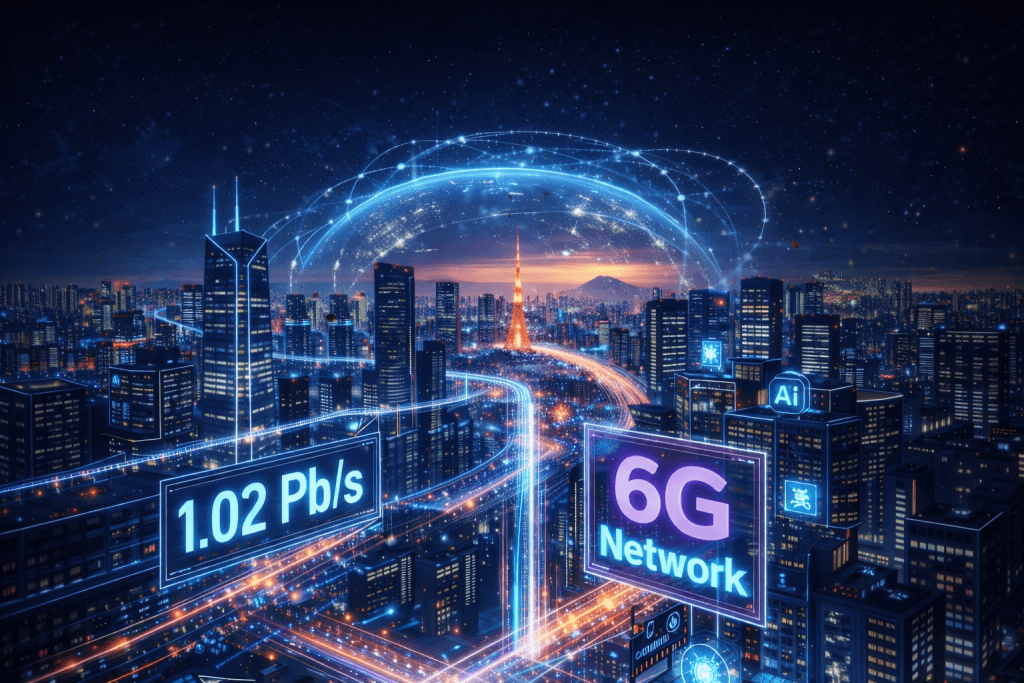
Japan Achieves World Record Internet Speed
Internet speed has reached a staggering new milestone. Researchers in Japan have shattered previous records by achieving a data transmission rate of 1.02 petabits per second (Pbps). To put this in perspective, a petabit is one quadrillion bits, or approximately 1,000,000 gigabits (The New Indian, 2026). This achievement represents a leap of over 2,000 times faster than the previous record of 402 terabits per second set by the same team in mid-2024 (afrikastar.com, 2026). This internet speed breakthrough, accomplished by the National Institute of Information and Communications Technology (NICT) in collaboration with Sumitomo Electric and other partners, fundamentally redefines what is possible in optical communications and sets the stage for the next generation of global connectivity (NOCPERU, 2026).
The Technology Behind the Breakthrough
The record-breaking internet speed was achieved using a specialized 19-core optical fiber (afrikastar.com, 2026). Standard optical fibers used in most networks today contain a single core a thin strand of glass that carries light signals. The Japanese researchers employed a multi-core fiber that contains 19 separate light paths within the same standard diameter of approximately 0.125 millimeters (NOCPERU, 2026). This approach, known as spatial division multiplexing, multiplies capacity by distributing data across physically separate cores rather than pushing more data through a single channel.
Maintaining the standard outer diameter is a critical engineering decision. Any increase in diameter would require redesigning connectors, conduits, undersea cable housings, and installation tools a prohibitively expensive global undertaking (afrikastar.com, 2026). By preserving compatibility, the researchers demonstrated that this record internet speed can be introduced incrementally rather than requiring a disruptive global replacement of infrastructure. The team also used dense wavelength division multiplexing, transmitting multiple laser wavelengths simultaneously within each core (The New Indian, 2026).
How Fast Is 1.02 Petabits Per Second?
The sheer scale of this internet speed is difficult to comprehend. A 1.02 Pbps connection is approximately 3.5 million times faster than a standard 300 Mbps home broadband connection (HMTV, 2026). To put it in practical terms, this speed would allow a user to download the entire Netflix library of movies and shows in a single second (The New Indian, 2026). Alternatively, it could stream 10 million 8K resolution videos simultaneously without any buffering or interruption.
This internet speed achievement was tested over a significant distance of approximately 1,800 kilometers (about 1,118 miles) (NOCPERU, 2026). Demonstrating stable petabit-class transmission over such a distance is a critical detail, as short-distance records often fail to translate into real-world usability. Over long distances, signals must pass through optical amplifiers, which introduce noise and limit performance. The successful long-distance test indicates that spatially multiplexed systems can survive realistic amplification and propagation conditions.
Advanced Signal Processing and Modulation
Achieving this internet speed required extremely precise control at the receiver. The system relied heavily on advanced digital signal processing. At petabit scales, even tiny imperfections in the fiber, temperature variations, or mechanical stress can distort signals (afrikastar.com, 2026). The receivers used powerful algorithms to compensate for chromatic dispersion, polarization effects, nonlinear interference, and inter-core crosstalk. This tight integration between optical hardware and computational processing is a defining feature of modern high-capacity networks.
Inside each of the nineteen cores, the experiment employed dense wavelength division multiplexing, with each wavelength carrying data encoded using high-order modulation formats. These formats pack multiple bits into a single symbol by manipulating amplitude and phase (The New Indian, 2026). While this dramatically increases spectral efficiency, it also makes signals more vulnerable to noise and distortion, requiring extremely precise correction at the receiver. The team successfully balanced these competing demands to achieve the record internet speed.
Compatibility with Existing Infrastructure
One of the most significant aspects of this breakthrough is its compatibility with current fiber optic technology. Because the specialized 19-core fiber maintains the standard outer diameter, it can be spliced and connected using existing infrastructure (NOCPERU, 2026). This means that the technology required to achieve this internet speed could theoretically be implemented through current fiber optic lines, though adapters and converters would be necessary at the endpoints.
This compatibility dramatically reduces the barrier to adoption. Network operators could upgrade their backbone connections incrementally without digging up streets or laying entirely new cables. The path to achieving this internet speed in practical networks involves upgrading transmission equipment at both ends of the fiber line rather than replacing the fiber itself (afrikastar.com, 2026).
Implications for Backbone Networks
This record-breaking internet speed is not intended for home broadband connections in the immediate future. Instead, it targets backbone and core networks the hidden foundation of the internet that interconnects data centers, cloud providers, submarine cable landing points, and national networks (Information Age | ACS, 2026). As traffic driven by artificial intelligence training, real-time analytics, and high-resolution media continues to grow exponentially, backbone capacity must increase faster than access speeds to prevent systemic bottlenecks.
Industry monitor Dell’Oro Group has forecast 15 percent year-on-year increases in fiber optic demand, citing “positive momentum” created by the AI industry’s frenzied growth (Information Age | ACS, 2026). The ability to achieve this internet speed in backbone networks will enable data centers to communicate more efficiently, reducing latency and improving the performance of cloud services and AI applications.
Enabling 6G and Future Wireless Technologies
The implications of this internet speed extend directly to future wireless technologies such as 6G. While wireless links operate at far lower speeds, every base station ultimately connects to fiber backhaul (NOCPERU, 2026). Ultra-dense networks, autonomous systems, and real-time machine-to-machine communication will demand massive fiber capacity behind the scenes. Petabit-class optical links make it feasible to centralize computation, reduce latency, and support globally synchronized digital services.
Researchers anticipate that their approach will pave the way for advancements in “Beyond 5G” services, enabling enhanced data rates and prolonging the lifespan of existing fiber optic infrastructure (The New Indian, 2026). This internet speed breakthrough is not merely about faster downloads it is about enabling the infrastructure required for autonomous vehicles, remote surgery, immersive virtual reality, and the metaverse.
International Collaboration and Competitive Context
The record was achieved by a British-Japanese research team, highlighting the importance of international collaboration in telecommunications research (Sing Tao Canada, 2026). Researchers from Japan’s NICT and the UK’s Aston University worked together to develop the new technique, which exploits the physical characteristics of standard ITU-T G.654 optical fiber widely deployed around the global internet.
Rather than transmitting data over the fiber with conventional single-mode techniques using long wavelengths in the C and L transmission bands, the researchers used shorter O-band wavelengths to transmit data using three-mode transmission over the same fiber optic cable (Daily Advent, 2026). The technique surpassed their previous record of 402 Tbps from mid-2024 while using nearly 20 percent less of the cable’s total bandwidth, suggesting there is still headroom to push even more data in the future. This internet speed achievement builds on a series of progressive breakthroughs from the same team.
The Journey to Petabit Speeds
The path to this record internet speed has been marked by consistent progress. In June 2021, the same NICT team reached 319 Tbps (Daily Advent, 2026). By mid-2024, they had increased that to 402 Tbps (Sing Tao Canada, 2026). Now, with the 1.02 Pbps achievement, they have more than doubled their previous record while opening an entirely new order of magnitude in data transmission. This represents a tripling of speed in approximately one year.
The key difference in the latest experiment was the transmission bandwidth increased to 20 THz, thanks to wavelength division multiplexing technology (The New Indian, 2026). Using signal modulation and amplification techniques, including amplifiers made of thulium and erbium, the Japanese researchers achieved their record internet speed over 57 kilometers in the initial test, with longer-distance validation at 1,800 kilometers (NOCPERU, 2026).
Economic and Commercial Implications
The commercial implications of this internet speed breakthrough are substantial. Global telecommunications network operators are rushing to roll out new optical fiber backbones to keep up with soaring data demand. So-called 400G backbones are now mainstream, but rollouts of faster 800G and 1.6T networks are rapidly ramping up, with Nokia predicting significant growth in 2026 (Information Age | ACS, 2026).
The connectivity industry group IOWN Global Forum has laid down a strategic vision for optical fiber development, with the ambition of reducing networks’ power consumption by 100 times, reducing end-to-end latency by 200 times, and boosting transmission capacity by 125 times (Information Age | ACS, 2026). Achieving this internet speed is a critical step toward those goals. As data becomes the core resource of modern society, breakthroughs like this will determine how scalable, resilient, and powerful the global digital ecosystem can become.
The Future of Internet Speed
While consumers should not expect to contract 1 Pbps internet speed in their homes for many years, the importance of this record is that it certifies that it is still possible to greatly improve current fiber optics without completely changing the cables (afrikastar.com, 2026). Historically, advances in backbone infrastructure have preceded consumer-facing improvements by many years. Early optical fiber systems were once considered excessive, yet they enabled today’s streaming, cloud computing, and global connectivity.
The 1.02 petabit-per-second record fits this pattern: it defines what is possible today so that tomorrow’s networks can be built with confidence (The New Indian, 2026). It establishes a credible technological roadmap for a future where data transmission is no longer a bottleneck. This internet speed achievement confirms that optical communication is far from reaching its final limits.
Conclusion
Japan’s achievement of 1.02 petabits per second represents a new chapter in the evolution of the internet. By combining spatial division multiplexing using 19-core fiber, advanced modulation techniques, precise digital signal processing, and infrastructure-compatible design, researchers have pushed the boundaries of what is physically possible in data transmission. This internet speed breakthrough will quietly determine how scalable, resilient, and powerful the global digital ecosystem can become in the era of AI, 6G, and beyond.
References
afrikastar.com. (2026, January 30). Breaking the limits of light: How Japan achieved 1.02 petabits per second over optical fiber. https://afrikastar.com/en/breaking-the-limits-of-light-how-japan-achieved-1-02-petabits-per-second-over-optical-fiber/
Daily Advent. (2026). *New record: Japan achieves 402 Tb/s in fiber optic data transmission*. http://lite.dailyadvent.com/detail/50846045240629en_ng
HMTV. (2026, March 31). Japan internet speed record. https://www.hmtvlive.com/amp/telugu-news/technology-news/japan-new-internet-speed-world-record-petabit-per-second-144177
Information Age | ACS. (2026, January 20). New internet speed record hits 430Tbps over fibre. https://ia.acs.org.au/article/2026/new-internet-speed-record-hits-430tbps-over-fibre.html
NOCPERU. (2026, April 3). Japan breaks Internet speed record by reaching 1.02 petabits per second using fiber optics. https://nocperu.com/en/component/content/article/13-news/586-japon-bate-el-record-de-velocidad-de-internet-al-alcanzar-1-02-petabits-por-segundo-usando-fibra-optica
Sing Tao Canada. (2026, January 31). *Japan achieves 1.02 Pb/s data transmission*. https://www.singtao.ca/tag/1-02-pb-s/
The New Indian. (2026, March 28). Japan sets world record with 1.02 petabit internet speed. https://www.newindian.in/tag/1-02-petabits/