Hyper-Personalised AI Tutors Shaping Smarter Learning
Hyper-personalised AI tutors are fundamentally reshaping how students learn and how educators teach. For generations, education has operated on a one-size-fits-all model, where teachers deliver the same lesson to thirty students despite vastly different needs, paces, and learning styles. This approach inevitably leaves some students behind while others remain unchallenged. But a new paradigm is emerging. Hyper-personalised AI tutors leverage artificial intelligence to create adaptive learning experiences tailored to each individual student, offering the promise of truly personalized education at scale. As these systems become more sophisticated, they are poised to transform classrooms, homes, and the very nature of teaching and learning (Khan Academy, 2024; Forbes, 2025).
What Are Hyper-Personalised AI Tutors?
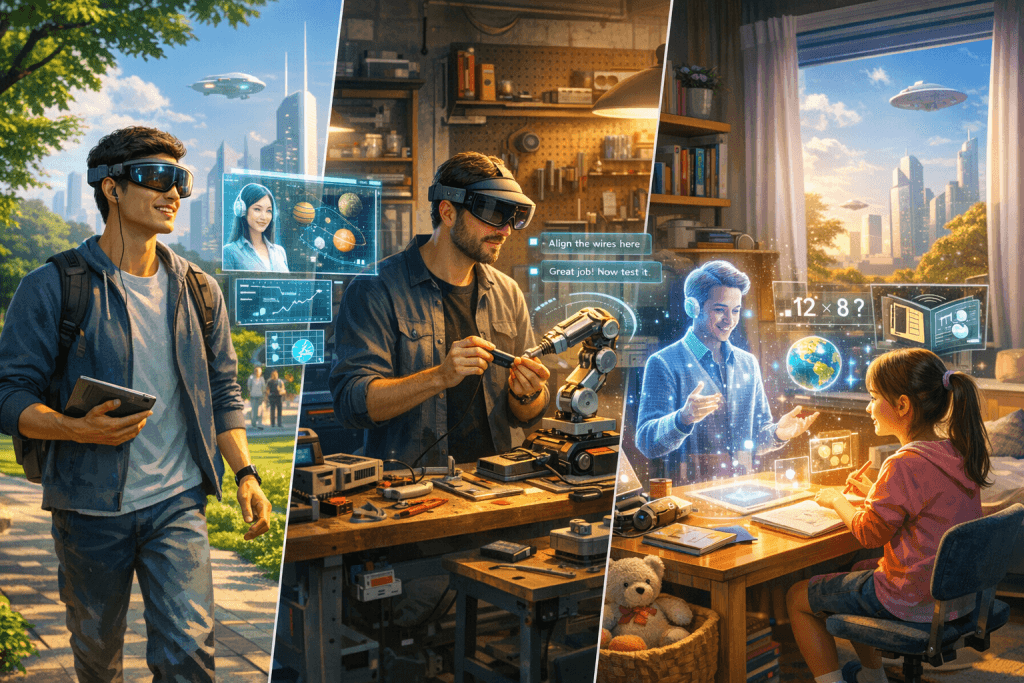
Hyper-personalised AI tutors are intelligent software systems that use artificial intelligence, particularly large language models and machine learning algorithms, to deliver customized instruction to individual learners. Unlike traditional educational software that follows fixed pathways, these tutors continuously assess a student’s knowledge, identify gaps, adapt to preferred learning styles, and provide real-time feedback and guidance (Harvard Graduate School of Education, 2025; EdSurge, 2025).
The “hyper-personalised” aspect distinguishes these systems from earlier adaptive learning tools. Rather than simply adjusting the difficulty of pre-written questions, hyper-personalised AI tutors engage in natural language conversations with students, explain concepts in multiple ways until understanding is achieved, generate practice problems on demand, and provide encouragement tailored to the student’s emotional state. They can function as patient, infinitely available tutors that never tire of repetition and can adjust their teaching approach based on what works best for each individual learner (MIT Technology Review, 2025).
Leading Platforms in the Space
Khan Academy’s Khanmigo represents one of the most prominent examples of hyper-personalised AI tutors in action. Launched as a pilot in 2023 and now widely available, Khanmigo uses GPT-4 technology to act as a Socratic tutor, guiding students through problems rather than simply providing answers (Khan Academy, 2024). The system engages students in dialogue, asking probing questions, providing hints, and helping students discover solutions themselves. Khan Academy founder Sal Khan has described Khanmigo as the realization of a decades-old dream: providing every student with a personal tutor, the educational intervention with the strongest evidence of effectiveness (The Verge, 2024).
Duolingo, the language learning platform, has integrated AI deeply into its hyper-personalised AI tutors. The company’s AI analyzes millions of user interactions to optimize lesson sequencing, predict where individual learners will struggle, and generate personalized explanations for errors (Duolingo, 2025). The platform’s AI tutors provide immediate, contextual feedback that mimics the experience of working with a human language instructor.
Startups are also entering the space. Sizzle AI, founded by a former Meta executive, offers a hyper-personalised AI tutor focused on STEM subjects that breaks down complex problems step by step, adapting explanations based on the learner’s demonstrated understanding (Forbes, 2025). CogniSpark provides AI-powered tutoring for K-12 students, with systems that identify learning gaps and create customized learning pathways (EdTech Magazine, 2025). These platforms demonstrate the growing diversity of hyper-personalised AI tutors across subjects and age groups.
How Hyper-Personalised AI Tutors Work
The technology behind hyper-personalised AI tutors combines several advanced capabilities. Large language models provide natural language understanding and generation, enabling conversational interactions that feel human-like. Retrieval-augmented generation allows the system to access accurate information while maintaining conversational flow. Continuous assessment algorithms analyze student responses, time on task, and error patterns to build detailed models of individual knowledge (Harvard Graduate School of Education, 2025).
Perhaps most importantly, hyper-personalised AI tutors incorporate insights from cognitive science and learning theory. They employ spaced repetition, interleaving, and retrieval practice—techniques proven to enhance long-term retention. They adapt not only to what a student knows but to how they learn best, whether through visual explanations, analogies, step-by-step worked examples, or hands-on practice (MIT Technology Review, 2025).
The systems also address the affective dimension of learning. Hyper-personalised AI tutors can detect frustration in a student’s language and adjust accordingly, offering encouragement, breaking problems into smaller steps, or switching to a different explanation style. This emotional responsiveness is critical for maintaining engagement and preventing the discouragement that often leads students to disengage (EdSurge, 2025).
The Evidence for Effectiveness
Early research on hyper-personalised AI tutors shows promising results. A 2025 study from Stanford University found that students using AI tutoring systems showed learning gains equivalent to moving from the 50th to the 65th percentile in mathematics, a substantial effect comparable to working with a human tutor (Stanford Graduate School of Education, 2025). Khan Academy reported that students using Khanmigo demonstrated increased persistence on challenging problems and reported higher confidence in their abilities (Khan Academy, 2024).
Duolingo’s research indicates that AI-personalized lessons improve retention rates by over 20 percent compared to non-personalized instruction (Duolingo, 2025). Perhaps most significantly, hyper-personalised AI tutors appear to benefit struggling students most, suggesting the potential to close achievement gaps rather than widen them (Forbes, 2025).
Transforming the Role of Teachers
The rise of hyper-personalised AI tutors does not eliminate the need for human teachers. Instead, it promises to transform their role. Teachers can be freed from routine tasks like grading, lesson planning, and repetitive drill practice, allowing them to focus on what humans do best: mentoring, inspiring, facilitating group discussion, and providing emotional support (Harvard Graduate School of Education, 2025).
In classrooms using hyper-personalised AI tutors, teachers receive detailed analytics about each student’s progress, identifying who needs help and with what concepts. They can then target their limited time where it will have the greatest impact. Sal Khan has described this as the “two sigma” solution, referencing educational researcher Benjamin Bloom’s finding that one-on-one tutoring produces learning outcomes two standard deviations above classroom instruction. Hyper-personalised AI tutors may finally make such personalized instruction scalable (The Verge, 2024).
Accessibility and Equity
Hyper-personalised AI tutors hold enormous potential to democratize access to high-quality education. A student in an under-resourced school can now access the same AI tutoring capabilities as a student in the wealthiest district. This has profound implications for educational equity (MIT Technology Review, 2025).
However, challenges remain. Access to devices and reliable internet connectivity remains uneven, particularly in rural and low-income communities. The cost of AI tutoring platforms, while far lower than human tutoring, is still prohibitive for some schools and families. Advocates argue that hyper-personalised AI tutors should be treated as essential educational infrastructure, funded publicly to ensure universal access (EdTech Magazine, 2025).
Privacy and Ethical Considerations
The widespread adoption of hyper-personalised AI tutors raises important questions about student data privacy. These systems collect detailed information about student knowledge, learning patterns, and even emotional states. Ensuring that this data is protected, used only for educational purposes, and not exploited commercially is essential (Harvard Graduate School of Education, 2025).
There are also concerns about algorithmic bias. If hyper-personalised AI tutors are trained on data that reflects existing educational inequities, they may perpetuate those inequities. Developers must work to ensure their systems are fair across race, gender, socioeconomic status, and learning differences (EdSurge, 2025).
The Future of Smarter Learning
As hyper-personalised AI tutors continue to evolve, their capabilities will expand. Future systems may incorporate multimodal learning, integrating visual, auditory, and kinesthetic elements. They may collaborate across subjects, helping students see connections between mathematics, science, literature, and history. They may support project-based learning, guiding students through complex, extended investigations rather than discrete exercises (MIT Technology Review, 2025).
The ultimate promise of hyper-personalised AI tutors is nothing less than unlocking human potential. By providing every student with a tutor that adapts to their unique needs, interests, and aspirations, these systems could help each person achieve their fullest potential. This is the vision of smarter learning: not replacing human connection with technology, but using technology to enhance and enable the human relationships at the heart of education (Khan Academy, 2024).
Conclusion
Hyper-personalised AI tutors represent one of the most promising developments in the history of educational technology. By combining the power of artificial intelligence with insights from cognitive science, these systems are finally making personalized, mastery-based learning scalable. While challenges of equity, privacy, and teacher integration remain, the trajectory is clear. Hyper-personalised AI tutors are not just improving test scores; they are reimagining what education can be. In doing so, they offer the hope of a future where every student, regardless of background or circumstance, has access to the personalized instruction they need to thrive.
References
Duolingo. (2025). How AI powers personalized language learning at scale. https://blog.duolingo.com/how-ai-powers-personalized-language-learning/
EdSurge. (2025, January 15). The rise of AI tutors: Personalized learning at scale. https://www.edsurge.com/news/2025-01-15-the-rise-of-ai-tutors-personalized-learning-at-scale
EdTech Magazine. (2025, February 10). AI tutors are changing the classroom. Here’s how. https://edtechmagazine.com/k12/article/2025/02/ai-tutors-are-changing-classroom-heres-how
Forbes. (2025, March 1). The AI tutor revolution: How personalized learning is finally here. https://www.forbes.com/sites/education/2025/03/01/ai-tutor-revolution-personalized-learning/
Harvard Graduate School of Education. (2025). AI and the future of teaching and learning. https://www.gse.harvard.edu/ideas/ed-magazine/25/01/ai-and-future-teaching-and-learning
Khan Academy. (2024). Khanmigo: Your AI-powered tutor and teaching assistant. https://www.khanacademy.org/khanmigo
MIT Technology Review. (2025, February 20). AI tutors are here, and they’re changing education. https://www.technologyreview.com/2025/02/20/ai-tutors-education-future/
Stanford Graduate School of Education. (2025). The effectiveness of AI tutoring systems: A randomized controlled trial. https://ed.stanford.edu/news/effectiveness-ai-tutoring-systems-2025
The Verge. (2024, November 15). Khan Academy’s AI tutor is here, and it’s a game-changer for education. https://www.theverge.com/2024/11/15/khan-academy-ai-tutor-khanmigo