The Smarter Future of Urban Access Beyond Drive-Thrus and Cars
Drive-thrus and cars have shaped the landscape of modern cities for nearly a century. From the double-lane coffee stands of suburban strips to the sprawling parking lots surrounding every big-box retailer, the automobile’s convenience has dictated how we design our public spaces (Dain, 2019). But a fundamental shift is underway. Urban planners, policymakers, and communities are reimagining what cities could look like when they prioritize people over vehicles. The future of urban access lies in moving beyond the dominance of drive-thrus and cars toward integrated, multi-modal systems that serve everyone, regardless of age or ability.
The Legacy of Car-as-King Development
For decades, zoning laws mandated ample on-site parking for almost every new development, reinforcing a pattern where drive-thrus and cars became the default organizing principle of urban space (Dain, 2019). This approach, born from mid-century efforts to retrofit downtowns originally designed for pedestrians and trolleys, has left a legacy of impervious surfaces, polluted runoff, and neighborhoods where crossing the street on foot feels like an act of courage. As one urban policy researcher notes, ample on-site parking encourages driving, increases construction costs, limits redevelopment potential, and ultimately makes for ugly places where our eyes are oriented at garage doors and pavement rather than people and storefronts (Dain, 2019). The convenience of drive-thrus and cars came at the cost of community vitality.
Rethinking Street Space for People
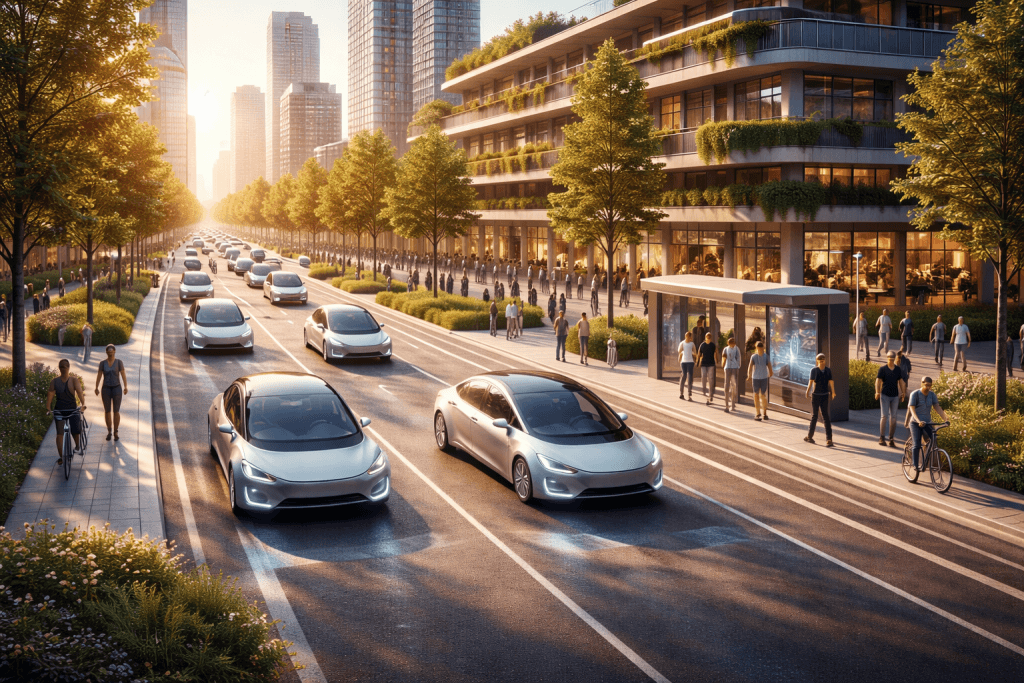
The emerging vision for urban mobility moves beyond drive-thrus and cars, starting with a simple but radical premise: streets are public spaces, not just thoroughfares for vehicles. The Landscape Institute, drawing on research from Farrells and WSP, argues that with the right planning, we can create safer roads, less-cluttered streets, reduced need for parking, and enhanced pedestrian spaces (Landscape Institute, 2026). This shift requires reprioritising how we allocate street space.
Dedicated bus lanes allow public transit to bypass congestion, while protected, connected active transport lanes create safe corridors for cycling, mobility aids, and scooters (European Parliament Library, 2024). As urban planner Brent Toderian puts it, we don’t need to look at these as tomorrow’s solutions; everything we talk about is urgent now, and “further” and “faster” are the most important words in urban change (The Globe and Mail, 2025).
Integrated Mobility Ecosystems
The future of urban access is not defined by a binary choice between public and private traffic, but by a shift to integrated multi-modal service ecosystems (European Parliament Library, 2024). Enabled by digital interconnectivity, the vision is for urban residents to hop seamlessly from a privately-owned car to a public train, and then to a shared rental e-scooter. This mobility-as-a-service model, accessible through a single digital platform, combines public transit, ride-hailing, bike-share, and taxis into one user-friendly experience (Swiss Re Institute, 2021).
Young people in cities like London already experience freedom through public transport, with free buses for under-18s and subsidized train fares, demonstrating that autonomy doesn’t have to come from drive-thrus and cars (The Globe and Mail, 2025). This digitally supported mobility offers a potentially greater sense of freedom than driving, without the burdens of insurance, maintenance, and parking.
The Autonomous Vehicle Opportunity
Autonomous vehicles are gradually appearing on roads in cities like Phoenix, San Francisco, and Austin, representing the next technological disruption to our mobility systems (Brookings Institution, 2025). While their long-term spatial implications remain underestimated, they offer a major opportunity to rethink our built environments (Fourth Regional Plan, 2026). Research shows autonomous vehicles are safer than human drivers, with roughly 90% of traffic fatalities attributable to human error (Swiss Re Institute, 2021).
As these vehicles become more common, they could accelerate the decline in private car ownership, particularly among young urbanites who already show less interest in owning drive-thrus and cars. With fewer personally owned vehicles, cities will need fewer parking lots and gas stations, freeing up vast amounts of land for parks, pedestrian walkways, bike lanes, and entertainment zones (Fourth Regional Plan, 2026).
However, there are risks in moving beyond drive-thrus and cars. Without careful planning, autonomous vehicles could reinforce negative effects of auto-based urbanism including sprawl, single-function infrastructure, and environmental degradation (Shieh, 2024). Philipp Rode of LSE Cities suggests that large cities may eventually restrict private autonomous vehicles from entering altogether, as tolerance for parked cars occupying precious public space continues to drop (Rode, 2025). The real opportunity lies in moving away from private ownership entirely, with cars becoming part of shared or public fleets accessible through membership clubs.
Designing for Proximity and Access
Perhaps the most transformative shift is the move toward proximity-based urban design beyond drive-thrus and cars. Brent Toderian emphasizes that the key to a low-traffic, human-centred city is density and mixed-use neighborhoods where housing, work, and amenities are close together (The Globe and Mail, 2025). This concept of 15-minute communities reduces car dependency by design, making it possible to meet daily needs without relying on drive-thrus and cars. Gil Penalosa, founder of 8 80 Cities, even proposes reimagining work schedules to eliminate rush hour entirely, allowing people to choose arrival times between 7 a.m. and 11 a.m. (The Globe and Mail, 2025). Such bold thinking recognises that congestion is not inevitable but a consequence of choices about how we organise time and space.
Congestion Management and Fair Access
Making driving less attractive in dense urban areas is a necessary trade-off in moving beyond drive-thrus and cars to create pedestrian-friendly places. Congestion charges, like those implemented in London, impose fees on drivers entering designated areas during peak hours, while perimeter control systems in cities like Zurich use traffic lights to manage flow into downtowns (Rode, 2025). The goal is not to punish drivers but to recognise that space in cities is finite. As Rode argues, driving in inner-city areas means making an exception for one’s own needs in environments where it’s simply not feasible for everyone to drive (Rode, 2025). The freedom of some must be balanced against the freedoms of the population at large, including children, elderly residents, and those who rely on public transit.
Some communities have already taken decisive action. In Concord, Massachusetts, zoning explicitly prohibits the service of food and beverages directly to customers in motor vehicles anywhere in town, preserving the colonial quaintness and walkability of its downtown (Dain, 2019). While such outright bans on drive-thrus and cars may not be feasible everywhere, they demonstrate a growing recognition that communities can choose different priorities.
The Role of Digital Innovation
Digital tools are accelerating the transition to sustainable urban mobility beyond drive-thrus and cars. The UN Environment Programme’s ACCESS project is deploying digital solutions across Latin American cities, from real-time transit information in Mexico City to smart traffic lights in Buenos Aires and passenger counters on electric buses (United Nations Environment Programme, 2026).
Dynamic traffic lights that adjust in real time based on actual road conditions, rather than fixed timers, can significantly improve traffic flow (United Nations Environment Programme, 2026). Meanwhile, digital van services using smart algorithms to match passengers going in similar directions are being trialled across Europe and North America, offering flexible transit options for suburban and rural areas without requiring fixed route further reducing reliance on drive-thrus and cars.
Equity and the Future of Work
As autonomous technology advances, the demand for human drivers of trucks, taxis, and ride-sharing services will decline, further accelerating the shift away from drive-thrus and cars (Brookings Institution, 2025). Cities must plan for this transition, ensuring that transportation-sector workers are not left behind. Entry-level driving positions will likely disappear, requiring retraining programs and new economic opportunities. At the same time, there is potential to improve access for those who need it most, including high-cost, high-need individuals at the younger and older ends of the age spectrum, as well as connecting individuals to jobs and reshaping how cities organise space (Shieh, 2024).
Conclusion
The future of urban access beyond drive-thrus and cars is not a distant utopia but an urgent practical necessity. With transport responsible for around 24% of direct CO2 emissions from fuel combustion, the move to sustainable mobility is central to reducing society’s carbon footprint (European Parliament Library, 2024). Cities that embrace integrated mobility, prioritize people over vehicles, and design for proximity rather than sprawl will be more livable, equitable, and resilient. The question is not whether we can afford to move beyond drive-thrus and cars, but whether we can afford not to.
References
Brookings Institution. (2025, May 20). How autonomous vehicles could change cities. https://www.brookings.edu/articles/how-autonomous-vehicles-could-change-cities/
Dain, A. (2019, November 23). Moving on from car-as-king development. CommonWealth Beacon. https://commonwealthbeacon.org/transportation/moving-on-from-car-as-king-development/
European Parliament Library. (2024). Disruptive transport, driverless cars, transport innovation and the sustainable city of tomorrow (W. Riggs, Ed.). https://link.europarl.europa.eu/portal/05ndR290NY4
Fourth Regional Plan. (2026, February). Adapt streets and highways for a technology-driven future. http://fourthplan.org/action/autonomous-future
Landscape Institute. (2026, February 17). How might driverless cars affect urban design? https://landscapeinstitute.org/news/how-might-driverless-cars-affect-urban-design/
Rode, P. (2025, June 10). Philipp Rode: Driving is not an unquestioned right. LSE Business Review. https://blogs.lse.ac.uk/businessreview/2025/06/10/philipp-rode-driving-is-not-an-unquestioned-right/
Shieh, E. (2024). Autonomous urbanism: Towards a new transitopia. Applied Research & Design. https://www.aiany.org/architecture/featured-projects/view/autonomous-urbanism-towards-a-new-transitopia/
Swiss Re Institute. (2021). Urban mobility: Innovation in short-distance travel. https://www.swissre.com/institute/research/sonar/sonar2021/urban-mobility.html
The Globe and Mail. (2025, October 6). A world without traffic? Three urban experts rethink how cities move. https://www.theglobeandmail.com/life/article-a-world-without-traffic-three-urban-experts-rethink-how-cities-move/
United Nations Environment Programme. (2026, February 26). Shifting gears: Accelerating the transition to sustainable urban mobility. https://www.unep.org/events/online-event/shifting-gears-accelerating-transition-sustainable-urban-mobility