
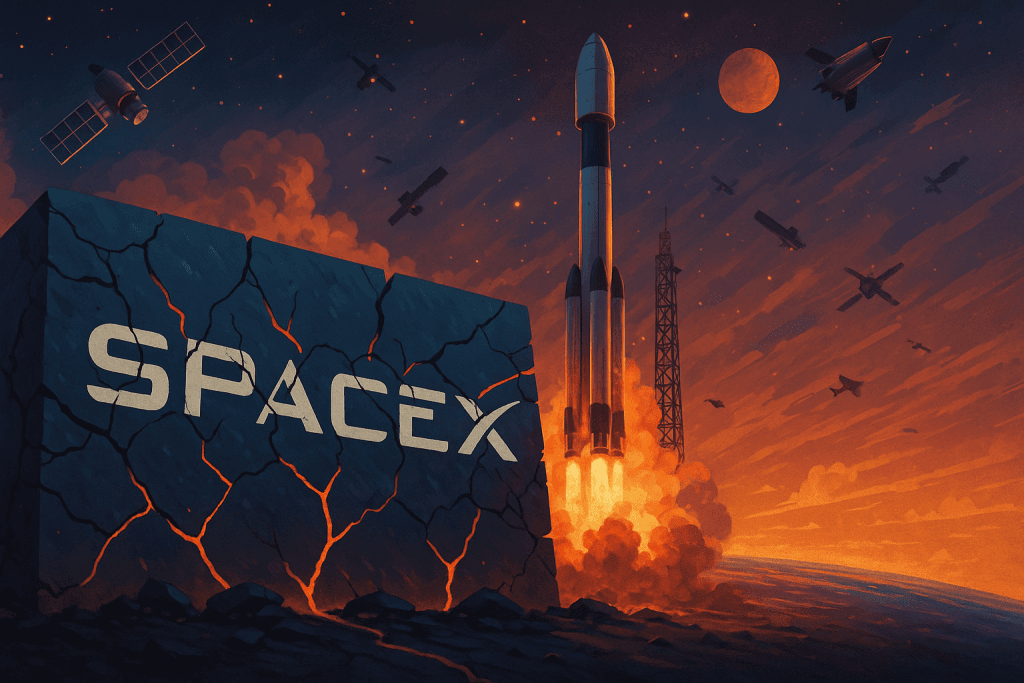
What Happens to Space Advancement if SpaceX Goes Bankrupt?
SpaceX, founded by Elon Musk in 2002, has been a driving force in the modern space race. With groundbreaking achievements like the Falcon 9, Starship, and the Starlink satellite constellation, SpaceX has revolutionised space travel, satellite deployment, and even the prospect of colonising Mars. But what if this titan of innovation were to suddenly go bankrupt? How would the global space industry and the future of space exploration be affected? This speculative article explores the potential consequences of SpaceX’s collapse and the ripple effects it would have on the advancement of space exploration.
1. A Sudden Void in the Space Industry
SpaceX’s bankruptcy would leave a massive void in the space industry. The company has been a leader in reducing the cost of space travel through reusable rocket technology, making it a cornerstone of both commercial and governmental space missions. Without SpaceX, the industry would lose its most innovative player, potentially stalling progress in reusable rocket technology and increasing the cost of launching payloads into orbit.
Competitors like Blue Origin, United Launch Alliance (ULA), and Arianespace would likely scramble to fill the gap, but none have yet matched SpaceX’s pace of innovation or cost efficiency. This could lead to a period of stagnation, where the industry struggles to maintain the momentum SpaceX had generated.
2. Delays in Mars Colonisation and Deep Space Exploration
One of SpaceX’s most ambitious goals has been to enable human colonisation of Mars. The Starship program, designed to carry humans and cargo to the Red Planet, represents a cornerstone of this vision. If SpaceX were to disappear, the timeline for Mars colonisation could be pushed back by decades. NASA and other space agencies might continue their own Mars programmes, but without SpaceX’s private-sector drive and resources, progress would likely slow.
Similarly, deep space exploration initiatives—such as missions to the Moon, asteroids, and beyond—could face significant delays. SpaceX’s ability to provide affordable launch services has been critical for both governmental and private missions. Its absence would force organisations to rely on more expensive alternatives, potentially reducing the frequency and scope of such missions.
3. The SpaceX Starlink Conundrum
SpaceX’s Starlink project, a satellite constellation designed to provide global internet coverage, has already launched thousands of satellites into low Earth orbit (LEO). If SpaceX were to go bankrupt, the fate of Starlink would be uncertain. The project could be sold to another company, but maintaining and expanding the constellation would require significant investment and technical expertise.
If Starlink were to fail, it would disrupt internet access for millions of users, particularly in remote and underserved areas. Additionally, the loss of Starlink could create a crisis in LEO, as defunct satellites contribute to the growing problem of space debris. This could complicate future space missions and increase the risk of collisions in orbit.
4. Impact on the Global Space Economy
SpaceX has been a major driver of the burgeoning space economy, inspiring startups and attracting investment to the sector. Its bankruptcy could shake investor confidence, leading to reduced funding for space-related ventures. Startups that rely on SpaceX’s launch services or collaborate with the company might struggle to find alternatives, potentially leading to a wave of failures in the industry.
On the other hand, SpaceX’s collapse could create opportunities for competitors to rise. Companies like Rocket Lab, Relativity Space, and others might step up to fill the void, but it would take time for them to achieve the same level of influence and capability.
5. Geopolitical Implications
SpaceX’s bankruptcy would also have geopolitical ramifications. The company has played a key role in reducing the United States’ reliance on Russian launch vehicles, such as the Soyuz rocket. Without SpaceX, the U.S. might once again find itself dependent on foreign partners for access to space, potentially weakening its position in the global space race.
Meanwhile, countries like China and India, which have been rapidly advancing their own space programmes, might seize the opportunity to take the lead in space exploration and commercialisation. This could shift the balance of power in space, with long-term implications for international cooperation and competition.
6. A Silver Lining? Innovation in the Face of Adversity
While the immediate aftermath of SpaceX’s bankruptcy would be chaotic, it could also serve as a catalyst for innovation. The space industry has always been resilient, and the loss of a major player might inspire new approaches and technologies. Governments, private companies, and international collaborations might redouble their efforts to achieve the goals SpaceX had set, leading to unexpected breakthroughs.
Moreover, the decentralisation of space innovation could foster a more diverse and competitive landscape. Smaller companies and startups, no longer overshadowed by SpaceX, might find new opportunities to thrive and contribute to the advancement of space technology.
Conclusion
The bankruptcy of SpaceX would undoubtedly be a seismic event for the space industry, with far-reaching consequences for space exploration, commercialisation, and geopolitics. While the immediate impact would likely be negative—slowing progress, increasing costs, and disrupting ongoing projects—the long-term effects are harder to predict. The space industry has always been driven by a spirit of exploration and innovation, and it is possible that new leaders would emerge to carry the torch forward.
Ultimately, the story of space advancement is one of resilience and adaptability. While SpaceX has been a transformative force, the dream of exploring and inhabiting the cosmos is bigger than any single company. The end of SpaceX would mark the closing of a chapter, but the next chapter could be just as exciting—and perhaps even more so.