Sustainable Futures: Eco-Friendly 3D Printing in Smart Cities
Eco-friendly 3D printing is central to the pursuit of sustainable futures in urban development, as cities seek innovations that reconcile rapid growth with ecological balance. A pivotal technology emerging in this space is additive manufacturing, which is fundamentally reshaping how smart cities are conceived, built, and maintained. By enabling precise, on-demand production with minimal waste and supporting the use of recycled and bio-based materials, this technology offers a practical pathway to reduce the construction industry’s substantial environmental footprint (Ford & Despeisse, 2016). Eco-friendly 3D printing integrates seamlessly within the smart city framework, where digital technologies optimise infrastructure and services to advance urban sustainability. Eco-friendly 3D printing acts as a cornerstone for building resilient, efficient, and liveable cities, directly contributing to the vision of sustainable futures.
1. Material Innovation and Circular Economy
The foundation of eco-friendly 3D printing for sustainable futures lies in the transition from conventional, petroleum-based plastics to advanced sustainable materials. Research is advancing the use of materials like polylactic acid (PLA) and polyhydroxyalkanoates (PHA), which are derived from renewable resources and are biodegradable. A critical practice for these sustainable futures is the development of a circular economy within manufacturing. This involves creating filaments from post-consumer recycled plastics and establishing industrial take-back programs where waste material is re-extruded into new filament, effectively closing the manufacturing loop (Kreiger & Pearce, 2013). To optimize material use, hybrid printing techniques, such as those explored by researchers at MIT, use software to strategically reinforce only the high-stress areas of a printed object with virgin material, while the bulk is made from a weaker, recycled or bio-based alternative. This can drastically reduce environmental impact while maintaining functionality, a key step toward sustainable futures.
2. Transformative Applications in Urban Construction
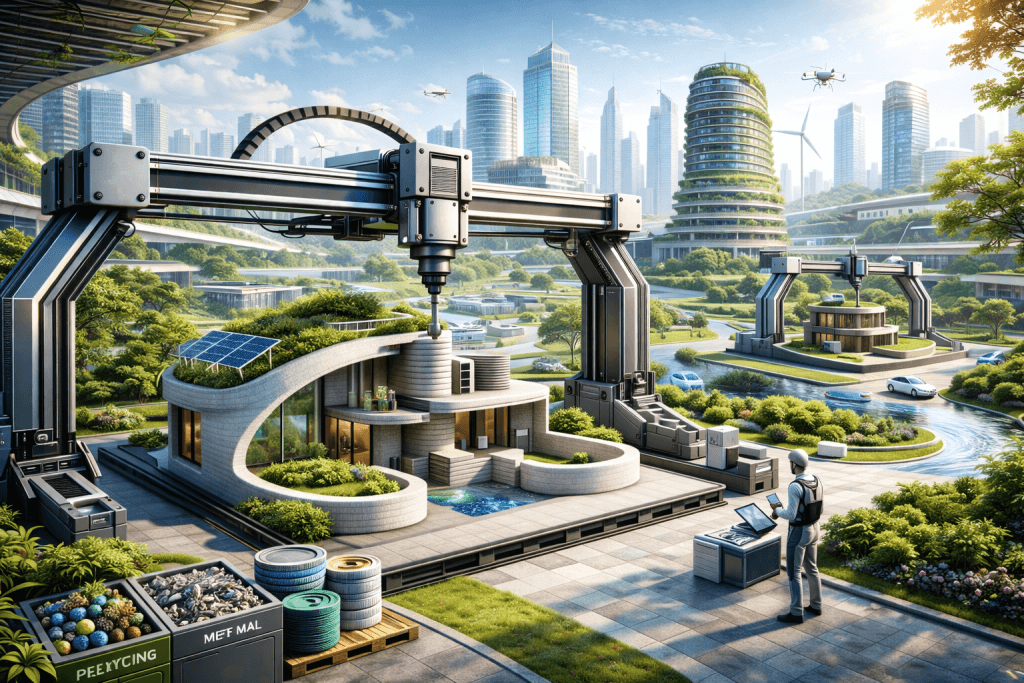
Eco-friendly 3D printing is moving from prototyping to real-world construction, addressing some of the most pressing challenges in urban development and paving the way for sustainable futures. In affordable housing, the technology enables the rapid construction of durable, low-cost homes using optimized material mixes, often with improved thermal efficiency. This application is critical for creating sustainable futures that are socially equitable. Furthermore, the technology excels at producing bespoke urban infrastructure, such as benches, planters, and bus stops, on-site and on-demand from recycled materials, reducing transportation emissions. It also facilitates sustainable maintenance through a “print-and-patch” approach, where repair materials are printed precisely to extend the lifespan of existing city assets like roads and railways, minimizing new resource consumption and supporting long-term sustainable futures.
3. Synergy with Smart City Technologies
The true potential for sustainable futures is unlocked when 3D printing integrates with other smart city technologies, creating intelligent, responsive, and self-optimizing urban systems. Integration with Digital Twin technology, a virtual, real-time replica of a physical asset, allows for continuous monitoring. Artificial Intelligence (AI) can analyze this data to predict maintenance needs, and a 3D printer can then fabricate the exact repair component, contributing to a self-healing urban fabric that is essential for resilient sustainable futures. Additionally, generative design algorithms, powered by AI, can create structural forms optimized for strength and material efficiency, forms ideal for 3D printing. This leads to structures that use significantly less material, directly lowering the embodied carbon of buildings and advancing the goals of sustainable futures (Bock, 2015). Finally, 3D printing enables localized, distributed manufacturing, shortening supply chains and allowing spare parts for public systems to be printed locally as needed, which enhances community resilience and economic sustainability, key pillars of sustainable futures.
4. Challenges and the Road Ahead
Despite its promise, the widespread adoption of eco-friendly 3D printing for sustainable futures faces several interconnected hurdles that require coordinated action.
- Regulatory and Standardization Gaps: Existing building codes and construction standards have not evolved to accommodate additive manufacturing processes, particularly for load-bearing structures and permanent habitats (Hossain et al., 2020). The path forward requires the development of new international standards and updated municipal permitting processes to safely integrate this technology.
- Scalability and Technical Limits: Printing large-scale infrastructure quickly and with a wide range of certified, high-strength, eco-friendly materials remains a challenge. Continued research and development in printer technology, such as faster print heads and robotic integration, and in material science for stronger sustainable composites are necessary.
- Economic and Skills Transition: The high initial investment for industrial-grade printers and a shortage of professionals skilled in both digital design and construction present barriers. Overcoming this necessitates new educational programs focused on digital fabrication and potential incentives to lower the capital cost barrier for adoption.
Addressing these challenges is imperative to fully realize the role of 3D printing in building sustainable futures.
Conclusion
Eco-friendly 3D printing is far more than a novel construction method; it is a foundational technology for reimagining how smart cities are built and sustained. By championing material efficiency, enabling circular economies, and integrating seamlessly with data-driven urban management systems, it provides a multidimensional tool for tackling environmental, social, and economic urban challenges. The journey toward fully realized sustainable futures demands continued innovation in green materials, supportive policy frameworks, and cross-disciplinary collaboration. As these efforts converge, 3D printing stands poised to transition from a promising innovation to a standard, indispensable tool in the smart city toolkit, directly shaping resilient and equitable sustainable futures for generations to come.
References
Bock, T. (2015). The future of construction automation: Technological disruption and the upcoming ubiquity of robotics. Automation in Construction, 59, 113–121. https://doi.org/10.1016/j.autcon.2015.07.022
Ford, S., & Despeisse, M. (2016). Additive manufacturing and sustainability: An exploratory study of the advantages and challenges. Journal of Cleaner Production, 137, 1573–1587. https://doi.org/10.1016/j.jclepro.2016.04.150
Hossain, M. A., Zhumabekova, A., Paul, S. C., & Kim, J. R. (2020). A review of 3D printing in construction and its impact on the labor market. Sustainability, 12(20), 8492. https://doi.org/10.3390/su12208492
Kreiger, M., & Pearce, J. M. (2013). Environmental life cycle analysis of distributed three-dimensional printing and conventional manufacturing of polymer products. ACS Sustainable Chemistry & Engineering, 1(12), 1511–1519. https://doi.org/10.1021/sc400093k