Could High-Speed Trains Replace Planes and Reshape Our Cities?
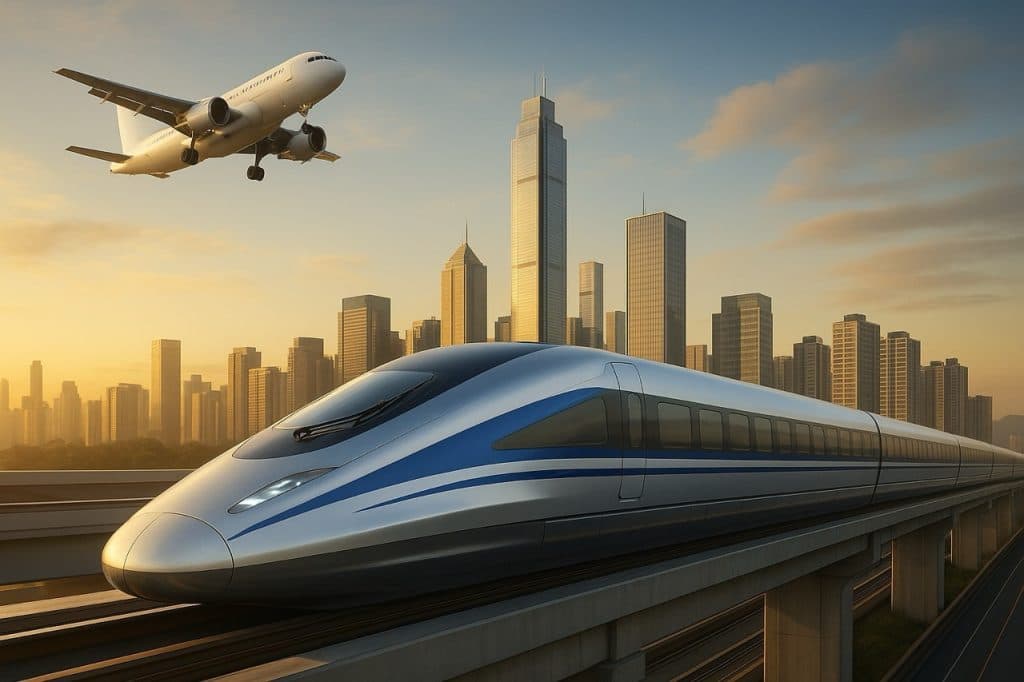
In July 2025, China unveiled a groundbreaking achievement in transportation: a maglev high-speed train capable of reaching speeds up to 600 km/h. Developed by the China Railway Rolling Stock Corporation (CRRC), this train was showcased at the 17th China International Modern Railways Technology and Equipment Exhibition in Beijing, drawing global attention to its potential to transform travel (Trak.in, 2025). With test speeds reaching 623 km/h in low-vacuum tubes, this maglev train promises to bridge the gap between conventional high-speed rail (around 350 km/h) and air travel (800–900 km/h) for journeys under 2,000 km (Travel and Leisure Asia, 2025). As high-speed rail technology advances, it raises intriguing questions: could trains like this eventually replace planes for certain routes, and how might they reshape urban development and residential patterns to support a better quality of life? This article explores these possibilities, drawing on recent developments and research to speculate on the future of high-speed transport.
The Rise of High-Speed Rail
High-speed rail has already established itself as a formidable mode of transportation in regions like Asia and Europe, where it competes effectively with air travel on short to medium-distance routes. China, with the world’s largest high-speed rail network, has taken this a step further with its 600 km/h maglev train. Unveiled in July 2021 and further showcased in 2025, this train uses magnetic levitation technology to “float” above tracks, reducing friction and enabling unprecedented speeds (CRRC Maglev, 2022). For example, it could cut the travel time between Beijing and Shanghai (approximately 1,200 km) from 4.5 hours by conventional high-speed rail to just 2.5 hours, compared to about 3 hours by plane when including airport check-in, security, and baggage claim (Trak.in, 2025).
The advantages of high-speed rail extend beyond raw speed. Unlike air travel, trains offer a seamless experience, with no need for lengthy security checks or baggage handling. Passengers can board in city centres and arrive directly in other urban hubs, avoiding the time and cost of airport transfers. Additionally, high-speed rail is significantly more environmentally friendly, producing far fewer emissions per passenger kilometre than planes (Railway Technology, 2018). As global efforts to combat climate change intensify, this environmental edge could make high-speed rail an increasingly attractive option.
Technical Features of China’s Maglev
| Feature | Details |
|---|---|
| Speed | 600 km/h (designed), up to 623 km/h in tests |
| Technology | Magnetic levitation with high-temperature superconducting magnets |
| Design | Aerodynamic body, aluminum alloy, and carbon fiber for reduced weight |
| Capacity | 2–10 carriages, each holding over 100 passengers |
| Current Status | Undergoing route feasibility, safety, and infrastructure tests (July 2025) |
| Future Plans | Potential mass deployment across China’s rail network |
Source: Adapted from Trak.in (2025) and CRRC Maglev (2022)
Challenging Air Travel
High-speed rail is already a strong competitor to air travel for certain routes, particularly in Asia and Europe. Research suggests that for distances up to 1,000 km, trains can offer faster door-to-door travel times than planes when accounting for airport procedures like check-in, security, and baggage claim (Bloomberg, 2018). For instance, the Eurostar between London and Paris is often preferred over flights due to its convenience and comparable travel time (Railway Technology, 2018). With trains like China’s 600 km/h maglev, this competitive range could extend to 1,500 km or more, covering major intercity routes like Beijing to Shanghai or even longer corridors.
The environmental benefits of high-speed rail further bolster its case. Trains produce significantly fewer greenhouse gas emissions than planes—up to seven times less per passenger kilometre in some cases (Rail vs. Air, 2024). This has led to policy shifts in countries like France, where short domestic flights have been banned when efficient rail alternatives exist, such as routes under 2.5 hours by train (Rail vs. Air, 2024). Austria has taken similar steps, banning flights between Vienna and Salzburg in favour of rail (Rail vs. Air, 2024). As sustainability becomes a global priority, high-speed rail is likely to see increased investment and adoption, potentially displacing air travel for short to medium-haul journeys.
However, challenges remain. Air travel remains faster for longer distances (beyond 1,500 km), and planes offer greater flexibility for international routes. High-speed rail also requires significant infrastructure investment, with maglev systems costing 4–5 times more than conventional rail due to specialized tracks and technology (CRRC Maglev, 2022). Despite these hurdles, advancements like China’s maglev suggest that the boundary where trains outcompete planes is shifting, and future innovations—such as vacuum-tube maglevs targeting speeds up to 4,000 km/h—could further blur the lines (ABC News, 2024).
Reshaping Urban Landscapes
High-speed rail’s impact extends beyond travel to influence urban development and residential patterns. By drastically reducing commute times, high-speed trains make it feasible for people to live further from city centres while maintaining access to urban jobs and amenities. This could lead to the development of new residential and economic hubs around high-speed rail stations, particularly in less crowded or more affordable areas.
Research indicates that high-speed rail can reshape urban economic geography. Areas near rail stations often become focal points for economic activity, attracting businesses, residents, and investment (ETRR, 2017). In China, cities along high-speed rail lines have seen increased property values and population growth, as connectivity to major urban centres makes these areas more attractive for living and working (Nature, 2023). For example, high-speed rail stations in suburban or rural areas can evolve into new economic growth points, fostering balanced regional development (Frontiers, 2022).
This decentralisation can alleviate pressure on overcrowded urban centres. In many cities, housing shortages and high costs push residents to seek alternatives. High-speed rail enables people to live in surrounding regions where housing is more affordable, and the environment is less congested, while still commuting to city jobs in under an hour. For instance, a 200 km commute on a 600 km/h train could take less than 20 minutes, making daily travel practical (Trak.in, 2025).
Case Study: China’s High-Speed Rail Network
| City Pair | Distance (km) | Current Rail Time | Maglev Time (est.) | Impact |
|---|---|---|---|---|
| Beijing–Shanghai | 1,200 | 4.5 hours | 2.5 hours | Boosts economic ties, population growth |
| Shanghai–Hangzhou | 200 | 1 hour | ~20 minutes | Enables daily commuting, urban sprawl |
| Guangzhou–Shenzhen | 140 | 40 minutes | ~15 minutes | Spurs suburban development |
Source: Adapted from Trak.in (2025) and Nature (2023)
Enhancing Quality of Life
The ability to live further from city centres offers significant quality-of-life benefits. Residents in less urbanised areas can enjoy larger living spaces, cleaner air, and a slower pace of life, all while retaining access to urban opportunities. High-speed rail makes this possible by compressing travel times, effectively shrinking the distance between rural or suburban areas and city centres.
For example, someone living 200 km from Beijing could commute to the city in under 20 minutes on the 600 km/h maglev, making it feasible to work in the city while living in a quieter, more affordable region. This could ease housing crises in major cities, where demand often outstrips supply, and promote more equitable regional development (Nature, 2023). Additionally, high-speed rail stations in suburban or rural areas can stimulate local economies, creating jobs and attracting businesses, further enhancing the appeal of these locations (ETRR, 2017).
The environmental benefits of high-speed rail also contribute to the quality of life. By reducing reliance on cars and planes, rail travel can lower air pollution and carbon emissions, creating healthier living environments (Rail vs. Air, 2024). Moreover, the development of green spaces and less densely populated communities around rail stations can offer residents a more sustainable and pleasant lifestyle.
Challenges and Considerations
Despite its potential, high-speed rail faces significant challenges. The high cost of building maglev infrastructure, estimated at 4–5 times that of conventional rail, poses a financial barrier (CRRC Maglev, 2022). Additionally, maglev trains require dedicated tracks, limiting their compatibility with existing rail networks. Widespread adoption would require substantial investment and coordination, particularly for international routes.
There are also questions about demand. High-speed rail is most effective on high-traffic corridors, and less populated routes may struggle to justify the investment. Furthermore, while trains can compete with planes for distances up to 1,500 km, air travel remains dominant for longer or transcontinental journeys due to its speed and flexibility (Bloomberg, 2018).
Public perception and policy will also play a role. While environmental concerns may drive support for high-speed rail, consumer preferences for low-cost air travel, especially with budget airlines, could slow the transition (Simple Flying, 2024). Governments will need to balance these factors, potentially incentivising rail travel through subsidies or regulations, as seen in France and Austria (Rail vs. Air, 2024).
Conclusion
China’s 600 km/h maglev train represents a bold step toward a future where high-speed rail could challenge air travel and reshape urban living. By offering faster, greener, and more convenient travel for short to medium distances, these trains could reduce reliance on planes, particularly as sustainability becomes a global priority. Simultaneously, high-speed rail’s ability to connect distant regions to urban centres could enable people to live further from cities, enjoying a better quality of life with more space, affordability, and environmental benefits.
While challenges such as cost and infrastructure remain, the trajectory of high-speed rail suggests a transformative potential. As technology advances and governments invest in sustainable transportation, high-speed trains could redefine how we travel and where we choose to live, creating a more connected and equitable world.
References
- ABC News (2024) China successfully tests maglev trains in vacuum tube, eyeing future speeds of 4,000 kph. [online] Available at: https://www.abc.net.au/news/2024-04-12/china-ultra-high-speed-trains-maglev-how-fast/103644930 [Accessed 16 July 2025].
- Bloomberg (2018) Watch Out, Airlines. High Speed Rail Now Rivals Flying on Key Routes. [online] Available at: https://www.bloomberg.com/news/articles/2018-01-09/high-speed-rail-now-rivals-flying-on-key-global-routes [Accessed 16 July 2025].
- CRRC Maglev (2022) CRRC Maglev. [online] Available at: https://en.wikipedia.org/wiki/CRRC_Maglev [Accessed 16 July 2025].
- ETRR (2017) The local economic impacts of high-speed railways: theories and facts. [online] Available at: https://etrr.springeropen.com/articles/10.1007/s12544-017-0233-0 [Accessed 16 July 2025].
- Frontiers (2022) The Impact of High-Speed Rails on Urban Consumption—From the Perspective of “Local-Adjacent” Effect. [online] Available at: https://www.frontiersin.org/journals/environmental-science/articles/10.3389/fenvs.2022.884965/full [Accessed 16 July 2025].
- Nature (2023) The impacts of high-speed railway on environmental sustainability: quasi-experimental evidence from China. [online] Available at: https://www.nature.com/articles/s41599-023-02135-6 [Accessed 16 July 2025].
- Railway Technology (2018) Faster than flying: the high-speed rail routes taking on the air industry. [online] Available at: https://www.railway-technology.com/features/faster-flying-high-speed-rail-routes-taking-air-industry/ [Accessed 16 July 2025].
- Rail vs. Air (2024) Rail vs. Air: Navigating the Shift Towards Sustainable Transportation. [online] Available at: https://globaledge.msu.edu/blog/post/57365/rail-vs-air-navigating-the-shift-towards [Accessed 16 July 2025].
- Simple Flying (2024) Flying Vs High-Speed Rail: A Look At The European Market. [online] Available at: https://simpleflying.com/europe-high-speed-rail-vs-regional-aviation/ [Accessed 16 July 2025].
- Trak.in (2025) China Showcases Maglev Train With 600 Km/Hr Speed: It Hovers Above Rail Tracks. [online] Available at: https://trak.in/stories/china-showcases-maglev-train-with-600-km-hr-speed-it-hovers-above-rail-tracks/ [Accessed 16 July 2025].
- Travel and Leisure Asia (2025) Maglev Train In China: Can This Futuristic Rail Outpace Air Travel? [online] Available at: https://www.travelandleisureasia.com/hk/news/maglev-train-china-2025/ [Accessed 16 July 2025].