Driverless Cars Are Entering The Robotaxi Era
Robotaxi era has finally arrived as a commercial reality. After years of promises, setbacks, and regulatory hurdles, autonomous vehicles are now carrying paying passengers across multiple cities worldwide. Driverless cars are no longer a futuristic concept but a tangible service available to the public. This new robotaxi era is defined by rapid expansion, improving technology, and growing public acceptance. From Waymo’s expanding fleet in the United States to Baidu’s Apollo Go covering Chinese cities, and Tesla’s long-awaited entry into driverless ride-hailing, 2026 marks the year when the robotaxi era transitioned from testing to commercial operations (Reuters, 2026; TechCrunch, 2026).
Waymo Leads the Pack
Waymo, the autonomous vehicle subsidiary of Alphabet, has emerged as the clear leader in the robotaxi era. The company now operates over 1,000 vehicles across Phoenix, San Francisco, Los Angeles, and Austin, completing more than 1 million paid rides monthly (TechCrunch, 2026; Reuters, 2026). In March 2026, Waymo announced that its service had grown by 400 percent year-over-year, with customer satisfaction ratings averaging 4.8 out of 5 stars. The company’s expansion has been fueled by improved technology and growing public acceptance as the robotaxi era gains momentum.
Waymo’s success is particularly notable in San Francisco, where the company’s driverless cars now serve over 300,000 residents across 80 percent of the city. Despite initial resistance from city officials and concerns about vehicle behavior, Waymo has demonstrated that its autonomous vehicles can navigate complex urban environments safely. The company reports that its vehicles are involved in significantly fewer injury-causing accidents than human-driven vehicles, a key metric as regulators consider further expansion in the robotaxi era (Reuters, 2026).
Tesla Enters the Market
After years of delays and unfulfilled promises, Tesla has finally launched its driverless ride-hailing service, marking a significant milestone in the robotaxi era. In March 2026, the company initiated its autonomous taxi service in Austin, Texas, deploying a fleet of vehicles operating without safety drivers for the first time (TechCrunch, 2026; Electrek, 2026). The service uses Tesla’s Full Self-Driving (FSD) technology, which has been refined through billions of miles of real-world driving data collected from Tesla vehicles worldwide.
Elon Musk announced the launch on social media, stating that the robotaxi era at Tesla would begin with a limited number of vehicles before scaling rapidly throughout 2026 (Electrek, 2026). The Austin service currently operates in a defined geofenced area, with plans to expand across the city by the end of the year. Tesla’s entry represents a significant shift for the company, which has long positioned autonomous driving as central to its future valuation and the broader robotaxi era.
China’s Rapid Expansion
China has emerged as a major competitor in the robotaxi era, with multiple companies deploying autonomous services across dozens of cities. Baidu’s Apollo Go now operates over 1,500 driverless cars across 10 Chinese cities, including Beijing, Shanghai, Shenzhen, and Wuhan (Financial Times, 2026; Baidu, 2026). The company completed over 1 million rides in the first quarter of 2026 alone, with ridership growing by 300 percent year-over-year as the robotaxi era accelerates in China.
Pony.ai, another Chinese autonomous vehicle company, has also expanded rapidly, with driverless cars now operating in Guangzhou, Beijing, and Shanghai (Bloomberg, 2026). The company received approval for fully driverless operations in multiple cities and has begun testing in international markets including South Korea and the Middle East. Chinese regulators have been notably supportive of the robotaxi era, with central and local governments providing clear regulatory pathways and infrastructure support.
Regulatory Landscape Evolves
The expansion of driverless cars has been enabled by evolving regulatory frameworks that support the robotaxi era. In the United States, the National Highway Traffic Safety Administration (NHTSA) has streamlined the process for deploying autonomous vehicles without traditional human controls. In March 2026, NHTSA issued new guidelines allowing manufacturers to deploy driverless cars without steering wheels or pedals under certain conditions, removing a major regulatory barrier (NHTSA, 2026).
California has been particularly aggressive in supporting the robotaxi era, with the Public Utilities Commission authorizing Waymo to expand its driverless services across the San Francisco Peninsula and Los Angeles (TechCrunch, 2026). The state has created a regulatory framework that balances innovation with safety, requiring detailed data reporting while allowing rapid scaling of successful operations.
China’s regulatory approach has been equally supportive of the robotaxi era. The Ministry of Industry and Information Technology has designated several cities as autonomous vehicle demonstration zones, providing dedicated infrastructure and streamlined approval processes. These zones have become testing grounds for driverless cars, with companies able to deploy services more quickly than in traditional regulatory environments (Financial Times, 2026).
Safety and Public Perception
Safety remains the central question for the robotaxi era. Waymo reports that its vehicles have driven over 50 million autonomous miles with no fatalities and significantly fewer injury-causing accidents than human drivers (Reuters, 2026). The company’s safety record has been independently validated by Swiss Re, which found that Waymo vehicles were involved in 88 percent fewer injury-causing accidents than human drivers across comparable mileage.
Public perception of driverless cars has improved significantly as the robotaxi era has progressed. Surveys conducted in 2026 show that over 60 percent of Americans now express willingness to ride in a driverless car, up from just 30 percent five years ago (Reuters, 2026). The shift reflects growing familiarity with autonomous vehicles, as well as the positive experiences of early users in the robotaxi era.
However, challenges remain. Incidents of driverless cars blocking traffic, confusing emergency vehicles, or becoming immobilized have attracted media attention and regulatory scrutiny. Critics argue that the technology is not yet ready for full deployment without human oversight, particularly in complex urban environments. Safety advocates have called for more rigorous testing requirements and greater transparency about accident data as the robotaxi era expands.
The Economics of Robotaxis
The economic case for driverless cars rests on the potential to reduce transportation costs dramatically. Without a human driver, operators can offer fares significantly below traditional ride-hailing services while maintaining profitability. Waymo has indicated that its driverless cars are already profitable on a per-trip basis in some markets, though capital costs remain substantial (TechCrunch, 2026).
Analysts project that the robotaxi era could create a market reaching $2 trillion by 2035, as driverless cars replace traditional ride-hailing, taxi services, and even private car ownership in dense urban areas (Goldman Sachs, 2026). The cost structure is compelling: a driverless car can operate 24 hours a day, with maintenance and energy costs as the primary expenses. As vehicle costs decline and utilization rates increase, the economic advantage of driverless cars over human-driven vehicles will grow throughout the robotaxi era.
The Labor Transition
The robotaxi era presents significant challenges for the millions of people employed as taxi drivers, ride-hailing drivers, and delivery workers globally. The American Trucking Associations has warned that autonomous vehicles could displace up to 500,000 driving jobs in the United States alone over the next decade (Bloomberg, 2026).
Companies and governments are beginning to address these transitions. Waymo has partnered with workforce development organizations to provide retraining programs for drivers displaced by automation (TechCrunch, 2026). California has established a task force to study the labor implications of the robotaxi era and recommend policies to support affected workers. However, advocates argue that more comprehensive measures, including wage insurance, retraining programs, and portable benefits, will be necessary to ensure a just transition.
Infrastructure Adaptation
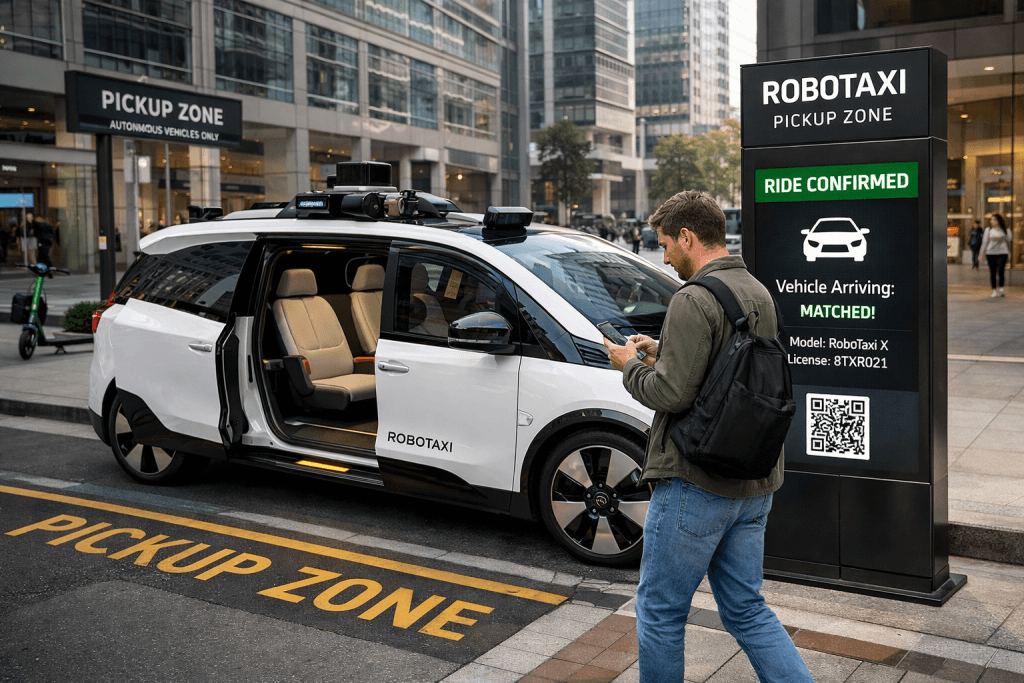
The robotaxi era is prompting cities to reconsider their infrastructure. Dedicated autonomous vehicle lanes, optimized traffic signal systems, and updated curb management policies are being developed to accommodate driverless cars (Bloomberg, 2026). In San Francisco, Waymo has worked with the city to create designated pick-up and drop-off zones that reduce congestion and improve safety.
Cities are also exploring how driverless cars can complement public transit rather than compete with it. Waymo has partnered with transit agencies in Phoenix and Los Angeles to provide first-mile, last-mile connections to rail and bus services. These partnerships suggest a future where the robotaxi era integrates driverless cars into broader mobility ecosystems rather than serving as standalone transportation solutions.
The Road Ahead
As the robotaxi era accelerates, the pace of change is remarkable. Waymo continues to expand its service area, Tesla is scaling its Austin operations, and Chinese companies are moving into new markets. The technology is improving rapidly, with each generation of driverless cars demonstrating greater capability and reliability.
The vision of driverless cars as a ubiquitous transportation option is no longer speculative. For millions of people in cities across the United States and China, the robotaxi era is already a practical, accessible alternative to traditional transportation. The question is no longer whether driverless cars will become widespread, but how quickly the transition will occur and how societies will adapt to the transformation brought by the robotaxi era.
References
Baidu. (2026). Apollo Go: Leading the autonomous ride-hailing revolution. https://apollo.auto/apollogo.html
Bloomberg. (2026, February 15). China’s robotaxi race heats up as Pony.ai expands to new cities. https://www.bloomberg.com/news/articles/2026-02-15/china-s-robotaxi-race-heats-up-as-pony-ai-expands-to-new-cities
Electrek. (2026, March 10). Tesla launches driverless ride-hailing service in Austin without safety drivers. https://electrek.co/2026/03/10/tesla-launches-driverless-ride-hailing-service-austin/
Financial Times. (2026, January 22). Baidu’s Apollo Go becomes world’s largest robotaxi service. https://www.ft.com/content/baidu-apollo-go-robotaxi-2026
Goldman Sachs. (2026). The robotaxi market: A $2 trillion opportunity by 2035. Goldman Sachs Global Investment Research.
NHTSA. (2026, March 1). New guidelines for autonomous vehicle deployment. National Highway Traffic Safety Administration. https://www.nhtsa.gov/autonomous-vehicles/new-guidelines-2026
Reuters. (2026, March 12). Waymo surpasses 1 million weekly robotaxi rides as autonomous driving goes mainstream. https://www.reuters.com/technology/waymo-surpasses-1-million-weekly-robotaxi-rides-2026-03-12/
TechCrunch. (2026, March 15). Waymo, Tesla, and the battle for robotaxi dominance. https://techcrunch.com/2026/03/15/waymo-tesla-robotaxi-dominance/