Asteroids and Earth: What Are the Real Risks of a Collision?
Space is vast—but it’s not empty. Orbiting the Sun are millions of asteroids, the rocky remnants of planet formation from the early solar system. These objects primarily reside in the main asteroid belt between Mars and Jupiter, where gravitational forces—especially from Jupiter—prevented them from coalescing into a planet. Others, called Near-Earth Objects (NEOs), have orbits that bring them close to Earth. These asteroids can be nudged from their stable orbits by collisions, gravitational interactions, or the Yarkovsky effect (a force caused by uneven heating from the Sun).
Occasionally, these wandering asteroids intersect with Earth’s orbit, raising an unsettling but scientifically valid question: Could an asteroid strike Earth—and if so, what can we do about it?
What Are Asteroids, and Why Do They Matter?
Asteroids are rocky bodies, mostly found in the asteroid belt between Mars and Jupiter, that vary in size from pebbles to hundreds of kilometers wide. Unlike comets, they lack icy tails but can still cause massive devastation if they collide with Earth.
Most burn up in the atmosphere as meteors. But larger asteroids—those over 140 meters—could destroy entire cities or regions. Even more concerning are “planet-killers,” like the 10-kilometer-wide asteroid that contributed to the extinction of the dinosaurs 66 million years ago (Alvarez et al., 1980).
Is an Asteroid Impact Likely?
The probability of a large asteroid hitting Earth in our lifetime is low but non-zero. According to NASA’s Planetary Defense Coordination Office, no known asteroid poses a significant risk in the next 100 years (NASA, 2024). However, only an estimated 40% of near-Earth objects (NEOs) larger than 140 meters have been identified—leaving the rest untracked. This figure is based on observations reported by NASA’s Near-Earth Object Observations Program, which has catalogued roughly 10,500 of the estimated 25,000 such objects in our solar neighborhood. The remaining 60% remain untracked due to limitations in current telescope coverage, especially in detecting dark, small, or fast-moving objects that can approach from directions near the Sun where optical instruments struggle. Additionally, observational gaps in the Southern Hemisphere hinder global detection efforts because most large, advanced survey telescopes are located in the Northern Hemisphere. This geographic imbalance results in less comprehensive sky coverage from southern latitudes. Combined with atmospheric challenges such as cloud cover and light pollution in key southern regions, it creates blind spots in monitoring near-Earth space.
The 2013 Chelyabinsk meteor in Russia, which exploded with 30 times the energy of the Hiroshima bomb and injured over 1,500 people, was undetected before entering the atmosphere. The meteor measured about 20 meters in diameter and weighed an estimated 13,000 metric tons. It entered Earth’s atmosphere at a speed of roughly 19 kilometers per second and disintegrated about 30 kilometers above the ground, creating a powerful airburst that damaged over 7,000 buildings across six cities. This event highlighted the importance of early detection systems.
Technology and the Future of Planetary Defense
To avoid the fate of the dinosaurs, humanity is investing in early warning and deflection systems:
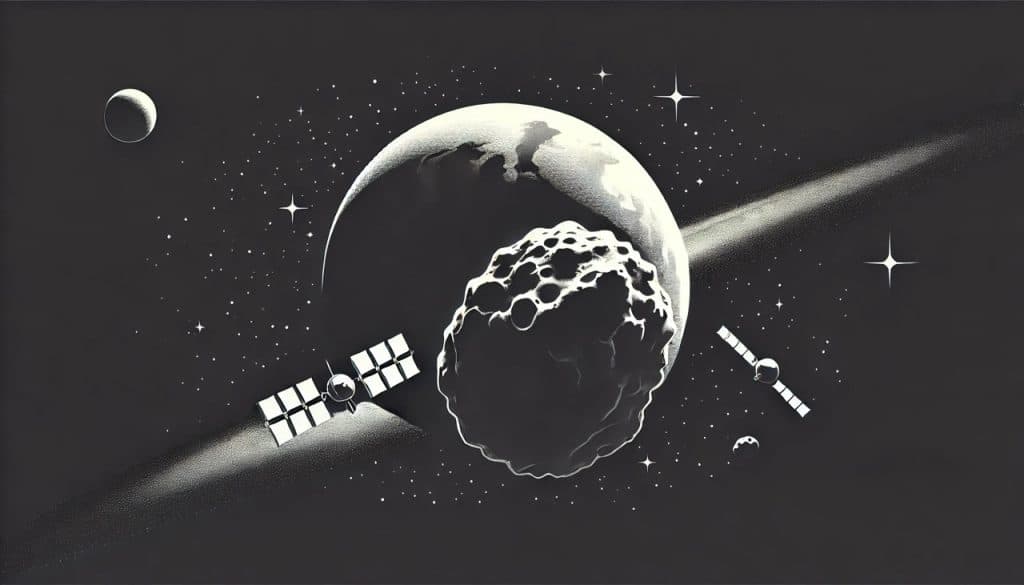
- NASA’s DART Mission (2022) demonstrated the first real-world asteroid deflection. By crashing a spacecraft into asteroid Dimorphos, scientists were able to change its orbit—a milestone in planetary defense (Cheng et al., 2023). Dimorphos, a moonlet about 160 meters in diameter orbiting a larger asteroid called Didymos, was chosen as the target due to its proximity and binary nature, which allowed precise orbital measurements. The DART spacecraft, traveling at over 6 kilometers per second, impacted Dimorphos and successfully shortened its orbital period by about 33 minutes. This measurable change confirmed that kinetic impact is a viable strategy for altering an asteroid’s path, an essential capability for future planetary defense efforts. The mission also tested autonomous navigation technologies and offered valuable data on asteroid structure and surface composition, which are critical for modeling impact dynamics and improving deflection accuracy.
- ESA’s Hera Mission, launching in 2024, will analyze the aftermath of DART to refine future impact strategies. Hera will travel to the Didymos binary system—the site of the DART impact—and closely study the crater left on Dimorphos, the change in its orbit, and the debris ejected by the collision. It will carry advanced imaging systems, a lidar altimeter, and CubeSats to conduct detailed surface mapping and subsurface analysis. This will provide crucial insights into the internal structure and composition of Dimorphos, improving our understanding of how asteroids react to kinetic impact. The findings from Hera will validate models used in planetary defense and help optimize future asteroid deflection missions.
- Ground-Based Telescopes and AI Detection: Innovations in machine learning are helping astronomers process massive datasets to detect faint, fast-moving objects in space. Traditional telescopes scan the night sky in segmented sweeps, capturing thousands of celestial objects each night. AI algorithms are now being used to sift through this immense data to identify unusual trajectories, spot new objects, and predict potential Earth-crossing paths with greater speed and accuracy. These systems are particularly effective at flagging transient or dim objects that might otherwise go unnoticed by human observers. Furthermore, AI models can continuously learn from new observations, improving detection sensitivity over time. This fusion of computational power and observational astronomy is crucial in bridging detection gaps and increasing the lead time for planetary defense actions.
International Collaboration Is Key
Asteroid impact isn’t just a NASA problem—it’s a global one. Agencies like ESA, JAXA, and China’s CNSA are increasingly collaborating on detection, data sharing, and response strategies. The United Nations Office for Outer Space Affairs (UNOOSA) even supports an International Asteroid Warning Network (IAWN).
These partnerships ensure that if an object is ever on a collision course with Earth, multiple nations can contribute data, resources, and strategies to prevent catastrophe.
What Can We Do on Earth?
While the general public can’t do much to deflect an asteroid, awareness and support for space science are vital. Investment in space agencies, telescope infrastructure, and AI analytics will ensure we’re not blindsided.
Private companies are also entering the space: SpaceX, Blue Origin, and other aerospace firms could one day play a role in deploying deflection missions or asteroid mining that reduces orbital debris.
Conclusion: Prepared, Not Paranoid
An asteroid impact might seem like a sci-fi scenario, but the risk is grounded in scientific reality. Thanks to missions like DART and advancing detection technology, we are more prepared than ever before. The fusion of data science, international cooperation, and cutting-edge aerospace engineering gives us the tools to predict and possibly prevent asteroid disasters.
As we look to the future, the asteroid threat reminds us of our place in the cosmos—and the responsibility to safeguard our planet using the best science and innovation humanity can offer.
References:
- Alvarez, L.W., Alvarez, W., Asaro, F., & Michel, H.V. (1980). Extraterrestrial cause for the Cretaceous–Tertiary extinction. Science, 208(4448), 1095-1108.
- Cheng, A.F., Rivkin, A.S., Michel, P., et al. (2023). DART Mission: Deflecting an Asteroid with Kinetic Impact. Nature, 620, 123–127.
- NASA. (2024). Near-Earth Object Program Overview. Retrieved from https://www.nasa.gov/planetarydefense/neoo
- ESA. (2024). Hera: ESA’s Asteroid Mission. Retrieved from https://www.esa.int/Safety_Security/Hera