
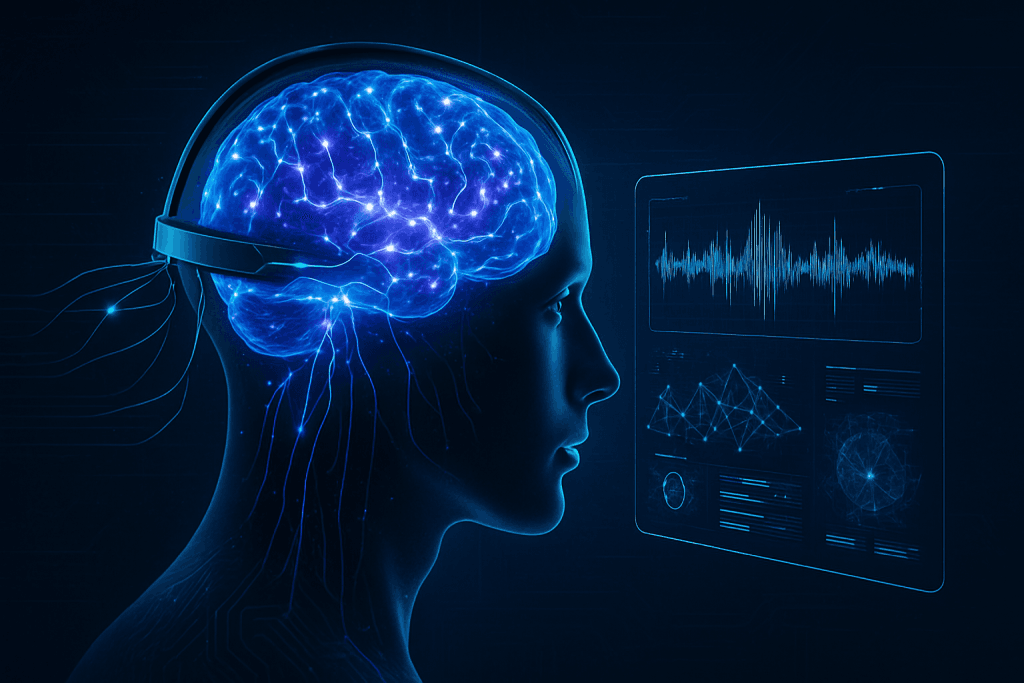
Neurotechnology and Brain-Computer Interface: Revolutionizing the Future
Neurotechnology and Brain-Computer Interface (BCI) are transforming the way humans interact with machines, offering unprecedented opportunities in healthcare, communication, and beyond. This cutting-edge field merges neuroscience with advanced technology, enabling direct communication between the brain and external devices. As research progresses, Neurotechnology and Brain-Computer Interface systems are poised to revolutionize medicine, enhance human capabilities, and redefine our understanding of the brain (Wolpaw & Wolpaw, 2012).
Understanding Neurotechnology and Brain-Computer Interface
Neurotechnology and Brain-Computer Interface systems facilitate direct communication between the brain and computers or other devices. By decoding neural signals, these interfaces can translate thoughts into actions, allowing users to control prosthetics, computers, or even vehicles using only their minds. The foundation of Neurotechnology and Brain-Computer Interface lies in its ability to interpret brain activity, often through electroencephalography (EEG), invasive implants, or other sensing methods (Lebedev & Nicolelis, 2017).
Applications in Healthcare
One of the most promising applications of Neurotechnology and Brain-Computer Interface is in healthcare. Patients with paralysis or neurodegenerative diseases like ALS can benefit immensely. For instance, BCIs enable individuals to operate wheelchairs, type messages, or manipulate robotic limbs through thought alone (Chaudhary et al., 2021). Neurotechnology and Brain-Computer Interface also hold potential for treating mental health conditions by modulating brain activity to alleviate symptoms of depression or PTSD (Thibault et al., 2018).
Enhancing Human Capabilities
Beyond medical uses, Neurotechnology and Brain-Computer Interface are expanding human potential. Researchers are exploring how BCIs can augment cognitive abilities, such as memory or learning speed. In the future, these interfaces might allow seamless communication between brains, enabling “thought-based” messaging (Rao, 2019). Such advancements could redefine teamwork, education, and even entertainment.
Challenges and Ethical Considerations
Despite its promise, Neurotechnology and Brain-Computer Interface face significant challenges. Technical hurdles include improving signal accuracy, minimizing invasiveness, and ensuring long-term reliability. Ethical concerns also arise, such as privacy risks, data security, and the potential for misuse (Yuste et al., 2017). Ensuring equitable access and addressing societal implications will be critical as this technology evolves.
The Future of Neurotechnology and Brain-Computer Interface
The future of Neurotechnology and Brain-Computer Interface is bright, with ongoing research pushing boundaries. Innovations like wireless BCIs and AI-driven neural decoding are accelerating progress (Musk, 2019). As these technologies mature, they could become as commonplace as smartphones, integrating seamlessly into daily life. The key will be balancing innovation with ethical responsibility to ensure benefits for all.
Conclusion
Neurotechnology and Brain-Computer Interface (BCI) represent one of the most groundbreaking advancements of the 21st century, bridging the gap between human cognition and artificial systems (Wolpaw & Wolpaw, 2012). These technologies are not only restoring lost functions for individuals with disabilities (Chaudhary et al., 2021) but are also expanding the boundaries of human potential (Rao, 2019). From enabling paralyzed patients to control robotic limbs (Lebedev & Nicolelis, 2017) to potentially enhancing memory and cognitive abilities, the applications are vast and transformative. However, as the field progresses, ethical considerations such as privacy, data security, and equitable access must remain at the forefront of development (Yuste et al., 2017). The future of Neurotechnology and Brain-Computer Interface promises to reshape healthcare, communication, and human-machine interaction in ways we are only beginning to imagine (Musk, 2019). By responsibly advancing these innovations, we can unlock unprecedented possibilities while ensuring they benefit society as a whole (Thibault et al., 2018). The journey ahead is both exciting and challenging, but the potential rewards improving lives and redefining human capabilities are immeasurable.
References
- Chaudhary, U., Birbaumer, N., & Ramos-Murguialday, A. (2021). Brain-computer interfaces for communication and rehabilitation. Nature Reviews Neurology. https://www.nature.com/articles/s41582-021-00507-7
- Lebedev, M. A., & Nicolelis, M. A. (2017). Brain-machine interfaces: From basic science to neuroprostheses and neurorehabilitation. Physiological Reviews. https://journals.physiology.org/doi/full/10.1152/physrev.00027.2016
- Musk, E. (2019). Neuralink: An integrated brain-machine interface platform. Journal of Medical Internet Research. https://www.jmir.org/2019/10/e16194/
- Rao, R. P. (2019). Brain-Computer Interfacing: An Introduction. Cambridge University Press. https://www.cambridge.org/core/books/braincomputer-interfacing/
- Thibault, R. T., Lifshitz, M., & Raz, A. (2018). Neurofeedback and brain-computer interfaces for mental health. The Lancet Psychiatry. https://www.thelancet.com/journals/lanpsy/article/PIIS2215-0366(18)30048-4/fulltext
- Wolpaw, J. R., & Wolpaw, E. W. (2012). Brain-Computer Interfaces: Principles and Practice. Oxford University Press. https://global.oup.com/academic/product/brain-computer-interfaces-9780195388855
- Yuste, R., Goering, S., & Bi, G. (2017). Ethical issues in neurotechnology and brain-computer interfaces. Science. https://www.science.org/doi/10.1126/science.aao2963