3D Printed Organs: How Bioprinting Is Redefining Medicine
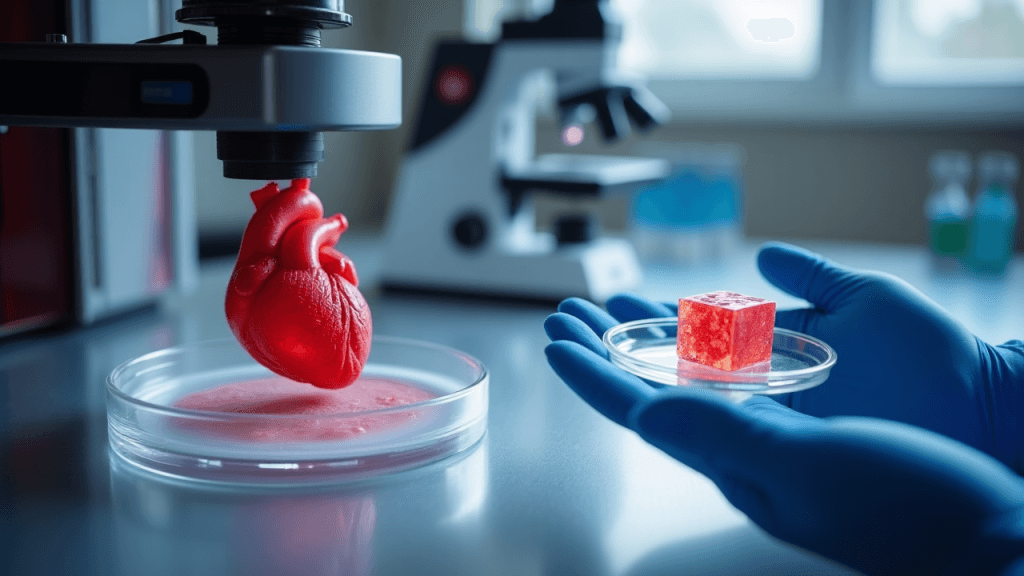
3D Printed Organs represent one of the most transformative frontiers in modern medical science, fundamentally redefining the paradigms of transplantation, drug testing, and personalized medicine. This process, known formally as bioprinting, involves the precise layer-by-layer deposition of living cells, biologics, and biomaterials to fabricate functional biological structures that mimic natural tissues. The pursuit of viable 3D Printed Organs is driven by a critical global shortage of donor organs, the risks of immune rejection, and the limitations of current transplant therapies (Murphy & Atala, 2014).
The Technology Behind Bioprinting
The core technology enabling 3D Printed Organs is an advanced adaptation of conventional 3D printing. Instead of plastics or metals, bioprinters utilize bioinks hydrogel-based materials laden with living cells and supportive growth factors. There are several primary bioprinting techniques. Extrusion-based printing, the most common method, uses pneumatic or mechanical pressure to dispense continuous filaments of bioink. Inkjet bioprinting adapts standard inkjet technology to deposit droplets of bioink precisely. Laser-assisted bioprinting uses a laser pulse to transfer cells with high precision and viability (Murphy & Atala, 2014). Each method is tailored for different cell types and structural complexities required for functional 3D Printed Organs.
Current Applications and Breakthroughs
The potential applications for 3D Printed Organs extend far beyond whole organ transplantation, already making significant clinical inroads. One of the earliest commercialized applications is in producing living tissue models for pharmaceutical research. Companies use bioprinted human tissues to test drug toxicity, providing more accurate and ethical alternatives to animal testing. In regenerative medicine, simpler 3D Printed Organs like skin grafts for burn victims and cartilage for knee repairs are in various stages of clinical trials (Vijayavenkataraman et al., 2018). For more complex solid 3D Printed Organs, such as kidneys and hearts, the challenges are substantial but progress is accelerating. A landmark study demonstrated a bioprinted heart patch that integrated with a rat’s heart and improved function after a myocardial infarction (Noor et al., 2019), showcasing the potential for repairing complex organs.
Overcoming the Vascularization Hurdle
The primary hurdle for creating implantable 3D Printed Organs is vascularization, the creation of intricate, functional blood vessel networks. An organ like the liver is dense with vessels necessary for oxygen delivery. Researchers are tackling this by printing sacrificial templates that dissolve to leave hollow microchannels, or by using bioinks that encourage cells to self-assemble into capillaries. According to a review in Nature Reviews Materials, while a fully implantable, life-sustaining 3D Printed Organ is still on the horizon, innovations in vascularization are critical to making it a reality (Güngör-Ozdil & Yan, 2022). This challenge is central to advancing the entire field of 3D Printed Organs.
Ethical and Regulatory Considerations
The ethical and regulatory landscape for 3D Printed Organs is evolving alongside the technology. Key considerations include ensuring equitable access to prevent a scenario where only the wealthy can afford custom-made organs. Regulatory bodies like the U.S. Food and Drug Administration (FDA) are developing frameworks to evaluate the safety and efficacy of these living, dynamic products, which do not fit neatly into existing categories for medical devices or drugs (U.S. Food and Drug Administration, 2021). Intellectual property rights over bioink formulations and printing processes are also a subject of intense debate, as they can impact research collaboration and the ultimate cost of these 3D Printed Organs.
The Future: 4D Printing and AI Integration
Looking forward, the next generation of 3D Printed Organs will be increasingly sophisticated. A promising direction is 4D bioprinting, where the printed structure is designed to morph or self-assemble over time in response to biological stimuli, more closely mimicking natural organ development. The integration of artificial intelligence is also poised to revolutionize the field by optimizing print parameters and designing complex vascular architectures that are impossible to blueprint manually. The goal is a future where a patient’s own cells are used to create a bespoke, immunologically compatible 3D Printed Organ on demand, effectively solving the transplant shortage.
Conclusion
3D Printed Organs stand at the confluence of biology, engineering, and data science, heralding a new era in medicine. They offer a direct solution to the dire shortage of transplantable organs and a path toward truly personalized treatments. From drug testing platforms to life-saving transplants, the impact of bioprinting is already being felt and will only expand. As research overcomes the final biological and technical hurdles, the vision of a surgeon implanting a patient-specific, fully functional 3D Printed Organ will transition from science fiction to standard medical practice.
References
Güngör-Ozdil, D., & Yan, D. (2022). Vascularization in 3D bioprinted organs: Current challenges and future directions. Nature Reviews Materials, 7, 1–16. https://doi.org/10.1038/s41578-022-00433-0
Murphy, S. V., & Atala, A. (2014). 3D bioprinting of tissues and organs. Nature Biotechnology, 32(8), 773–785. https://doi.org/10.1038/nbt.2958
Noor, N., Shapira, A., Edri, R., Gal, I., Wertheim, L., & Dvir, T. (2019). 3D printing of personalized thick and perfusable cardiac patches and hearts. Advanced Science, 6(11), Article 1900344. https://doi.org/10.1002/advs.201900344
U.S. Food and Drug Administration. (2021). Technical considerations for additively manufactured medical devices. https://www.fda.gov/regulatory-information/search-fda-guidance-documents/technical-considerations-additively-manufactured-medical-devices
Vijayavenkataraman, S., Yan, W.-C., Lu, W. F., Wang, C.-H., & Fuh, J. Y. H. (2018). 3D bioprinting of tissues and organs for regenerative medicine. Advanced Drug Delivery Reviews, 132, 296–332. https://doi.org/10.1016/j.addr.2018.07.004