Terraforming: Can We Engineer Life on Other Planets?
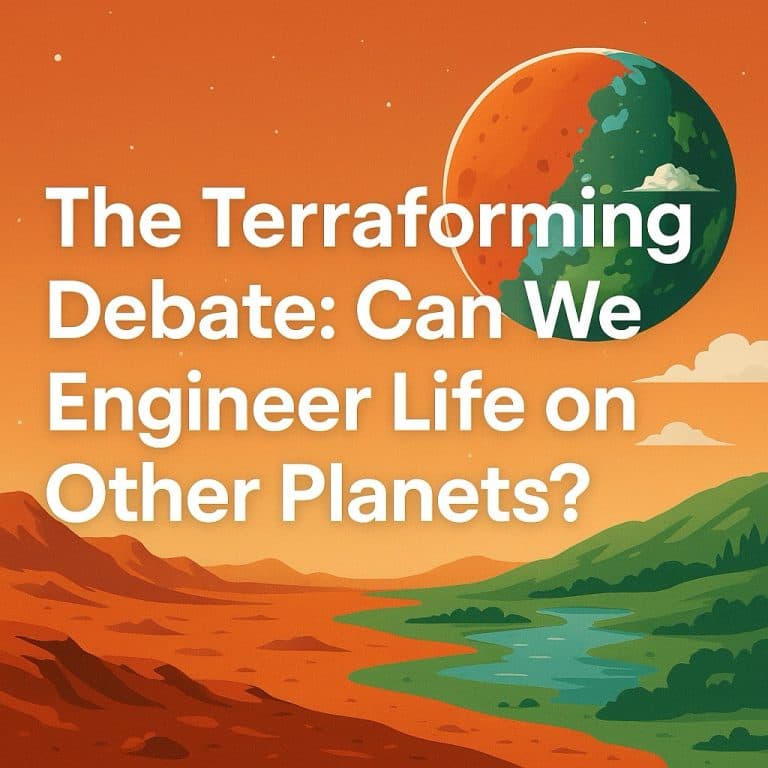
As humanity peers beyond Earth, the idea of terraforming—modifying an entire planet to make it habitable for life—shifts from the realm of science fiction to an increasingly debated scientific and ethical question. With advancements in biotechnology, climate modelling, and energy systems, the prospect of engineering life on other worlds is no longer purely speculative. But can we actually do it—and more importantly, should we?
Terraforming Mars: Fiction vs Feasibility
Mars, with its surface temperature ranging from -125°C to 20°C, its thin carbon dioxide-rich atmosphere, and its barren landscape, has become the prime candidate for planetary engineering. Popularised in media and embraced by visionaries like Elon Musk, Mars presents an enticing, if extreme, test bed for terraforming.
The fundamental concept behind terraforming Mars involves three primary challenges:
- Increasing atmospheric pressure
- Warming the planet
- Introducing stable water sources
Multiple strategies have been proposed, including:
- Greenhouse gas emission amplification: Creating artificial factories to release fluorinated gases into the Martian atmosphere, effectively thickening it and trapping heat.
- Orbital mirrors: Placing giant mirrors in space to reflect sunlight onto the surface.
- Regolith bombardment: Using nuclear explosions or massive impacts to release CO₂ trapped in Martian soil.
While intriguing, these methods remain limited by current energy requirements, economic feasibility, and ethical boundaries. A 2018 NASA study concluded that even if all CO₂ on Mars were released, it would not be enough to significantly raise pressure and temperature to human-tolerable levels (Jakosky & Edwards, 2018).
Biotech and Synthetic Biology in Planetary Engineering
Advances in synthetic biology may offer a more elegant solution: designing organisms that can live in and transform alien environments. These engineered microbes could photosynthesise, release oxygen, fix nitrogen, and sequester greenhouse gases.
Some promising approaches include:
- Cyanobacteria colonisation: Certain extremophile cyanobacteria can survive harsh radiation and low temperatures. With minor genetic tweaks, these could form the foundation for ecological succession.
- CRISPR-enhanced extremophiles: Using CRISPR to edit the genomes of extremophiles, tailoring them to survive Martian UV radiation, low pressure, and high salinity.
- Bio-mining microbes: Microorganisms that extract nutrients and convert rock into usable substrates for building or farming.
NASA’s Synthetic Biology Initiative and ESA’s MELiSSA project are already conducting experiments in controlled Martian-like environments to understand how microbes interact with non-Earth ecosystems.
Still, there’s an inherent unpredictability in biological systems—especially when placed in alien ecosystems where unintended consequences can cascade.
Materials Science and Energy Systems: Building for Terraforming
Terraforming isn’t just a biological or atmospheric problem; it’s also a materials science challenge. Building infrastructure that can endure extreme cold, dust storms, and corrosive soil requires novel composites and coatings.
- Self-healing materials for habitat structures
- Aerogels as insulation to trap heat
- Plasma-based tools for in-situ resource utilisation (ISRU)
The massive energy demands for terraforming also put pressure on innovation in portable and renewable energy systems, from compact nuclear reactors to solar concentrators designed for low-light planetary conditions.

Ethical Boundaries and Cosmic Stewardship
Even if terraforming were technically achievable, there remains a crucial question: Do we have the right to alter another planet’s ecosystem?
This conversation intersects with planetary protection protocols, which currently prohibit contamination of other celestial bodies to preserve their natural states and potential biosignatures. Terraforming might irreversibly erase traces of indigenous microbial life—if it exists.
There’s also the risk of techno-colonialism, in which planetary engineering becomes an extension of Earth’s exploitative resource extraction. If humans haven’t yet solved sustainability on our own planet, should we be allowed to reengineer others?
Ethicists like Christopher McKay argue that terraforming should only be pursued after careful consideration of planetary ethics, long-term governance, and global consensus (McKay, 1999).
Terraforming Beyond Mars: Venus, Titan, and Exoplanets
While Mars garners the spotlight, other celestial bodies have also entered terraforming discussions:
- Venus: With its thick sulphuric acid clouds and 450°C surface, Venus presents immense challenges. Some propose floating cities in the upper atmosphere or solar shades to cool the planet.
- Titan: Saturn’s moon has a nitrogen atmosphere and liquid methane lakes, making it interesting for reverse terraforming—modifying humans or synthetic organisms to survive there instead.
- Exoplanets: With thousands of exoplanets identified, the conversation extends into interstellar realms. But without proximity and reliable data, these remain theoretical discussions for now.
Is Terraforming the Right Solution?
As the global climate crisis worsens, critics argue that efforts to colonise and terraform other planets may serve as distractions from fixing Earth. Terraforming Mars would require centuries, possibly millennia. Could those resources not be better used to reverse-engineer Earth’s own environmental decline?
Others see terraforming as a long-term backup plan—a Plan B for humanity’s survival in the face of existential risks.
The debate ultimately hinges on the philosophical tension between preservation and expansion. Terraforming forces us to consider not only what we can do, but what we value as a species.
Conclusion: Between Capability and Conscience
Terraforming remains, for now, a theoretical pursuit—part scientific challenge, part philosophical provocation. Yet, as synthetic biology, energy systems, and planetary exploration technologies advance, what was once considered fantasy may eventually become feasible.
Whether we use this power to play creator on alien worlds—or use it to better care for our own—will define not only the next frontier of science, but the future ethics of our civilisation.
References
Jakosky, B. M., & Edwards, C. S. (2018). Inventory of CO₂ available for terraforming Mars. Nature Astronomy, 2(8), 634–639. https://doi.org/10.1038/s41550-018-0529-6
McKay, C. P. (1999). The Terraforming of Mars. In: Levin, G.V., Buillon, J. (eds) Mars: The Living Planet. https://ntrs.nasa.gov/citations/19990023202
Rothschild, L. J. (2010). Synthetic biology meets bioprinting: constructing living systems. Trends in Biotechnology, 28(9), 430–438. https://doi.org/10.1016/j.tibtech.2010.06.004
Westall, F., et al. (2021). A critical analysis of life-detection strategies for Mars missions. Astrobiology, 21(10), 1181–1200.https://doi.org/10.1089/ast.2020.2309