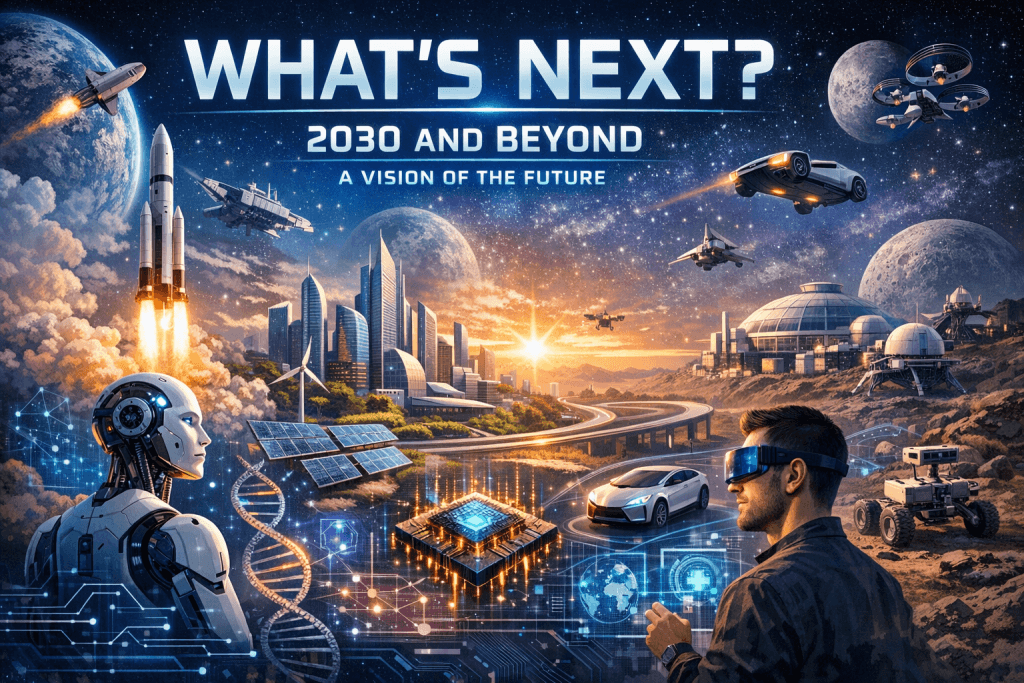
What’s Next? 2030 and Beyond: A Vision of the Future
2030 and beyond is not merely a point on a timeline; it is the start of a critical inflection point for humanity. As the world approaches the culmination of the 2030 Agenda for Sustainable Development, a moment of both reckoning and opportunity emerges. The period beyond 2030 demands a fundamental re-evaluation of development models, a radical acceleration of technological integration for social good, and a proactive response to profound demographic shifts.
This essay explores the trajectories for social development and sustainability, the dual-edged nature of technological breakthroughs, and the undeniable demographic realities that will collectively define our collective future. The agenda for 2030 and beyond must reconcile these interconnected dimensions to forge a path toward an equitable, resilient, and sustainable world. This requires a vision that moves beyond crisis management to embrace systemic, justice-centered transformations.
Reimagining Social Development and Sustainability Post-2030
The foundational framework for our future is being actively debated, with the period 2030 and beyond necessitating a deep rethinking of social development priorities. Current models are faltering, evidenced by the fact that between 2019 and 2022, 25 million more people fell into extreme poverty, increasing the global total to 712 million (Bonaccorsi et al., 2025). This stagnation highlights that economic growth without fair distribution is unsustainable. Consequently, a new vision is coalescing around the concept of “eco-social contracts,” which integrate human well-being with environmental sustainability, democratic participation, and social justice on an equal footing (Hujo, 2024). These contracts represent a core principle for the era 2030 and beyond, moving beyond siloed approaches.
The formal process of shaping the post-2030 agenda is underway, with key milestones set. The SDG Summit in 2027 will officially kickstart intergovernmental discussions on the future of sustainable development, informed by the scientific evidence of the third Global Sustainable Development Report (GSDR; Bonaccorsi et al., 2025). This builds on recent political momentum, such as the 2025 Doha Political Declaration from the Second World Summit for Social Development, which reaffirmed commitments to address poverty, unemployment, and social exclusion while recognizing new challenges like digital transformation and demographic change (Hujo, 2024).
A pivotal shift advocated for the 2030 and beyond period is the move beyond Gross Domestic Product (GDP) as the primary measure of progress. The Doha Declaration reaffirmed the commitment to develop complementary frameworks, a move essential for valuing social and environmental health alongside economic output (Hujo, 2024). This evolution in measurement is critical for the paradigm shift required for 2030 and beyond.
The Transformative and Disruptive Force of Technology
Technological innovation will be the most visible and powerful shaper of daily life in the 2030 and beyond period. Forecasts indicate global investment in transformative technologies will exceed $3.5 trillion annually by 2030, driving breakthroughs across sectors (World Economic Forum, 2024). The integration of these technologies will redefine existence, but their governance will determine whether they exacerbate or alleviate existing inequalities in the 2030 and beyond era.
Table: Key Technologies and Their Projected Impact by 2030
| Technology Domain | Key Projections for 2030 | Primary Societal Impact |
|---|---|---|
| Artificial Intelligence | Global AI software revenue to hit $126 billion by 2025; rise of explainable AI (XAI). | Decision-making in healthcare, business, and policy; ethical concerns around bias and control. |
| Energy & Sustainability | Renewables to supply nearly 50% of global electricity; energy storage market to reach $620 billion. | Enabling 24/7 clean energy access, critical for climate goals and energy security. |
| Biotechnology & Health | Gene editing market forecast at $14.5 billion; advances in anti-aging and regenerative medicine. | Potential to cure genetic diseases, extend healthy lifespans, and raise ethical questions on human enhancement. |
| Connectivity & Computing | Emergence of 6G; quantum computing market potentially reaching $65 billion. | Ultra-fast networks for IoT and smart cities; quantum leaps in cryptography, materials science, and drug discovery. |
However, the path toward 2030 and beyond is fraught with tension between technological promise and peril. While AI can optimize systems and biotechnology can heal, these same tools risk deepening social exclusion, eroding privacy, and manipulating public trust if left unchecked (Tavanti & Sfeir-Younis, 2025). The Doha Declaration explicitly calls for addressing the challenges of digital transformation, including misinformation and hate speech, in ways that protect democratic values (Hujo, 2024). Therefore, a central task for governance in the 2030 and beyond period will be to steer innovation through ethical frameworks, robust regulation, and inclusive design to ensure technology serves as an engine for equity rather than a tool of division (Tavanti & Sfeir-Younis, 2025). This is a defining challenge for 2030 and beyond.
Demographic Realities as a Foundational Context
Any viable framework for 2030 and beyond must be built upon the bedrock of irreversible demographic trends. These shifts will reshape labor markets, healthcare systems, and geopolitical influence. In the United States, the population is projected to grow older and larger, increasing from 331 million in 2020 to 349 million in 2030 (Cooper Center for Public Service, 2024). A defining milestone in the 2030 and beyond period will be reached around 2030, when over 20% of the U.S. population, approximately 71 million people, will be over the age of 65. This aging trend is not uniform but concentrated, with states like Maine, Florida, and Vermont expected to have nearly a quarter of their populations in this age bracket (Cooper Center for Public Service, 2024). Simultaneously, the national median age will rise from 38.8 years in 2020 to over 40 years by 2030.
These trends intersect with significant internal migration. Population growth is consistently shifting toward the South and West, while the Northeast and Midwest regions face anticipated stagnation or decline in the coming decades (Cooper Center for Public Service, 2024). This redistribution will influence political representation, economic investment, and infrastructure needs. Globally, nations will face divergent challenges, from aging societies with declining birth rates to young, rapidly growing populations (Hujo, 2024). Preparing for 2030 and beyond therefore demands social policies, such as universal social protection, gender-responsive care systems, and lifelong learning, that are adaptive to these demographic realities, ensuring resilient economies and cohesive societies.
Conclusion
The period 2030 and beyond presents a complex convergence of an unfinished social agenda, a technological revolution, and profound demographic change. Successfully navigating this future requires abandoning incrementalism in favor of transformative thinking. It calls for integrating the vision of eco-social contracts with the prudent harnessing of technology, all while designing policies that are responsive to an aging and shifting population. The work of defining this path is already active in global forums, scientific reports, and policy debates.
Ultimately, the goal for 2030 and beyond is to build a world where progress is measured not just by output, but by justice, sustainability, and the dignity of all people across generations.
References
Bonaccorsi, E., Kosolapova, E., & Wagner, L. (2025). Beyond 2030: Advancing social development, UN80 initiative, 2027 GSDR. International Institute for Sustainable Development. https://sdg.iisd.org/commentary/policy-briefs/beyond-2030-advancing-social-development-un80-initiative-2027-gsdr/
Cooper Center for Public Service. (2024). *National 50-state population projections: 2030, 2040, 2050*. University of Virginia. https://www.coopercenter.org/research/national-50-state-population-projections-2030-2040-2050
Hujo, K. (2024). Beyond 2030: Rethinking social development. UN Today. https://untoday.org/beyond-2030-rethinking-social-development/
Tavanti, M., & Sfeir-Younis, A. (2025). Sustainability beyond 2030: Trajectories and priorities for our sustainable future. Routledge.
United Nations. (2015). Transforming our world: The 2030 Agenda for Sustainable Development. https://sdgs.un.org/2030agenda
World Economic Forum. (2024). *9 breakthrough technologies that will change everyday life by 2030*. World Ecomag. https://worldecomag.com/technologies-innovation-and-technology-2030/