
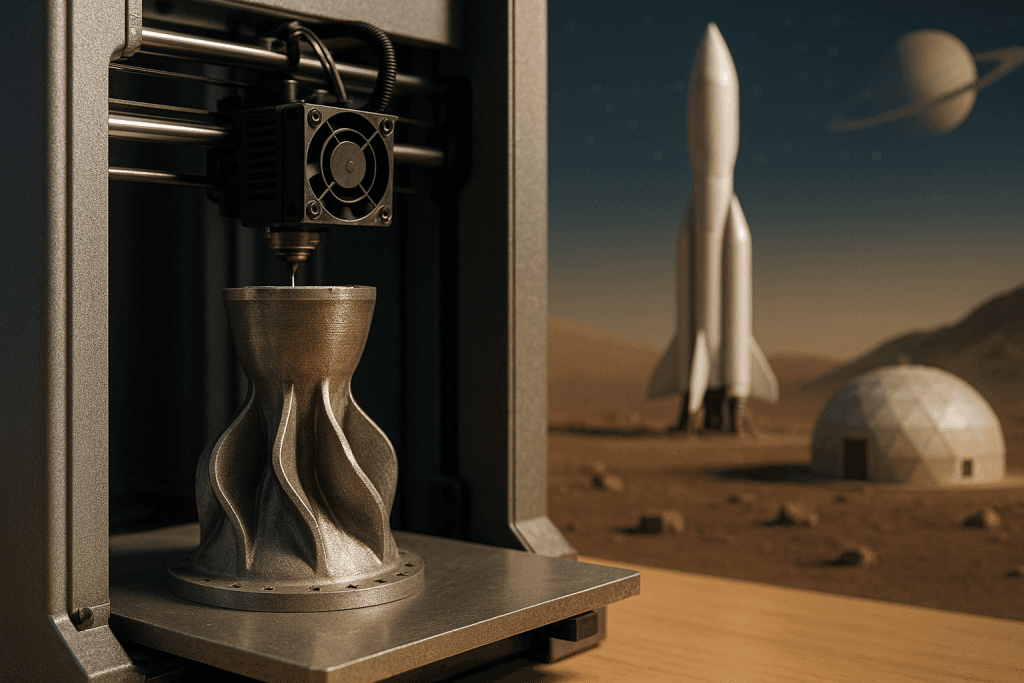
3D Printing in Aerospace: Building for the Future Space Travel
3D printing is driving a manufacturing revolution across the final frontier. As humanity sets its sights on sustainable exploration of the Moon, Mars, and beyond, traditional methods are proving too cumbersome, expensive, and rigid for deep-space missions. Additive manufacturing commonly known as 3D printing builds objects layer by layer from digital models, fundamentally reshaping how aerospace organisations design, test, and build spacecraft. This technique shifts the paradigm from subtractive to additive fabrication, allowing for the creation of complex, lightweight, and highly optimised structures that were once impossible or too costly to produce.
Core Advantages: Why 3D Printing is Ideal for Aerospace
The core advantages of 3D printing for aerospace are profound. Firstly, it enables unprecedented design freedom. Engineers can now create intricate geometries, such as lattice structures and topology-optimized parts, which minimize weight while maintaining or even enhancing strength. In an industry where every kilogram launched into orbit costs tens of thousands of dollars, this weight reduction is a primary driver. Secondly, 3D printing consolidates assemblies. What was once a complex assembly of dozens of individually machined and fastened parts can now be printed as a single, integrated component. This reduces potential failure points, simplifies supply chains, and accelerates production timelines. Thirdly, it facilitates on-demand manufacturing. For long-duration space missions, the ability to print tools, spare parts, or even medical supplies from digital files and recycled materials addresses the critical challenge of logistical resupply.
Current Applications: From Rocket Engines to Satellites
The application of 3D printing is already a reality in modern spacecraft. Rocket engines, with their complex networks of cooling channels, have become a flagship success story. Companies like SpaceX and Relativity Space extensively use metal 3D printing to manufacture superalloy combustion chambers and injector heads. These components feature internal cooling passages that are printed directly into the part, improving engine efficiency and thermal management in ways traditional machining cannot achieve (Zhang et al., 2018). Similarly, critical satellite components, including antenna brackets and structural housings, are being printed to be lighter and stiffer, directly increasing payload capacity or extending mission life.
In-Situ Resource Utilization: Printing with Moon Dust and Martian Soil
The promise of 3D printing becomes even more compelling for in-situ resource utilization (ISRU) – the practice of using materials found at the destination. For establishing a sustained presence on the Moon or Mars, transporting all construction materials from Earth is infeasible. 3D printing offers a solution by using locally sourced regolith (lunar or Martian soil) as a printing material. Research by NASA and academic partners has demonstrated the potential to 3D print durable habitation structures, landing pads, and radiation shields using simulated regolith (Buchner et al., 2022). This approach would dramatically reduce the mass that must be launched from Earth, forming the cornerstone of future extraterrestrial outposts.
On-Orbit and Deep-Space Manufacturing
Beyond structures, 3D printing is poised to revolutionize life support and maintenance in space. The International Space Station (ISS) has hosted several 3D printers, which have been used to manufacture tools and functional parts on orbit. This capability proves that 3D printing works in microgravity and can provide immediate solutions to unforeseen problems (Prater et al., 2019). Future missions could see astronauts printing customized medical instruments, replacement air filters, or specialized adapters from polymer or metal feedstocks, moving from a “take everything you might need” model to a “make what you need, when you need it” model.
Challenges and Standardization Hurdles
However, the path to standardizing 3D printing for critical aerospace applications is not without challenges. The consistency and certification of 3D printed parts remain significant hurdles. Aerospace components must withstand extreme stresses, temperatures, and vacuum conditions. Ensuring that every layer-bond in a printed part is flawless and that material properties are uniform requires rigorous process control, non-destructive evaluation, and the development of new certification standards (Frazier, 2014). Furthermore, the range of space-grade materials suitable for 3D printing, while growing, still needs expansion to meet all thermal, radiation, and mechanical demands of deep space.
Future Frontiers: Multi-Material Printing and Bioprinting
Looking ahead, the future of 3D printing in aerospace points toward multi-material printing and advanced bioprinting. The ability to print a single component with graded materials for instance, a combustion chamber with a high-conductivity interior and a high-strength exterior could yield transformative performance gains (Gibson et al., 2021). For human health on multi-year missions, research is exploring the 3D printing of biological tissues using bio-inks, potentially enabling the on-demand creation of skin grafts or even simple organ tissues for medical treatment (Mironov et al., 2017).
Conclusion: An Indispensable Technology for Exploration
3D printing is far more than a novel manufacturing technique; it is an enabling technology for humanity’s future in space. From printing lighter and more efficient rocket engines on Earth to fabricating habitats on Mars from local dust, the applications are foundational. As the technology matures, with improvements in speed, material science, and in-space operational protocols, 3D printing will become indispensable. It shifts the paradigm from Earth-centric manufacturing to a distributed, agile, and sustainable model for space exploration. The continued integration of this technology will not only make space travel more affordable and reliable but will also empower astronauts to be more self-sufficient, truly building the future of space travel one layer at a time.
References
- Buchner, C., et al. (2022). Additive manufacturing of lunar regolith for extraterrestrial construction. Acta Astronautica, 200, 316-328. DOI: 10.1016/j.actaastro.2022.07.038
- Frazier, W. E. (2014). Metal additive manufacturing: A review. Journal of Materials Engineering and Performance, 23(6), 1917-1928. DOI: 10.1007/s11665-014-0958-z
- Gibson, I., Rosen, D., & Stucker, B. (2021). Additive Manufacturing Technologies. Springer. DOI: 10.1007/978-1-4939-2113-3
- Mironov, V., et al. (2017). Organ printing: From bioprinter to organ biofabrication line. Current Opinion in Biotechnology, 46, 1-7. DOI: 10.1016/j.copbio.2017.01.013
- Prater, T., et al. (2019). NASA’s in-space manufacturing project: Toward a multi-material fabrication laboratory for the International Space Station. AIAA SCITECH 2019 Forum. DOI: 10.2514/6.2019-0404
- Tofail, S. A. M., et al. (2018). Additive manufacturing: scientific and technological challenges, market uptake and opportunities. Materials Today, 21(1), 22-37. DOI: 10.1016/j.mattod.2017.07.001
- Vayre, B., Vignat, F., & Villeneuve, F. (2012). Designing for additive manufacturing. Procedia CIRP, 3, 632-637. DOI: 10.1016/j.procir.2012.07.108
- Zhang, J., et al. (2018). A review of the fatigue properties of additively manufactured Ti-6Al-4V. Progress in Materials Science, 98, 1-36. DOI: 10.1016/j.pmatsci.2018.02.007